
You pay it. Your wind and hail deductible is your share of a storm claim, and in Texas a roofer is not allowed to pay it, waive it or rebate it for you. What catches most Katy homeowners off guard is not who pays. It is how big the number turns out to be. On many Texas policies the wind and hail deductible is a percentage of your dwelling coverage instead of a flat $1,000, and that changes whether a roof claim is even worth filing.
This guide covers how the deductible works, how to figure yours in about two minutes, why a “we’ll cover your deductible” offer is a trap, and the legitimate ways to plan for it before the next storm.
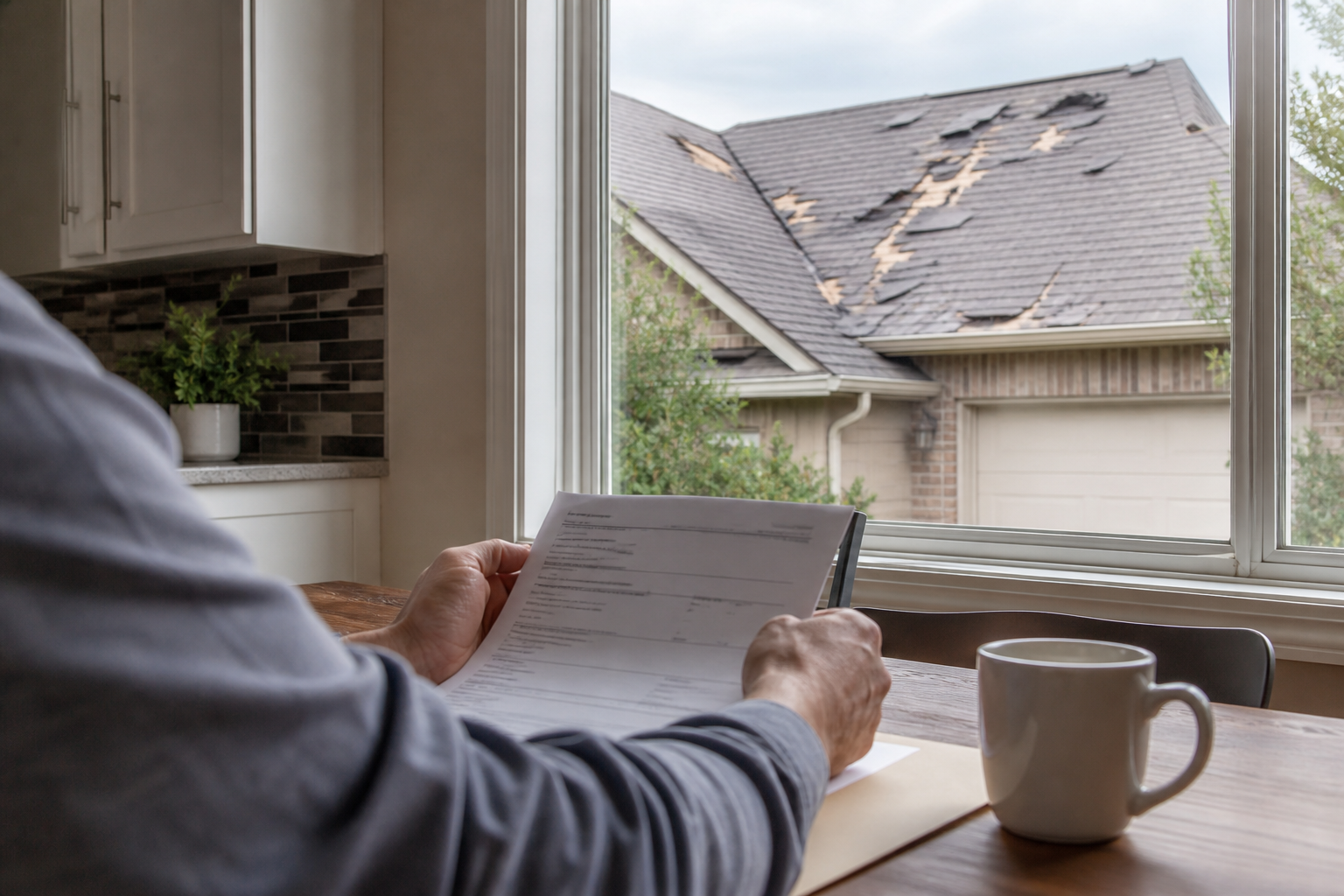
What a Wind and Hail Deductible Actually Is
The Texas Department of Insurance defines a deductible in its home insurance guide as “the amount of a claim that you must pay yourself.” The insurer subtracts it from what it owes you, and you pay that part of the bill.
The same guide notes that “you might have different deductibles for each type of coverage.” In practice, many Texas homeowners policies list one deductible for most losses, such as fire, theft or a burst pipe, and a separate one for windstorm and hail. Because hail and wind cause most of the roof claims we see in Katy, Fulshear and Cypress, the wind and hail deductible is usually the number that decides what a new roof costs you out of pocket.
Flat Dollar or Percentage: How to Read Your Deductible
A deductible can be a set dollar amount or a percentage. TDI’s page on what to know about deductibles uses two homes insured for $150,000 to show the difference. Policy A has a $500 deductible. Hail destroys the roof, the repair costs $6,500, and Policy A pays $6,000. Policy B has a 5 percent deductible, which is $7,500. On that same $6,500 repair, Policy B pays nothing, because the repair costs less than the deductible.
That is the part people miss. A percentage wind and hail deductible is figured from your dwelling coverage, not from the size of the damage. A small claim on a well-insured house can come in entirely under the deductible.
Here is the math with round numbers. These are illustrations of how the calculation works, not typical rates for any carrier:
- $300,000 dwelling coverage at 1% = $3,000 deductible
- $300,000 dwelling coverage at 2% = $6,000 deductible
- $450,000 dwelling coverage at 2% = $9,000 deductible
- $450,000 dwelling coverage at 3% = $13,500 deductible
Your real figure is on your declarations page. TDI’s guide puts it plainly: “The first page of your policy is the declarations page. It has a summary of your policy, including your coverages, dollar limits, and deductibles.” Look at it at every renewal. If your dwelling coverage goes up, a percentage wind and hail deductible goes up in dollars right along with it, even if the percentage never changes.
When the Roof Damage Is Smaller Than the Deductible
This is where a free inspection earns its keep. If the repair estimate lands below or near your wind and hail deductible, filing a claim may pay little or nothing. TDI also warns that “filing small claims may affect how much you have to pay for insurance later.”
So our order of operations is simple. Get the roof looked at, get a written scope with photos, compare it to your deductible, and then decide. Our post on whether to call insurance or a roofer first walks through that timing.
Honest tradeoff: sometimes the right answer is to pay for a small repair yourself and keep the claim off your record. A few lifted shingles or a cracked pipe boot on a newer roof rarely justifies a claim with a $6,000 deductible. Widespread hail bruising across every slope usually does.

How the Deductible Comes Off a Roof Claim
On a repair claim, TDI says the insurer’s check “will be for the estimated cost of repairs, minus depreciation and your deductible.” Whether that depreciation ever comes back depends on your policy type.
TDI’s own roof example: a roof bought 10 years ago now costs $10,000 to replace. With a $2,000 deductible, a replacement cost policy pays $8,000. An actual cash value policy might value that roof at $7,000, so after the same $2,000 deductible it pays $5,000. Same storm, same deductible, $3,000 difference. Our guide to actual cash value vs replacement cost covers how to tell which one you have, and insurance roof replacement in Texas covers what the policy pays for.
Either way, the deductible is paid to your roofing contractor as part of the job. On our contracts it is shown on its own line, so you, your lender and your insurer can all see it.
Can a Roofer Cover Your Wind and Hail Deductible?
No. TDI’s answer to whether a contractor can waive your deductible starts with one word: “No.” It goes on: “It’s illegal for contractors to waive your deductible or help you avoid paying it.”
TDI names the usual methods. One is an estimate higher than the real cost, with the extra insurance money used to cover your deductible. Another is a rebate or credit in the amount of your deductible, which TDI says is “also illegal.” Your insurer can ask for proof you paid, such as a canceled check, money order receipt, credit card statement or a copy of a payment plan with your contractor. TDI adds that contractors who illegally waive deductibles “could be fined or go to jail.”
If someone offers, TDI’s advice is to talk to your insurance company first. You can also report it to the Texas Attorney General’s Consumer Protection Hotline at 800-621-0508. For the full breakdown of the law and the pitches we hear in Katy driveways, read can a roofer waive my deductible in Texas.
What We See in the Field
Every storm season we get calls from homeowners who were promised a no-deductible roof by another company, then watched the adjuster catch the gap between the invoice and the actual scope. That can stall a claim or sink it.
We also inspect roofs where a deductible-waiving crew made the numbers work by cutting the job. Missing drip edge, reused flashing, no new pipe boots, underlayment skipped in the valleys, shingles laid over soft decking. None of it shows from the driveway. It shows up at the next hard rain. A $6,000 deductible does not disappear. It comes out of the roof or out of the paperwork.
Legitimate Ways to Plan for Your Wind and Hail Deductible
- Read your declarations page now, before hail season, and write the dollar amount of your deductible somewhere you will find it.
- Ask your agent what a different deductible would cost. TDI notes that the higher the deductible, generally the lower the premium, so this is a real tradeoff, not a free lunch.
- Set the money aside the way you would for an AC replacement. It is the one storm cost you can predict in advance.
- Finance your share if you need to. Spreading a deductible over time through legitimate roof financing is legal. Skipping it is not.
- Ask about impact-resistant shingles when you replace. Some Texas carriers offer a premium credit for Class 4 roofs, and our post on Class 3 vs Class 4 shingles covers when that upgrade pays.
- Insist on a written, itemized estimate with the deductible shown as its own line.
Financing details are on our roof financing page, and the impact-rating math is in Class 3 vs Class 4 shingles.
Wind and Hail Deductible Questions We Hear
Can my roofer just knock my deductible off the price?
No. TDI says rebates or credits in the amount of your deductible are illegal, the same as a straight waiver.
Do I pay the deductible again if a second storm hits?
Usually, yes. TDI’s deductibles page says that for home policies, “the deductible will be applied to each claim.”
Is my wind and hail deductible the same as a hurricane deductible?
Not always. Some policies list a separate named-storm deductible, so check every deductible on your declarations page. Coastal homes are a different situation: TDI notes that on the Texas coast or in Harris County on Galveston Bay, your home policy might not cover wind and hail at all, and that coverage comes from the Texas Windstorm Insurance Association. Most Katy and Fulshear policies carry wind and hail on the regular home policy.
Will All Out Roofing tell me if the damage is under my deductible?
Yes. We photograph the roof, show you what we found, and tell you plainly if the repair is likely to come in under your wind and hail deductible. Sometimes that means the honest advice is not to file.
If a storm just came through and you want a second set of eyes before you call your carrier, call All Out Roofing at (281) 769-4282 or schedule a free inspection.
About the author
About the author — Brent Burgin is the owner and operator of All Out Roofing, a licensed local roofing contractor serving Katy, Houston, Cypress, Fulshear, and surrounding communities. Brent has lived in the Katy/Fulshear area since age 7 and is also a licensed Texas real estate agent (TREC #630213, with Terra Point Realty since 2013) — a cross-domain background that helps homeowners think through roof decisions in the context of their home’s overall value and any pending real estate transactions. Brent is a CertainTeed Master Craftsman and Shingle Quality Specialist, and All Out Roofing also installs GAF and Owens Corning shingle systems. He will tell you when a claim is not worth filing.
All Out Roofing, LLC — 25220 Kingsland Blvd, Ste 100, Katy, TX 77494. Available 24/7 for storm response.