
An insurance roof replacement is not one thing. Two houses on the same Katy street, hit by the same hailstorm, with the same shingle and the same age roof, can end up with wildly different outcomes — one gets a new roof for the cost of a deductible, the other gets a check that covers less than half the job.
The difference is almost never the damage. It is what is printed on page four of a policy neither homeowner has read.
This is the plain-English version of how it actually works in Texas: what your policy pays, why carriers quietly change the terms as your roof ages, what the deductible really is, and the specific mistakes that shrink a payout or end a claim before it starts.
The one distinction that decides everything
Texas homeowners policies settle roof claims one of two ways, and it is worth finding out which one you have before you need it.
Replacement cost value (RCV) pays what it costs to put a new roof on your house at today’s prices. The Texas Department of Insurance describes it as paying up to the full cost to repair your roof at current prices.
Actual cash value (ACV) pays replacement cost minus depreciation for age and wear. A roof that is halfway through its expected service life is worth roughly half of a new one, in the carrier’s arithmetic.
Here is an illustration with round numbers, not a quote — your actual figures depend on your policy and your roof. Say a replacement runs $20,000 and your wind and hail deductible is 2% of a $400,000 dwelling limit, so $8,000. Under RCV the carrier’s exposure is the full $20,000 less your $8,000, and you are out the deductible. Under ACV on a roof the carrier depreciates 50%, they value it at $10,000, subtract the same $8,000 deductible, and send you $2,000 toward a $20,000 job.
Same storm. Same roof. A $10,000 swing in what an insurance roof replacement costs you personally. TDI walks through the mechanics in its guide to replacement cost versus actual cash value, and we go deeper on how it plays out locally in our post on ACV versus RCV on a Katy roof.
Carriers move you from one to the other, and they do it quietly
This is the part that catches people, and it has become far more common in this state over the last few years.
You bought the house with an RCV policy. Your roof was six years old. Nothing about your coverage felt like it changed. But TDI notes plainly that as roofs age, some companies will switch to actual cash value — and that a company in poor-roof-condition territory may decline to cover the roof at all.
The switch usually arrives as a roof surfacing endorsement or a cosmetic damage exclusion buried in a renewal packet. Carriers are supposed to tell you when they change your coverage. They tell you in the way insurers tell you things: in the mail, in February, in a document that looks like the eleven documents before it.
So before storm season, do this. Pull your declarations page. Find the wind and hail deductible — it is often a percentage of the dwelling limit rather than a flat dollar amount, and on a $500,000 house a 2% deductible is $10,000, not the $1,000 most people picture. Then search the document for the words roof surfacing, actual cash value and cosmetic. Five minutes now is worth more than any argument later.
When an insurance roof replacement is actually on the table
A policy covers sudden, accidental damage from a covered peril. In our area that is overwhelmingly wind and hail. It does not cover a roof that simply wore out, and TDI states it directly: an insurance company will not pay for a new roof just because it is old or worn out.
What adjusters are actually looking for:
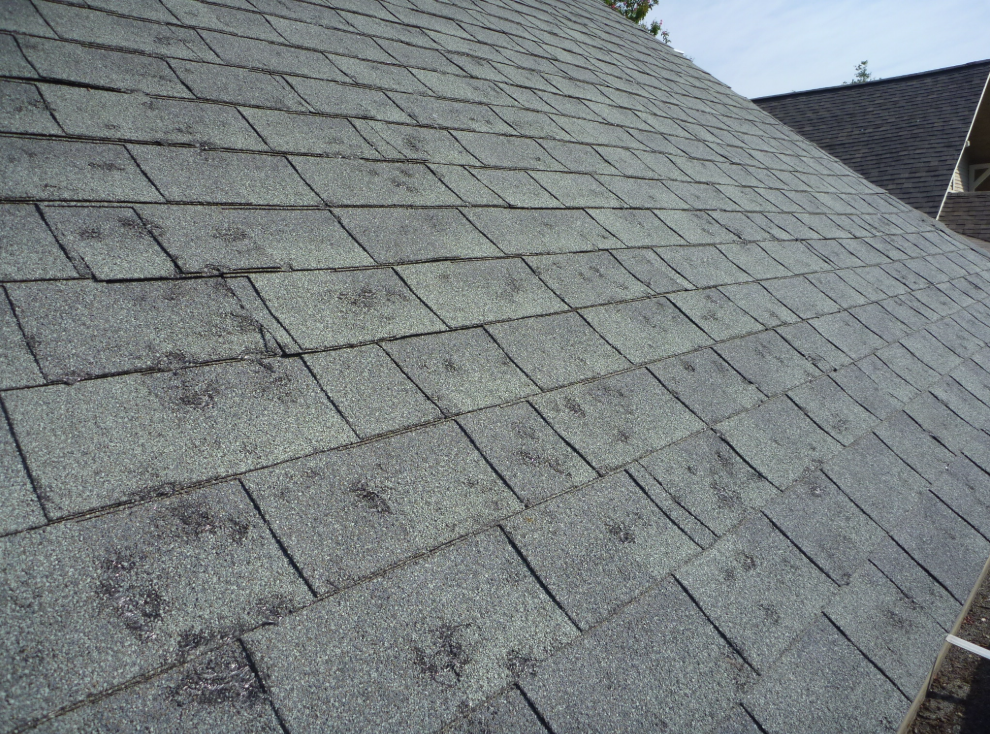
Hail bruising. Not holes. A hail strike fractures the asphalt mat under the granules and knocks granules loose in a circular pattern. The shingle can look intact from ten feet away and still be finished, because the fiberglass mat is cracked and the UV protection is gone. This is why an inspector who only looks for visible holes will tell you a legitimately damaged roof is fine.
Wind creasing and unsealing. A shingle lifted and dropped breaks the factory seal strip. It lies back down looking normal. In the next storm it goes.
Damage density. Carriers work from test squares — typically a 10 by 10 foot area per slope — and count hits. Enough hits per square on enough slopes and the roof is a replacement rather than a repair. This is why a report that documents one damaged area is not a claim and a report that documents damage by slope is.
We break down what a storm report has to contain in our storm damage roof inspection guide.
The deductible is yours, and no contractor can absorb it
Every insurance roof replacement in Texas includes a deductible you pay out of your own pocket. That is not a custom — it is state law, and it applies to both sides.
A contractor who offers to waive it, eat it, cover it, or write you an invoice for more than the real price so the deductible disappears is committing insurance fraud, and the statute reaches the homeowner who knowingly goes along with it. It is the single most common bad offer that shows up on doorsteps in the week after a storm. TDI covers the rules in roofing and insurance: know the law, and we wrote about the specifics in can a roofer waive my deductible in Texas and who actually pays your roof deductible.
If somebody is willing to break that law in front of you during the sales call, form your own view about what they will do on your decking when nobody is watching.
Where claims go wrong
Most reduced or denied claims I see come down to one of these, and every one of them is avoidable:
- Filing without knowing whether you have damage. A claim with no payout still sits on your CLUE record for years and can affect renewal pricing. Get the roof looked at first, then decide whether to file.
- Missing the reporting window. Texas policies require prompt notice, and many carriers apply a hard deadline measured from the date of loss. The longer you wait, the harder it is to prove which storm did it.
- No date of loss. 'Sometime last spring' is not a date of loss. Pull the actual storm date for your address before you call.
- Signing a contingency agreement you did not read. Some post-storm contracts lock you to a contractor no matter what the carrier approves, with a cancellation penalty attached.
- Letting the adjuster inspect alone. You are entitled to have your roofer on the roof at the same time. An adjuster covering dozens of houses a day and a roofer covering one will not find the same things.
- Repairing before documentation. Emergency tarping to stop active water intrusion is expected. A permanent repair before the adjuster sees it can cost you the claim.
What the payout actually looks like
On an RCV policy the money arrives in two pieces, and this surprises people every time.
The first check is the actual cash value of the roof, minus your deductible. It lands before any work starts, and it is deliberately not enough to pay for the roof. The second piece — recoverable depreciation — is released after the work is done and invoiced. TDI describes the same two-check sequence: a partial payment first, with the remainder sent after repairs have begun.
Two practical consequences. First, do not judge your claim by the first check; people call us convinced they have been shortchanged when they are simply looking at half the settlement. Second, there is usually a deadline for claiming that recoverable depreciation, often a year or two from the date of loss. Homeowners who bank the first check and put off the job sometimes forfeit the rest. That money is only released against completed work.
On an ACV policy there is no second check. What you got is what there is, and the gap is yours to close. That is the whole reason it is worth knowing which policy you have before a storm rather than after.
If your claim was denied
A denial is a position, not a verdict. Ask for it in writing with the specific policy language cited. Then compare what the adjuster documented against what an independent inspection finds — genuine disagreements about damage density on a slope are common, and they are resolvable with evidence.
You can request a reinspection. You can invoke the appraisal clause in your policy if it has one, which sends the valuation dispute to independent appraisers rather than to a lawsuit. And you can file a complaint with the Texas Department of Insurance. We went through the pattern of denials in this market in why Texas insurers deny hail and wind roof claims.
What does not help is arguing louder. What helps is a dated, slope-by-slope report with photographs and a scale reference.
Where to start
Before the next storm: find your declarations page, confirm RCV or ACV, and find the real number on your wind and hail deductible. After a storm: get an honest inspection before you file, and get the date of loss right.
We will come look at your roof and tell you whether you have a claim — including when the answer is that you do not, which is a conversation we have often. Filing a claim you did not need is not a free roll of the dice, and we would rather say so. If the roof is simply at the end of its life rather than storm damaged, our 2026 Katy roof replacement cost guide is the more useful page. Call us at (281) 769-4282.
About the author
About the author — Brent Burgin is the owner and operator of All Out Roofing, a credentialed, fully insured local roofing contractor serving Katy, Houston, Cypress, Fulshear, and surrounding communities. Brent has lived in the Katy/Fulshear area since age 7 and is also a licensed Texas real estate agent (TREC #630213, with Terra Point Realty since 2013) — a cross-domain background that helps homeowners think through roof decisions in the context of their home’s overall value and any pending real estate transactions. Brent is a CertainTeed Master Craftsman and Shingle Quality Specialist, and All Out Roofing also installs GAF and Owens Corning shingle systems.
All Out Roofing, LLC — 25220 Kingsland Blvd, Ste 100, Katy, TX 77494. Available 24/7 for storm response.