Class 3 vs Class 4 shingles is the choice most Texas homeowners face when they replace a roof, whether they know it or not. Both are impact-rated. Both cost more than a basic architectural shingle. The question is whether the jump to Class 4 pays you back on a Katy, Fulshear or west Houston house, or whether you are paying for a label.
I am a roofer here, and I quote this upgrade on most of the replacements I bid. Here is how the ratings work, what the Texas insurance discount actually requires, and when I tell people to skip it. If you want the product side, our guide to Class 4 impact-resistant shingles covers the lines we install.
Class 3 vs Class 4 shingles: what the rating means
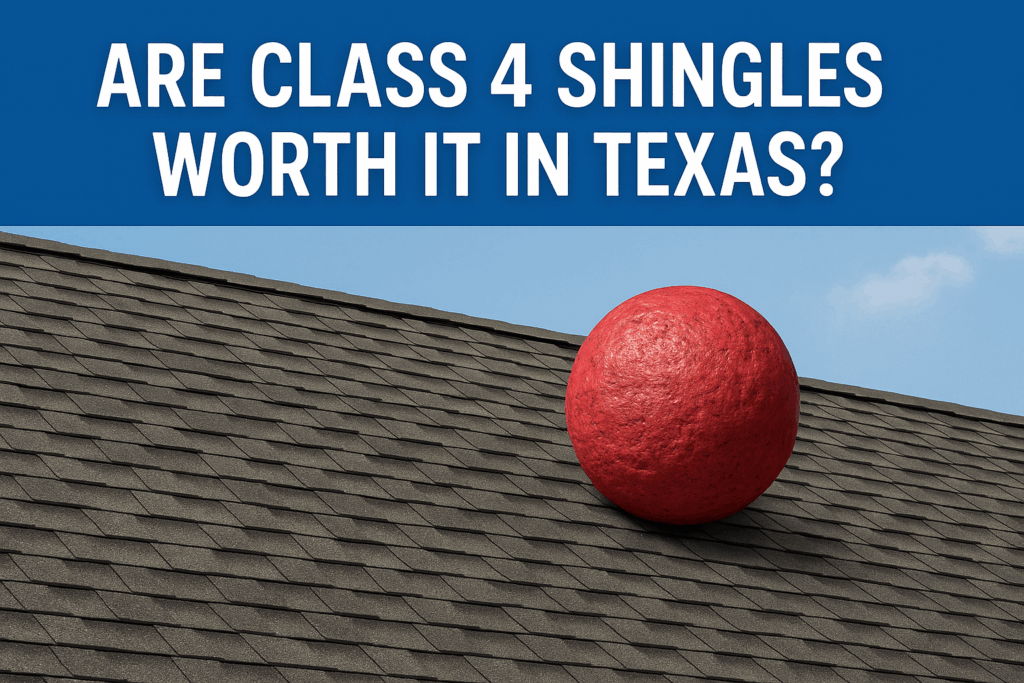
Impact ratings come from a lab test called UL 2218. A steel ball is dropped onto the shingle, twice in the same spot, and the shingle passes if the mat underneath does not crack or split. According to the Insurance Institute for Business & Home Safety, the Class 3 ball is 1.75 inches in diameter and the Class 4 ball is 2 inches, each dropped from the height that gives it the energy of a real hailstone that size.
So the honest one-line difference is this: a Class 3 shingle passed the test with a 1.75-inch ball, and a Class 4 shingle passed it with a 2-inch ball. Class 4 is the top of the scale. There is no Class 5.
Two things the label does not tell you. It does not mean hail-proof, and it does not mean every Class 4 shingle performs the same. The same IBHS research found polymer-modified impact-resistant shingles did noticeably better than traditional impact-resistant shingles across all four test classes. The rating is a floor, not a ranking.
What the difference looks like on a Katy roof
Plenty of storms here bring hail smaller than either test ball. On a storm with pea-to-marble hail, a Class 3 and a Class 4 roof will usually both come through fine, and so will many standard shingles. The gap shows up on the bigger storms, the ones with hail at an inch and a half or more, which are the storms that drive replacement claims.
On those days, a Class 4 roof tends to take fewer bruises and fewer fractured mats per square than a Class 3 roof. Fewer damaged shingles can mean a repair instead of a full replacement, or no claim at all. That is the real value. It is not that the roof never gets hit. It is that each storm costs you less of the roof.
A Class 3 shingle is a reasonable middle ground. The catch in Texas is the insurance side: the credit is highest at Class 4, and how much a carrier gives for Class 3 varies a lot. That is usually where the math tips.
What the Class 4 upgrade costs
On the bids we write, a Class 4 line costs more than the standard architectural line from the same manufacturer, and a Class 3 line usually sits in between. The difference depends on the brand, the color, the roof size and the pitch, so I would not trust anyone who gives you a single percentage without measuring your roof.
The fair way to compare is to ask for both options priced on the same quote, same crew, same underlayment and same flashing. Then the only number that changes is the shingle. Our Texas roof replacement cost guide covers what drives the rest of the bid, and roof financing is there if you want to spread the difference into monthly payments.
How the Texas insurance discount works
This is the part people get wrong. The Texas Department of Insurance roofing discount page says impact-resistant roofing rated Class 1, 2, 3 or 4 can qualify for a premium credit, that Class 4 gets the highest credit, and that the amount for each class is set by each insurance company on a company-by-company basis. In other words, there is no state percentage. Your carrier decides.
To get it, TDI says the roofing must carry the proper UL label or a label from another TDI-approved lab showing the impact class, and the roofer completes TDI form PC068, the Impact-Resistant Roofing Installation Form. In practice you need three things:
- A documented rated shingle. Your invoice should name the manufacturer, the product line and the impact class.
- The installation form. We fill out the PC068 on every impact-rated roof we install.
- Notice to your carrier. You or your insurance agent send it in. Ask when the credit starts, because it often begins at renewal.
Before you choose between Class 3 vs Class 4 shingles, call your agent and ask for your premium quoted three ways: standard shingle, Class 3 and Class 4. Carriers differ a lot on how they credit Class 3. That one phone call usually settles the question.
If a previous owner put on an impact-rated roof and never filed the form, you may be missing a credit you already qualify for. An inspection can document what is on the roof.
When Class 4 shingles are not worth it
- You are selling within a few years. The premium credit may not pay back the upgrade before you list, though an impact-rated roof is a real line in a listing.
- Your carrier gives little or no credit. Some do not. You would be paying for the protection alone, which can still be worth it, but go in knowing that.
- Your HOA limits shingle styles or colors. Check the approved list before you pick a line.
- The deck or ventilation has problems. Soft decking or a hot, poorly vented attic needs fixing first. A premium shingle on a bad deck will not perform.
One more point that confuses people: the shingle manufacturer’s warranty covers defects, not hail. Hail damage on a Class 4 roof is still an insurance claim. You will just see less of it per storm. Keep your installation paperwork with your policy documents, because you may need it again when you change carriers.
So is Class 4 worth it over Class 3?
For most Katy-area homeowners who plan to stay five years or more, I lean Class 4 over Class 3. Not because the 2-inch ball matters on every storm, but because the insurance credit is highest at Class 4 and the bigger storms are the ones that cost you a roof.
One thing I will not promise is a longer life. A Class 4 shingle still ages in Texas sun like any asphalt shingle, and heat, attic ventilation and installation matter more to lifespan than the impact class does. What you are buying is better odds on hail day.
Class 3 makes sense when your carrier credits it nearly as well as Class 4, or when the color or profile you need is only available in a Class 3 line. Standard shingles still make sense when you are selling soon and your carrier offers no credit at all.
If hail already damaged your roof and you have a roof insurance claim open, ask whether the upgrade can be added for the price difference. On some roof replacements in Katy it can. If you are comparing specific brands, our impact-rated shingle comparison for Katy goes line by line.
Find out what is on your roof now
Not sure whether your roof is already impact-rated, or what class it is? We offer free, no-obligation roof inspections and can usually identify the shingle line and document it for your carrier. If you are getting replacement quotes, we will price standard, Class 3 and Class 4 on the same bid so you can see the real difference. Call All Out Roofing at (281) 769-4282 whenever it suits you.
About the author
About the author — Brent Burgin is the owner and operator of All Out Roofing, a licensed local roofing contractor serving Katy, Houston, Cypress, Fulshear, and surrounding communities. Brent has lived in the Katy/Fulshear area since age 7 and is also a licensed Texas real estate agent (TREC #630213, with Terra Point Realty since 2013) — a cross-domain background that helps homeowners think through roof decisions in the context of their home’s overall value and any pending real estate transactions. Brent is a CertainTeed Master Craftsman and Shingle Quality Specialist, and All Out Roofing also installs GAF and Owens Corning shingle systems.
All Out Roofing, LLC — 25220 Kingsland Blvd, Ste 100, Katy, TX 77494. Available 24/7 for storm response.