
Attic Ventilation Methods That Actually Work in a Texas Attic
Every summer I get the same call. The upstairs will not cool, the electric bill jumped, and somebody has already quoted a new air conditioner. Then I go up in the attic and find it running near 150°F with the soffit vents packed solid with blown insulation. The attic ventilation methods on that house were never wrong on paper. They just stopped working, and nobody went up to look.
This is the long version of what I check and why: what each of the common attic ventilation methods actually does, why the intake and exhaust sides have to balance, what the code asks for, and where Texas heat and humidity change the math.
Fair warning — a good part of this post is about what not to buy.
Schedule An Inspection Today
What Attic Ventilation Methods Are Supposed to Do
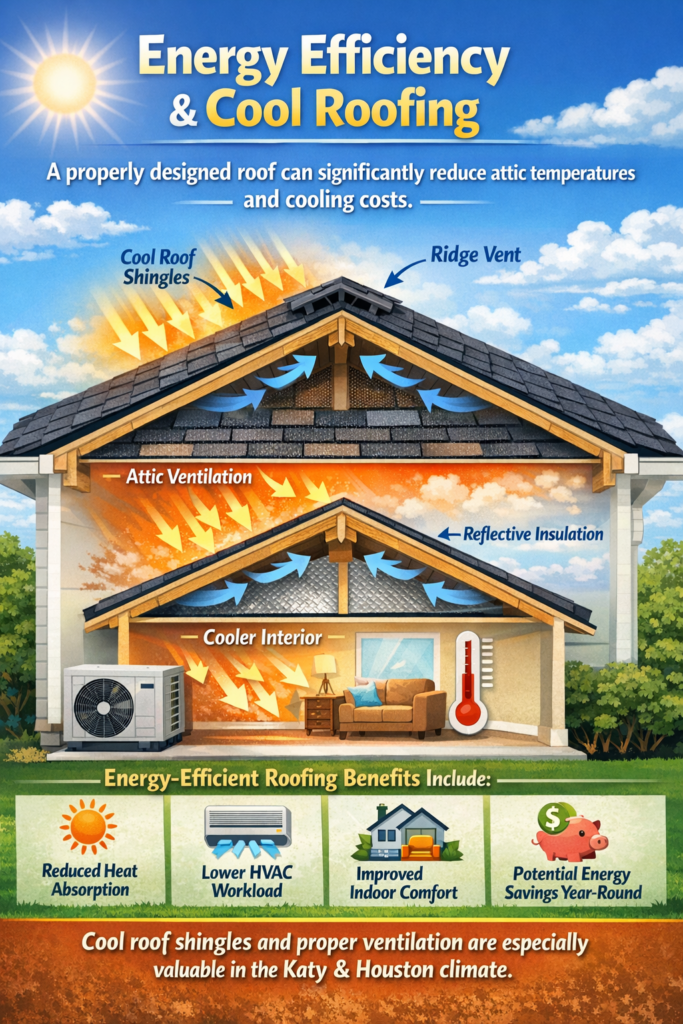
Strip the product names away and every attic ventilation system does one job: bring outside air in low and let it leave high. Cool air enters at the eaves, picks up heat and moisture, rises, and exits at the top. That is the whole mechanism.
So the attic ventilation methods on your roof are not really a set of products. They are two halves of one loop:
- Intake — low, at the eaves. Almost always soffit vents.
- Exhaust — high, at or near the ridge. Ridge vents, box vents, turbines, or powered fans.
Break either half and the loop stops. That is why a roof can carry four brand-new ridge vents and still run a 150°F attic — there is nothing feeding them. The vents are not the system. The airflow is.
If the rest of the assembly is unfamiliar, our walkthrough of the parts of a residential roofing system covers where ventilation sits relative to decking, underlayment and shingles.
Why Texas Punishes a Bad Ventilation Design
In a mild climate a marginal attic is a slow problem. Here it is not.
A Katy attic under a dark roof on a July afternoon commonly runs 140°F to 160°F. That heat sits directly against the underside of your decking and, through it, against the back of your shingles. Asphalt shingles are a petroleum product. Cook them from below for fifteen summers and the volatile oils that keep them flexible bake out. What is left is brittle, and brittle shingles crack, shed granules, and lift in wind a healthy roof would have shrugged off.
Then there is humidity, which is the half most people forget. Gulf Coast air carries a lot of water, and showers, cooking and laundry push more of it up through ceiling penetrations. With no exhaust path that moisture condenses on the coldest surface it can find, usually the roof deck on a cool night. You get dark staining first, then mold, then soft sheathing.
Two more details specific to homes around here:
- Your ductwork is probably up there. In most Houston-area homes built in the last thirty years, the air handler and flex duct run through the attic. Cooling that space is not only about protecting the roof — it decides what temperature the air in your ducts is fighting.
- The radiant load is enormous. The Department of Energy’s Building America program treats air sealing, insulating and venting attics as one combined strategy in hot climates rather than three separate upgrades.
How Failed Attic Ventilation Methods Show Up as Roof Damage
A lot of what gets blamed on “bad shingles” is a ventilation failure wearing a shingle-shaped symptom.
What I find on the roof:
- Curling and clawing — edges lifting, usually worst on the slope with the least intake beneath it.
- Granule loss out of proportion to age — a ten-year-old roof shedding like a twenty-year-old one.
- Sealant strips that let go — tabs that were never storm-damaged but no longer bond, so the next strong gust takes them.
- Uneven aging slope to slope — the clearest tell of all. Weather hits every slope the same. Bad airflow does not.
What I find in the attic:
- Dark streaking on the underside of the decking, often following the nail lines.
- Rusted nail shanks poking through the sheathing, wet to the touch on a humid morning.
- Insulation flattened and grey near the eaves, a sign air has been forcing through the wrong path for years.
The practical cost is service life. A roof that should give you twenty-plus years in this climate gives you twelve to fifteen when the attic never breathes. Nobody itemizes that on an invoice, but it is the most expensive line in the whole discussion.
The Balance Rule: Why Half a System Is Worse Than None
Here is the part that decides whether the attic ventilation methods on your house are doing anything at all.
Intake and exhaust have to be roughly balanced, and if you cannot get them equal you want more intake than exhaust. An exhaust-heavy attic cannot pull enough air from the soffits, so it finds air somewhere else, and the nearest supply is your conditioned house — drawn up through can lights, the attic hatch, and every gap around a plumbing stack. You have then built a machine that pulls air you paid to cool into a 150°F space and throws it out the ridge.
The code framing is the 1/300 rule. The IRC’s minimum vent area section, R806.2, sets net free ventilating area at 1 square foot for every 300 square feet of attic floor when intake and exhaust are properly split, with a 1/150 default when they are not.
Run it on a real house. A 2,000 square foot attic at 1/300 needs roughly 6.7 square feet of net free area — about 960 square inches — split near half to intake and half to exhaust. Call it 480 square inches on each side.
Two things trip people up on that arithmetic:
- Net free area is not the size of the hole. Louvers and insect screen block a large share of the opening. The rated NFA is printed on the product; the physical dimensions will flatter you.
- A blocked soffit vent has a net free area of zero no matter what it is rated for. This is the most common failure I find, and it is usually insulation shoved into the eaves by a well-meaning crew who never installed baffles.
The Attic Ventilation Methods, and What Each One Is Good For
Ridge vent (exhaust)
A continuous slot cut along the peak, covered with a baffled vent and capped with shingles. It exhausts along the whole ridge line at the hottest point in the attic, it is nearly invisible from the street, and HOAs never argue with it. Of the exhaust-side attic ventilation methods, this is the one I install most.
The catch: it only performs with adequate soffit intake below it, and it needs enough ridge length to hit its numbers. A cut-up roof with three short ridges and six hips does not give you much ridge to work with.
Box vents, or static vents (exhaust)
Low square vents set near the top of a slope. Unglamorous and useful, especially on roofs with limited ridge line. You need enough of them — one or two on a large attic is decoration.
Turbine vents (exhaust)
Wind-driven spinners. They move real air when there is wind and behave like an ordinary box vent when there is not. They are visible from the ground, the bearings eventually start complaining, and some HOAs restrict them. Honest verdict: effective, unlovely, and fine if the look does not bother you.
Powered attic fans (exhaust)
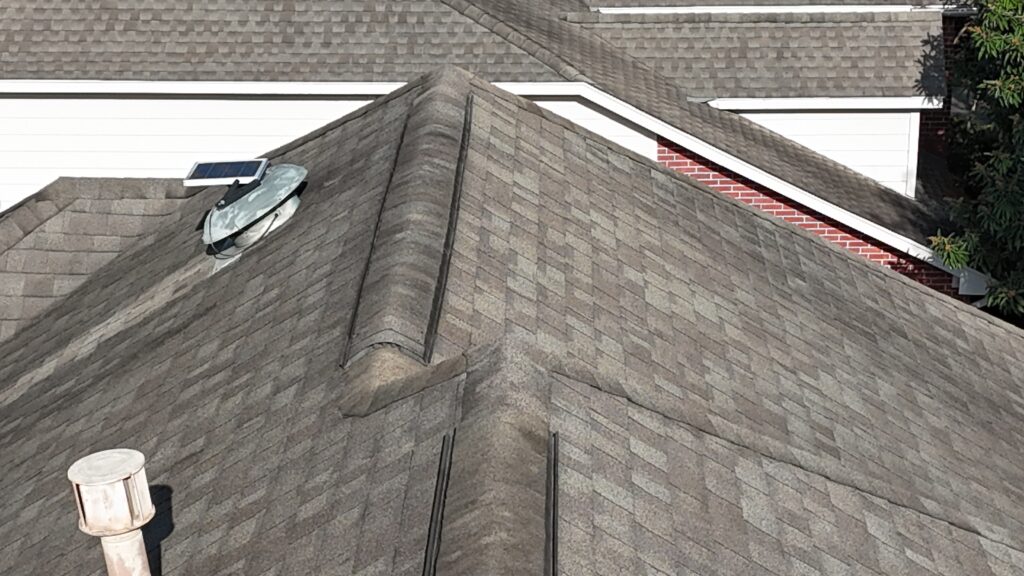
The one I talk people out of most often. A powered fan moves a lot of air, which is exactly the problem when the intake side is undersized. It will happily make up the shortfall by pulling conditioned air out of your house, so you are paying for the fan and for the cooling it wastes. In an attic with genuinely generous soffit intake, a solar unit can earn its place. In the typical Katy attic with half-blocked soffits it is a mistake in a nice housing.
Soffit vents (intake)
The half nobody photographs, and the half that fails. Continuous perforated soffit is the best version. Whatever you have, it needs baffles holding the insulation back so there is a clear channel from the eave up into the attic.
If your eaves are solid — some older homes here have no soffit venting at all — edge-of-roof intake vents that install in the first course of shingles are the usual fix.
Unvented, spray-foam assemblies
Worth naming because it throws out the loop entirely: insulate at the roof deck with closed-cell foam and bring the attic inside the building envelope. The IRC handles this separately under R806.5, unvented attic assemblies. It performs well, especially with ducts up there, and it costs multiples of any vented approach. It is also not something to do halfway — a partly foamed attic with vents still open is the worst of both.
Energy Bills, and the Warranty Clause Nobody Reads
On the energy side, keep expectations calibrated. Correcting the attic ventilation methods on a badly vented house makes the attic meaningfully cooler and takes load off an air handler sitting in that heat. It is not a new-HVAC-sized change. If someone promises you a specific percentage off your bill from vents alone, they are guessing.
The cooling upgrades stack, and ventilation goes first because everything else sits on it. We cover the rest in energy-efficient and cool roofing for Texas homes, and the radiant side specifically in our post on attic radiant barriers in Katy.
Now the warranty part, which costs real money.
Every major shingle manufacturer — CertainTeed, GAF, Owens Corning — conditions its warranty on ventilation meeting the requirement in their installation instructions. Read the exclusions and you will find language voiding coverage for damage caused by inadequate ventilation. When a manufacturer’s inspector goes up to look at a premature failure claim, the attic is one of the first places they go, because heat damage from below has a specific signature and it is easy to document.
So a homeowner who saved a few hundred dollars skipping vent correction during a reroof can find a thirty-year warranty reduced to nothing. Our guide to how roofing warranties actually work walks through what is and is not covered.
How to Check Your Own Attic Ventilation in Ten Minutes
You do not need a contractor to tell whether the attic ventilation methods on your house are still working. Pick a hot afternoon, take a flashlight, and look for five things.
- Light at the eaves. Stand in the attic with your light off and look toward the edges. You should see daylight coming through the soffit vents. If you see only insulation, your intake is blocked, and that is your problem.
- Baffles. Look for rigid channels holding insulation back from the eave. No baffles on a blown-insulation attic usually means blocked intake somewhere.
- Staining on the decking. Dark patches or streaks on the underside of the plywood, particularly up near the ridge.
- Rusty nail points. Condensation has been forming on them. That is a moisture problem, not a leak.
- Mixed exhaust types. A ridge vent plus turbines plus box vents on one attic space can short-circuit — the lower vents become intake for the higher ones and the far end of the attic stops moving air entirely.
Smell counts too. A musty attic in a house with no known leak is a ventilation report, not a plumbing one.
This is worth folding into your regular routine, so we put it on the seasonal list in our Katy roof maintenance calendar.
The Five Mistakes I Find Most Often
Good attic ventilation methods fail in a small number of predictable ways. In rough order of how often I find them:
- Insulation blocking the soffits. The number one finding, and often created by the last insulation crew rather than the last roofer.
- Exhaust added, intake never touched. Somebody sold more vents up top. Nobody looked at the bottom.
- Decorative vents. Gable vents with the framing never cut out behind them. They look like ventilation from the driveway.
- Short-circuited mixed systems. Covered above. Pick one exhaust type per attic space.
- Bath fans dumping into the attic. Not ventilation at all — a humidifier aimed at your decking. These have to terminate outside.
None of these are visible from the ground, which is why “the roof looks fine” is not an answer to a ventilation question.
What the county will and will not enforce is a separate matter, and it varies by where your address actually sits. We walk through that in roof ventilation code in Harris and Fort Bend County. There is also a fair stack of bad advice circulating on this subject, which we sorted through in attic ventilation myths debunked.
Fix It During a Reroof, Not After
If a replacement is anywhere on your horizon, that is when the attic ventilation methods on your house should get corrected, and the reason is cost rather than quality.
During a tear-off the decking is exposed, the crew is already up there, and cutting a ridge slot or adding intake at the eave is incremental labor on a job you are paying for anyway. The same corrections done as a standalone visit two years later means mobilizing a crew, staging the site, and working around a finished roof. The work is identical. The bill is not.
A bid worth taking seriously will state the ventilation plan: what intake you have, what exhaust is going on, and how that lands against the 1/300 requirement. If a bid says nothing about the attic at all, that is worth a question before you sign. Our repair versus replacement guide covers how to think about the timing.
The honest counterpoint: if your roof has a decade left and your attic came through the ten-minute walkthrough clean, leave it alone. Not every attic needs work, and the attic ventilation methods already on a well-built house are frequently adequate. Plenty of homes here are fine as they sit.
Where This Leaves You
The short version, if you skipped to the bottom. All the attic ventilation methods above come down to one loop: intake and exhaust have to balance. Intake is the half that fails. The 1/300 rule is the yardstick. And the cheapest moment to correct any of it is during a roof you were already replacing.
If you went up and found daylight at every eave, clean decking and no rust, you are in good shape and you can stop reading here. If you found packed soffits or staining, that is worth addressing before it turns into shingles.
We will come look and tell you what we find, including when the answer is that nothing needs doing. That happens often enough that I would rather say it up front. Call us at (281) 769-4282 whenever it works for you.
Roof Ventilation FAQs
Why is roof ventilation important in Texas?
Because attic temperatures here commonly reach 140°F to 160°F on a summer afternoon, and Gulf Coast humidity adds a moisture problem on top of the heat. Together they cook shingles from underneath and condense on the decking at night, which is why attic ventilation methods matter more in this climate than in most of the country.
Can poor ventilation void a roof warranty?
Yes. Every major manufacturer conditions its warranty on ventilation meeting the requirement in their installation instructions, and heat damage from below leaves a signature an inspector can document. It is one of the more common reasons a long warranty turns out to be worth nothing.
Is ridge vent better than box vents?
Usually, when there is enough ridge length and adequate soffit intake feeding it. On a cut-up roof with short ridges, box vents can do more. Design beats vent type — a ridge vent with blocked soffits underneath it performs worse than nothing.
Does ventilation reduce energy bills?
It helps, mostly by taking load off an air handler and ducts sitting in that heat. Expect a real but modest change, not an HVAC-sized one. Anybody quoting you a specific percentage off your bill from vents alone is guessing.
Can ventilation be fixed without replacing the roof?
Sometimes, but full correction is often easiest and most effective during roof replacement.
About the author
About the author — Brent Burgin is the owner and operator of All Out Roofing, a licensed local roofing contractor serving Katy, Houston, Cypress, Fulshear, and surrounding communities. Brent has lived in the Katy/Fulshear area since age 7 and is also a licensed Texas real estate agent (TREC #630213, with Terra Point Realty since 2013) — a cross-domain background that helps homeowners think through roof decisions in the context of their home’s overall value and any pending real estate transactions. All Out Roofing is a CertainTeed Select ShingleMaster, a credential fewer than 1% of contractors hold, and installs GAF and Owens Corning shingle systems. Attic questions are his favorite kind, because the answer is so often cheaper than the caller expected.
All Out Roofing, LLC — 25220 Kingsland Blvd, Ste 100, Katy, TX 77494. Available 24/7 for storm response.