
Roof Repair vs Replacement: How to Know Which Your Katy or Houston Home Needs
The roof repair vs replacement question is the most expensive call a Texas homeowner makes without much information to go on. Get it wrong in one direction and you pay a roofer four times over five years for the same leak. Get it wrong in the other and you spend $18,000 on a roof that had eight good years left.
We inspect roofs across Katy, Fulshear, Cinco Ranch, Cross Creek Ranch and the west Houston suburbs, and the answer almost never comes down to how bad the damage looks from the driveway. It comes down to four things: how old the roof is, how far the damage spreads, whether the layers under the shingles are still sound, and what your insurance policy will actually pay.
This guide walks through how a licensed roofer makes that call — the same way we do it on a real inspection, not the way a salesperson does it from the street.
Why the Roof Repair vs Replacement Call Matters More Than You Think
Repairing a roof that needed replacing costs you twice. You pay for the repair, and then you pay again when the next storm finds the next weak spot. Along the way you can lose things that are harder to get back.
- Repeated service calls on the same slope
- Moisture working into the decking, where you cannot see it
- A manufacturer warranty voided because the system was patched instead of corrected
- An insurance carrier that starts treating the roof as a maintenance problem instead of storm damage
That last one catches people. Once a carrier has a record of repeated small claims on one roof, the next claim gets harder, and renewal gets more expensive. Texas carriers have been tightening on older roofs for two years now.
Replacing a roof that only needed a repair is the cheaper mistake, but it is still a mistake. A sound ten-year-old roof with one bad valley does not need $18,000 spent on it. It needs a roofer who will say so.
The goal is the right answer, not the fastest one and not the biggest invoice.
When Repair Is the Right Answer
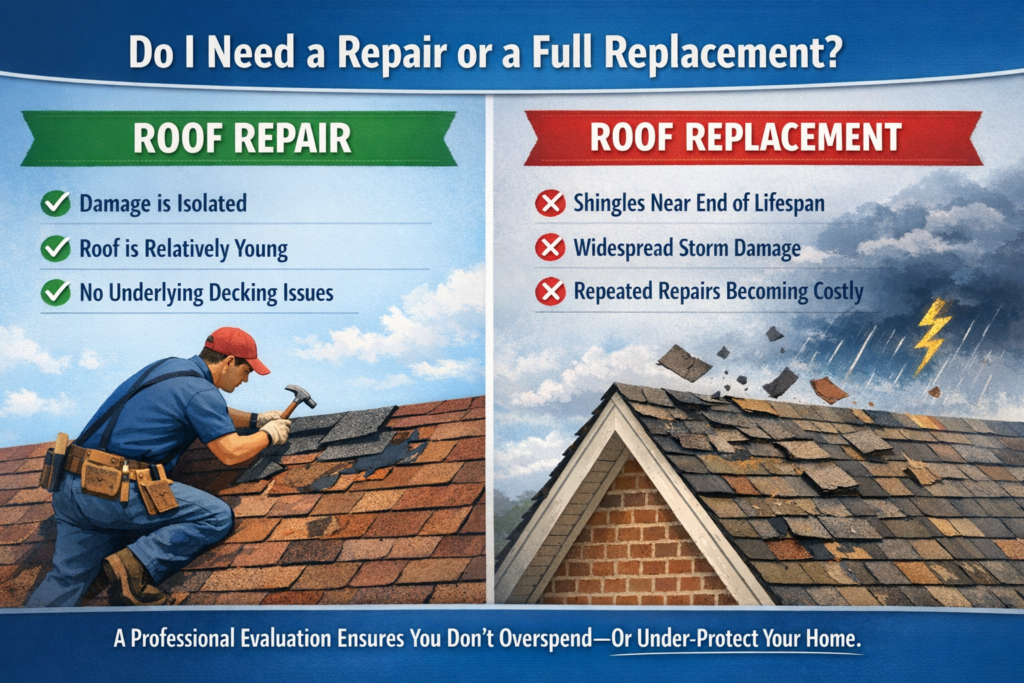
Repair works when the damage is isolated and the system underneath it is still doing its job. That means the decking is solid, the underlayment is intact, and the shingles around the damage still flex instead of crack.
Repair is usually appropriate if:
- Damage sits in one area — a slope, a valley, a section of ridge
- The roof is under ten to twelve years old
- Shingles still bend without snapping when you lift a corner
- There is no soft decking and no staining on the underlayment
- The rest of the field still holds its granules
The jobs that fit this profile are the ordinary ones: wind-lifted shingles along a rake edge, a pipe boot that dried out and split, step flashing that pulled away from a wall, a few hail bruises confined to one plane. Those are real repairs with a real service life, not a stalling tactic.
If you are trying to work out whether what you are looking at is even damage, start with the warning signs a roof needs repair and then get eyes on it. A roof inspection costs you nothing with us and settles the question in about forty-five minutes.
When Replacement Is the Smarter Option
Replacement becomes the right call when the problem is the system, not a spot on it. Once the mat, the sealant strip or the decking is compromised across multiple planes, patching just moves the leak.
Replacement is the better answer when:
- The roof is near or past its service life
- Storm damage shows up on three or more slopes
- Shingles crack at the fold or shed granules into the gutters
- There are already several patches from previous repairs
- Decking is soft or delaminated underneath
- The shingle line has been discontinued and nothing matches
That last point is worth sitting with. If your shingle is out of production — and a lot of pre-2015 lines are — a repair leaves a visible patch that does not weather to match. Some homeowners accept that on a back slope and not on the street face.
Hail is the usual reason a Katy roof crosses from repairable to replaceable. A bruise does not always break the surface. It crushes the mat under the granules, and that spot fails eighteen months later when nobody is thinking about the storm anymore. Shingles that look fine from the ground can be finished, which is the whole reason the roof repair vs replacement call has to be made on the roof rather than from it. The storm and hail roof damage guide covers what that bruising actually looks like.
Roof Age Decides More of This Than Damage Does
Age is the single strongest input into the roof repair vs replacement decision, because it tells you how much life you are protecting when you spend the money.
What asphalt shingles actually last around Houston
Manufacturers rate architectural shingles for thirty years. In Fort Bend and Harris County they typically deliver fifteen to twenty, and the heat is why. Deck temperatures over a poorly ventilated Katy attic run well past what the asphalt was designed to cycle through, and the shingle ages from underneath before it ages from above.
- Under eight years: repair almost always makes sense
- Eight to fifteen years: the inspection decides — this is the real gray zone
- Fifteen years and up: replacement usually wins on total cost
There is a simple way to think about it. Divide the cost of the work by the years of service it buys. A $1,200 repair on a seventeen-year-old roof might buy you two years, which is $600 a year. A $16,000 replacement that runs eighteen years is under $900 a year and resets the warranty, the insurance position and the resale conversation at the same time.
If ventilation is part of why your roof aged out early, it is worth understanding how the parts of a residential roofing system work together before you buy the next one.
Storm Damage Changes the Equation
Wind and hail are what push most Gulf Coast roofs across the line. Both leave damage that is easy to miss and expensive to ignore.
What we look for after a storm:
- Bruising. Press a thumb into the impact mark. If it gives like a soft spot on a peach, the mat is crushed.
- Seal failure. Wind lifts a shingle, breaks the adhesive strip, and the shingle lays back down looking normal. It is no longer sealed.
- Underlayment exposure. Granule loss in sheets rather than specks means the mat is taking UV directly.
- Flashing deformation. Bent or lifted metal at walls, chimneys and valleys, which is where most post-storm leaks start.
- Collateral evidence. Dented gutter aprons, soft aluminum on vent caps, and pocked fence caps date the storm and support a claim.
One slope of wind damage on a young roof is a repair. Bruising across the whole field is not, no matter how good the roof looks from your driveway. Start with the signs your roof may need repairing if you are not sure which side of the line you are on.
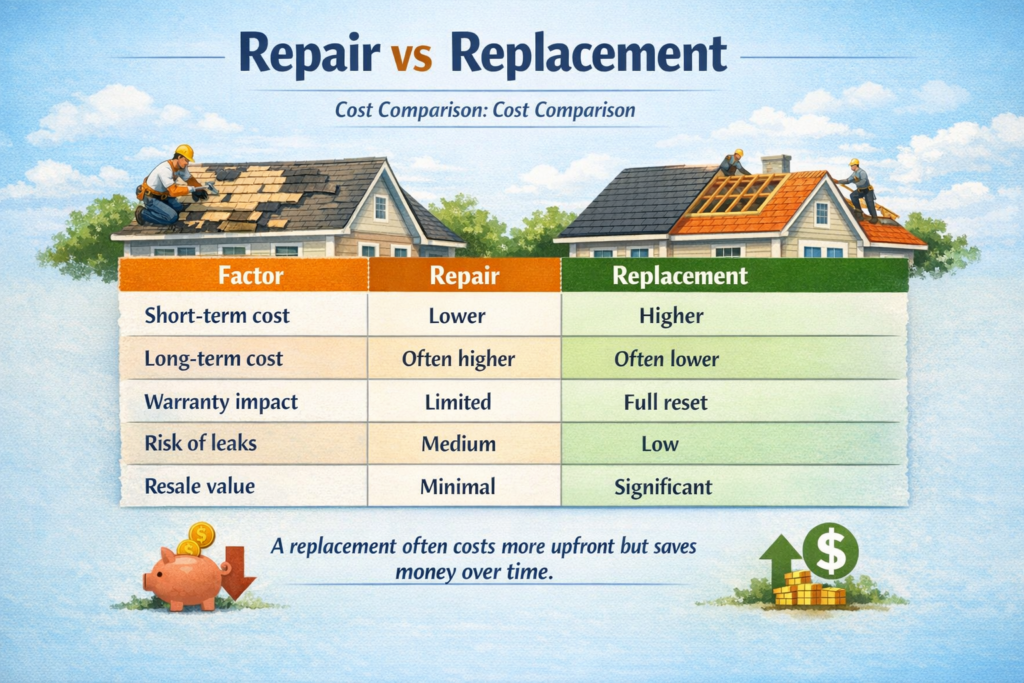
Cost Comparison: Repair vs Replacement
Around Katy and west Houston, an ordinary repair — a boot, a section of flashing, a dozen shingles — generally lands in the several-hundred to low-four-figure range. A full replacement on a typical two-story home here runs into five figures. Those are ranges, not quotes; pitch, layers, decking condition and access move them a lot. The roof replacement cost breakdown for Houston gets specific about what drives the number.
| Factor | Repair | Replacement |
|---|---|---|
| Short-term cost | Lower | Higher |
| Long-term cost | Often higher | Often lower |
| Warranty impact | Limited | Full reset |
| Risk of leaks | Medium | Low |
| Resale value | Minimal | Significant |
| Best when roof is | Under 12 years | 15+ years |
The honest version: replacement is not always the better buy. If your roof is eight years old and a limb took out six shingles, a repair is the right answer and anyone telling you otherwise is selling. Our deeper look at whether you need a repair or a full replacement walks the same decision from the other direction, and if you are dealing with an active leak right now, start with the practical steps for a leaking roof. For an active emergency, see emergency roof leak repair in Katy: what to do in the first hour. And if you are weighing whether to fix now or wait, read the real cost of putting off roof repairs in Katy.
How we make the call
We get on the roof, lift shingles, check the decking from the attic where we can, photograph everything, and give you both numbers. If a repair will hold, we will tell you so and we will write it that way. Our crew is fully credentialed and insured, and we hold a $900 repair to the same standard as a full replacement.
If you want a second opinion on a roof repair vs replacement quote you have already been given, call us at (281) 769-4282. The inspection is free and you will get the photos either way.
What Your Policy Does to the Math
Insurance can flip the roof repair vs replacement answer on its own, because it changes what the work actually costs you rather than what it costs.
A storm-related replacement is generally payable when the damage was sudden and accidental, when it is documented, and when the claim is filed inside your policy’s deadline. Wear and tear is not. That distinction is the whole argument in most denied claims.
The bigger variable is how your policy pays. A replacement cost policy pays to put back what you had, minus your deductible. An actual cash value policy pays depreciated value, and on a fifteen-year-old roof that difference can be most of the job. The Texas Department of Insurance explains the two settlement types in replacement cost or actual cash value, and covers roof endorsements and claim timing in its guidance on insurance and your roof. Read your declarations page before you call anyone. The words you are looking for are near the wind and hail deductible.
Two things we tell every homeowner. Your wind and hail deductible is usually a percentage of the dwelling amount, not a flat number, so it is larger than you think. And no contractor in Texas can absorb it for you — that is a state law matter, not a policy preference. We cover what that means in can a roofer waive my deductible and in the breakdown of what hail damage insurance covers in Katy.
Roof Repair vs Replacement FAQs
Can a roof be repaired after hail damage?
Sometimes—but widespread hail damage usually shortens roof lifespan beyond reliable repair.
Is replacing a roof always better than repairing it?
No. Younger roofs with isolated damage often perform well with repairs.
How do professionals decide repair vs replacement?
By evaluating roof age, damage pattern, system condition, and future risk.