
 Roof age home value questions are the ones I get asked most often — and I sit in an unusual seat to answer them. I own a roofing company (All Out Roofs) and I’ve been on hundreds of Katy-area roofs. I’m also a licensed Texas real estate agent (TREC #630213) with our brokerage in Fulshear, and I sit across the table from buyers and sellers regularly working through what a roof means to a specific deal. Most posts you’ll find on “roof age and home value” are written by one side or the other. This one is written by someone doing both.
If you’re within 12-24 months of putting your Katy-area home on the market, or you’re a buyer trying to figure out how much a stale roof should knock off your offer, this is what roof age home value negotiation actually looks like — with real numbers from the Katy market as of this year.
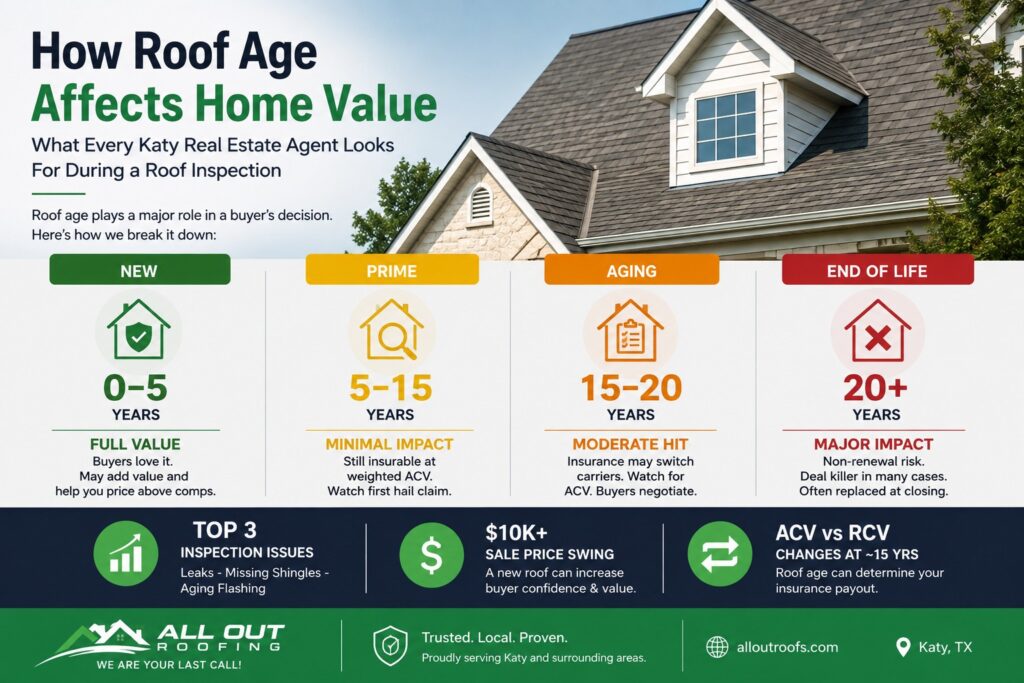
The single most important roof age home value number: 15
For most single-family homes in this market, roof age home value becomes a real deal issue at about 15 years. Under 15, the roof rarely moves the negotiation. Over 15, it starts showing up as a repair credit, a price adjustment, or an inspection-response conversation. Over 20, it becomes one of the top three things every buyer’s inspector will flag, and it’s often the item that determines whether the deal closes on schedule or not at all.
This isn’t a hard rule — it’s a pattern I see in this specific market. A well-maintained 18-year-old roof with documentation and a professional installer can outperform a poorly installed 10-year-old roof. But as a rough frame for planning: 15 is the number where the roof stops being invisible in a real estate transaction.
What a buyer’s inspector writes about roof age and home value
I’ve read hundreds of inspection reports for buyer clients. The roof section usually reads one of three ways depending on age:
Roof age 0-10 years: “Roof appears to be in good condition. Estimated remaining useful life: 10-20 years.” Sometimes a note about minor flashing or pipe boot conditions. Rarely a repair recommendation unless something specific is visible.
Roof age 10-18 years: “Roof is nearing the mid-point of its useful life. [Specific findings — granule loss, some shingle lifting, minor flashing issues.] Recommend periodic inspection and monitoring. Repair or replacement may be needed within 2-4 years.” This is where the language starts to soften the buyer’s leverage.
Roof age 18+ years: “Roof is nearing or at end of expected useful life. [Specific findings — significant granule loss, brittleness, multiple areas of concern.] Recommend replacement in near future.” This is the language that triggers repair credit negotiations.
Roof with no documented age or install date: “Age of roof cannot be determined.” This is the language buyers use to negotiate as if the roof is at end of life, even when it may not be. Documentation matters — if you have a permit, a receipt, or a manufacturer warranty registration for the roof, keep it in your closing packet.
The specific language on the inspection report is what the buyer’s agent uses in the response-to-inspection negotiation. The buyer generally isn’t reading the whole 60-page report — they’re reading the summary. And the summary is where “replacement recommended” becomes a five-figure conversation.
What buyers actually ask for
When the inspection report flags the roof, here’s what the buyer’s response usually looks like, in order of frequency:
Repair credit at close. Most common. The buyer asks for a specific dollar amount off the sale price to cover the estimated cost of eventual replacement — often the full replacement cost, sometimes a partial (based on remaining useful life). On a $500K Katy home with a 20-year-old roof, this is typically a $12K-$18K credit request.
Seller-paid replacement before close. Second most common. The buyer asks the seller to replace the roof before closing, with the buyer usually being allowed to have input on the shingle color and installer. This is a bigger ask on the seller’s side because it delays close and requires seller coordination, but it can save the deal when the buyer’s financing has issues with the older roof.
Price reduction on the sale price. Less common. The buyer asks to drop the sale price by an amount that reflects the roof age. This can be cleaner on the buyer’s tax basis but usually gets less than a full replacement credit.
Walk away. Less common but real. Some buyers — especially those doing a first-time or FHA purchase — will exit a deal if the roof is old enough that their insurance carrier won’t write coverage, or their inspection response feels big enough that they lose confidence in the property.
The tactic a seller responds with usually depends on how much interest the property has, how strong the buyer’s offer is on other terms, and whether the seller has done any pre-listing work. Which brings us to the actual leverage move.
The pre-listing roof age home value decision
If you’re 6-12 months from listing and your roof is over 15 years old, you have four options, ranked by how they usually shake out in this market:
Option 1: Replace the roof before listing. Highest cost, highest control. You choose the installer, the shingle, the color, the timeline. You get to list with “new roof (2026)” as a featured line item in the MLS description. Buyers and their agents see a clean inspection on the roof. You typically list at a stronger price and negotiate less on inspection response.
Real numbers on a 2,500 sq ft Katy home: replacement cost $15K-$20K. Impact on list price: often $10K-$25K stronger, depending on the neighborhood and price band. Impact on days on market: usually shorter. Net financial impact: often close to break-even or modestly positive, plus reduced deal risk. It’s not always a clear win — it depends on the buyer pool for the specific price band — but it’s often the cleanest move.
Option 2: Get an inspection and disclose proactively. Middle cost, middle control. You have a licensed roofer inspect the roof before listing. You get a written condition report — in some transactions, this is packaged as a formal roof certification, which certain lenders and buyers request by name. You disclose the report to buyers upfront and price the house accordingly. Buyers do their own inspection, but there are usually fewer surprises. On a roof in decent shape, this sometimes works as well as replacement without spending the money.
The catch: this works when the report is genuinely positive. If the report identifies issues, you now have documented awareness — and you’re now legally required to disclose those issues on the Texas Seller’s Disclosure Notice (Form TXR 1406). Disclosure isn’t optional once you know.
Option 3: Do nothing, list as-is, negotiate the inspection response. Lowest upfront cost, lowest control. This is what most sellers do. You list. The buyer inspects. The report comes back with the roof findings. You negotiate repair credit or price reduction. Deal usually still closes. You typically give up somewhere in the range of $8K-$18K in credit or price on an older roof.
The catch: sometimes the buyer walks. Sometimes the buyer’s insurance carrier won’t write coverage. Sometimes the buyer’s lender requires the roof to be replaced before funding. Every one of these turns a “$12K credit” scenario into a “deal falls apart” scenario, and now you have a re-listing situation with an older roof and a deal history to explain.
Option 4: Replace the roof after listing, once the inspection comes back. Almost never a good idea. You’re now negotiating from weakness, on a compressed timeline, with a buyer whose leverage just increased. If you’re going to replace, do it before the listing, not after.
What the specific numbers look like
Rough current numbers for this market (Katy, Fulshear, Richmond corridor) on a 2,000-2,500 sq ft home with standard architectural shingles:
- New replacement cost: $14,000-$20,000 for standard architectural. $17,000-$25,000 for impact-resistant (Class 4). Add for high pitch, complex geometry, or premium shingle upgrades.
- Buyer credit request on 20-year-old roof: typically $12,000-$18,000, often referencing a specific replacement estimate the buyer obtained from a roofer during inspection.
- Listing-price uplift from “new roof (year)” in the description: varies by neighborhood and price band. In master-planned communities where nearby comps are competing with new construction, a new roof can support $10K-$25K more in list price. In older neighborhoods where buyers are more price-focused, the uplift may be smaller.
- Insurance implications: the buyer’s ability to get insurance can be a hard yes/no, not a negotiation. If two or three carriers won’t write coverage on the property because of roof age, the buyer’s options narrow. This is where a deal actually breaks.
The math I run for seller clients typically looks like: “If you replace, you’re out ~$16K net cost, and you probably list at $15K-$20K higher with reduced deal risk. If you don’t replace, you’ll likely give up $10K-$15K in credit and take on some deal risk. It’s not a clean win either way — depends on your specific timeline and cash situation.”
If you can’t afford the pre-listing replacement (or you don’t want to tie up cash), the disclosure-and-price-accordingly path in Option 2 usually beats the do-nothing path in Option 3 by a modest margin. Buyers value knowing what they’re buying. Surprises kill deals faster than known issues.
The specific Katy-area situations that come up
Cinco Ranch homes built 2000-2010. Many of these still have the original builder shingles. A significant chunk are now hitting the wall on age and insurance. If you’re selling in this cohort, plan for roof to be a real conversation in the deal. Some of the earliest-built sections have already turned over on roofs (owners replaced 5-8 years ago); some haven’t.
Cross Creek Ranch older sections. Similar pattern for homes in the 15-20 year age range. The community’s HOA has shingle color and style approval processes that need to be built into any replacement timeline — usually a 30-day approval window.
Firethorne, Grand Lakes, Seven Meadows homes in the 15-20 year range. Same story. If you’re selling from any of these communities, get an inspection now — before the listing conversation gets serious.
Newer Cross Creek West, Fulshear Lakes, Cane Island homes. Under 10 years old for most of them. Rarely a factor in the deal yet, but the same builders using the same tract-grade shingles across communities means the same age-cliff conversation will start showing up in 8-12 years.
Older Fulshear and Weston Lakes custom homes on larger lots. These properties often have larger, more complex roof systems that are more expensive to replace. Age matters more here because the replacement cost is higher, so the credit negotiation is larger. Pre-listing replacement makes even more sense on the higher-end properties where a $30K-$50K replacement credit request can knock a serious hole in a deal.
The insurance issue making roof age home value urgent right now
I wrote a related post on Monday about Texas insurance carriers restricting coverage on older roofs — worth reading if you haven’t. The short version: even if a buyer would accept a repair credit and close on an older-roof home, they may not be able to get insurance on the property. Or the insurance they can get is dramatically more expensive than they expected, which changes what they can afford to bid.
This has moved the roof age home value from a “nice to know” item in the transaction to a “may kill the deal” item on properties over 15 years old. Any seller with an older-roof property is now doing this math more actively than they used to.
What buyers should think about with roof age home value
If you’re a buyer looking at an older-roof property, the questions worth asking:
- What’s the specific age of the roof? Ask for documentation, not just what the seller says.
- Has the seller had a recent roof inspection? Ask to see it.
- What’s the shingle brand and grade? Some 15-year shingle lines age worse than others.
- Is there any manufacturer warranty still active? Some warranties are transferable to a new owner if handled properly at close.
- Can you get insurance on the property with the roof as-is? Ask an independent insurance agent for a real quote before you finalize your offer.
- Is a pre-close replacement a possibility if the age is a hard problem for your lender or insurance? Some sellers will do it; some won’t.
The right offer on an older-roof property usually accounts for the eventual replacement one way or another — either through a lower price, a specific credit, or a seller-paid pre-close replacement. If your agent isn’t raising these questions before you write an offer, they’re missing an obvious step.
Where a cross-domain view helps
I’ve had the same conversation from both sides of the table. As the roofer, I’ve had sellers call me two weeks before their listing goes live asking “can you look at this and tell me what to do?” — and sometimes the honest answer is “you should have called me six months ago.” As the agent, I’ve watched deals get stuck on a roof issue that a pre-listing $500 inspection and $2K in targeted repairs would have prevented.
The best time to think about the roof and the home sale together is 12-18 months before you list. That’s when you have real options: replace, repair, inspect and price accordingly, or list as-is with a clear plan. Three months before listing, the options narrow. Two weeks before, you’re just responding to inspections.
If you’re within that window and you want an honest read — no upsell, no sales pressure — call us. If replacement isn’t the right answer for your situation, we’ll tell you. If a modest repair and a good inspection report gets you where you need to go, we’ll say so. The point is to give you the information to make the call, not to sell you a roof you don’t need.
About the author
Brent Burgin is the owner and operator of All Out Roofing, a licensed local roofing contractor serving Katy, Houston, Cypress, Fulshear, and surrounding communities. Brent has lived in the Katy/Fulshear area since age 7 and is also a licensed Texas real estate agent (TREC #630213, with Terra Point Realty since 2013) — a cross-domain background that gives him a specific perspective on how roofing decisions intersect with the sale of a home. All Out Roofing is a CertainTeed Master Craftsman, Master Craftsman Shingle Specialist, and installs GAF and Owens Corning shingle systems.
If you’re 6-18 months from listing a Katy-area home and want a walkthrough on where the roof sits in the deal, or you’re a buyer looking at an older-roof property and want an honest read on what to negotiate — call us at (281) 769-4282 or reach out through the contact form. Free inspection, no pressure.
All Out Roofing, LLC — 25220 Kingsland Blvd, Ste 100, Katy, TX 77494. Available 24/7 for storm response.