Short answer: Synthetic roof underlayment is the polymer sheet that has replaced old-school “roofing felt” on most quality Texas roofs. Both sit between your roof deck and your shingles. There are three families of it — asphalt-saturated organic felt (No. 15 and No. 30), fiberglass-reinforced felt, and modern synthetic and peel-and-stick membranes — and they are absolutely not equal. Below is a straight ranking of every type of roofing felt and underlayment from worst to best, what each one costs you in real-world performance, and what actually belongs on a Houston-area roof.
Underlayment is the single most-skipped line item in a roofing bid, and it’s the one homeowners never see once the shingles go down. That’s exactly why it’s where corners get cut. Below is the same breakdown we walk our own customers through in Katy, Fulshear, and across the Houston metro.
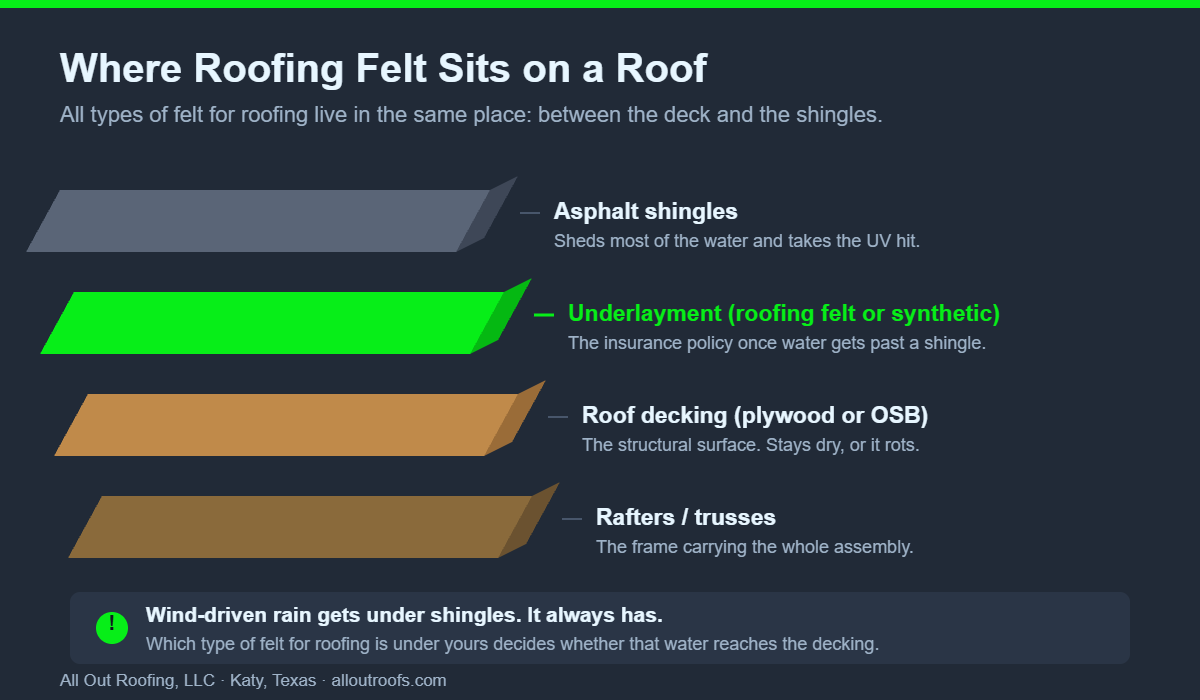
What Roofing Felt Actually Does
Shingles are the roof’s raincoat. Felt is the roof’s insurance policy. Its job is not to be the primary water barrier — it’s to handle everything shingles can’t:
- Secondary water barrier. When wind-driven rain gets under a shingle, or a shingle blows off in a Gulf Coast storm, underlayment is the only thing between the water and your decking.
- Deck protection during the build. Between tear-off and shingle-out, underlayment is your roof. If a pop-up thunderstorm rolls in at 3 p.m., the quality of that layer decides whether you get a wet ceiling.
- A flat, uniform surface. Underlayment separates the shingles from resin bleed, knots, and deck seams that telegraph through the finished roof.
- Code compliance. Underlayment is required under asphalt shingles. It isn’t optional, and “we’ll save you money by skipping it” is a red flag, not a discount.
Every product below, from No. 15 felt to premium synthetic roof underlayment, is hired to do those same jobs. What separates them is how long they keep doing them once Texas heat and Gulf Coast storm season go to work on the roof.
Roofing Felt and Synthetic Roof Underlayment, Ranked Worst to Best
Ranked by real-world durability, tear resistance, water performance, and how they hold up in Texas heat. Costs shown are typical installed material ranges per roofing square (100 sq. ft.) and vary by market and roof complexity.
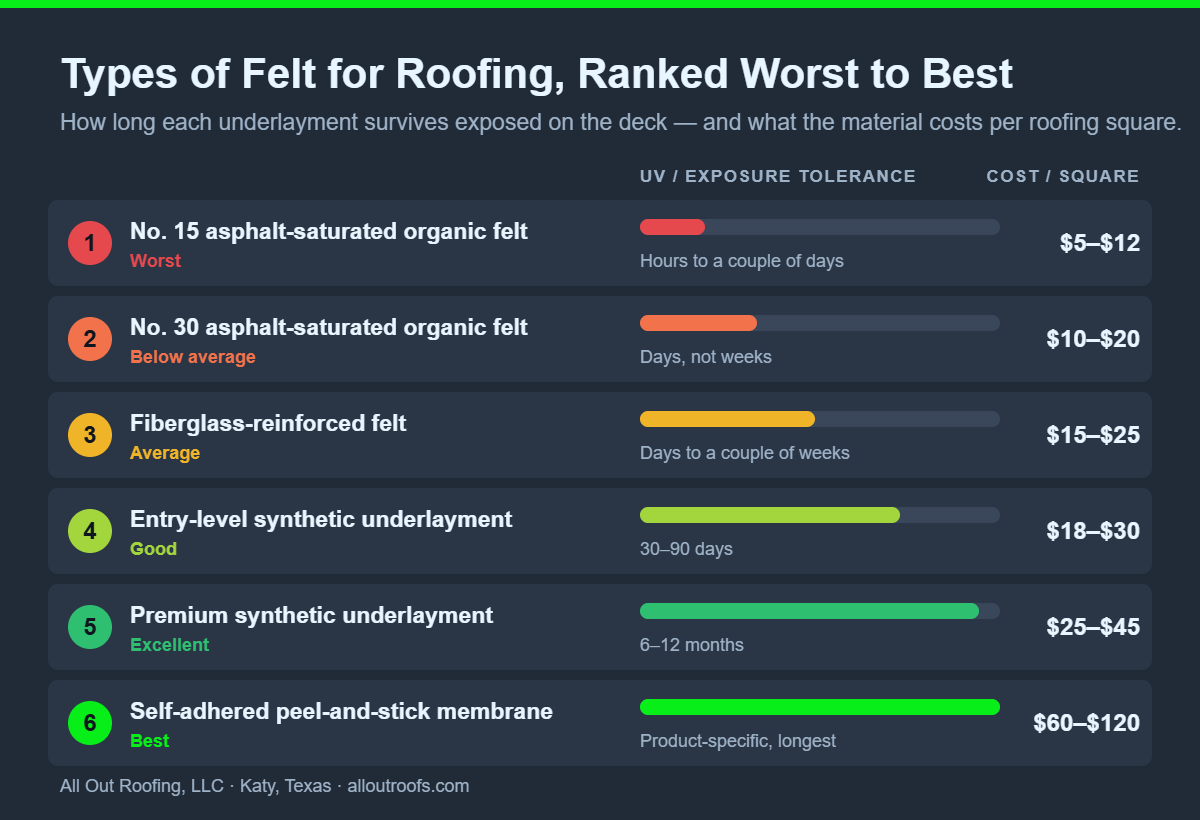
Here is every option ranked the way we would spec it on a Katy roof: worst on top, best on the bottom. Notice that synthetic roof underlayment takes two of the top three spots.
| Rank | Type of Felt / Underlayment | What It Is | Weight & Coverage | UV / Exposure Tolerance | Tear & Wind Performance | Typical Material Cost | Verdict |
|---|---|---|---|---|---|---|---|
| 1 | No. 15 asphalt-saturated organic felt Worst | The classic black “tar paper.” A cellulose/paper mat saturated in asphalt. Meets ASTM D226 Type I or ASTM D4869 Type I. | About 8–13 lbs per square today (ASTM D4869 sets roughly 34.6 lbs for a 4-square roll). One roll covers about 400 sq. ft. | Hours to a couple of days. Dries out, curls, and buckles fast in Texas sun. | Poor. Tears around fasteners, rips in wind, and staples pull through easily. | $5–$12 / square | Meets minimum code and nothing more. Cheapest bid material — and the reason so many “new” roofs leak at the first blow-off. |
| 2 | No. 30 asphalt-saturated organic felt Below average | Same organic-mat construction, roughly twice as heavy. ASTM D226 Type II / ASTM D4869 Type IV. | About 20–26 lbs per square (ASTM D4869 sets roughly 43.2 lbs for a 2-square roll). One roll covers about 200 sq. ft. | Days, not weeks. Better than No. 15 but still degrades in sustained sun. | Fair. Noticeably tougher underfoot and around nails than No. 15. | $10–$20 / square | A real upgrade over No. 15 and still common on tile and metal jobs — but it absorbs water, wrinkles, and is heavy to install correctly. Of the felts still sold by the pallet in Texas, this is the most common step up off the bottom rung. |
| 3 | Fiberglass-reinforced (inorganic) felt Average | Asphalt felt built on a fiberglass mat instead of paper. Meets ASTM D6757. | Sold in 15- and 30-style weights; typically 200–400 sq. ft. per roll. | Days to a couple of weeks depending on product. | Good. The glass mat resists the wrinkling and moisture-buckling that plagues organic felt. | $15–$25 / square | The best version of traditional felt. If a felt roof is what you want, this is the felt to ask for by name. |
| 4 | Entry-level synthetic underlayment Good | Woven or spun polypropylene/polyethylene sheet. Lightweight, no asphalt. | Extremely light — around 3–6 lbs per square. Rolls commonly cover 1,000 sq. ft. | Typically 30–90 days of rated UV exposure. | Very good. Won’t tear at fasteners the way felt does; wind-resistant when cap-nailed. | $18–$30 / square | Even a budget synthetic outperforms most felt. Watch out for slick, unrated sheets — traction and a published ASTM listing matter. This is the first synthetic roof underlayment on the list, and the first product that is not asphalt on a mat. It shows in the exposure rating. |
| 5 | Premium synthetic underlayment Excellent | Heavier polymer sheet with a slip-resistant walking surface and a published standard (ASTM D8257) or ICC-ES report. | Around 5–10 lbs per square; rolls cover 1,000 sq. ft. and lay flat with no buckling. | Commonly 6–12 months of rated exposure. | Excellent. High tear strength, superior fastener holding, stays put in high wind. | $25–$45 / square | The right default for a modern shingle roof in the Houston area. Lays flat, walks safe, and survives a delay between tear-off and shingle-out. |
| 6 | Self-adhered (peel-and-stick) polymer-modified bitumen Best | Rubberized asphalt membrane with a full adhesive backing that bonds directly to the deck. Meets ASTM D1970. Often called “ice and water shield.” | Heaviest of the group; rolls typically cover 200 sq. ft. | Varies by product — usually 30–180 days, and some are rated for high-temperature roofs. | Best in class. Seals around every nail and fastener; nothing gets under it. | $60–$120 / square | The strongest waterproofing money buys. Full-deck coverage is premium-priced, so most quality roofs use it strategically (see below). The strongest product on this list, and the reason we spec it in valleys, at eaves, and around penetrations. |
Two things jump out of that table. The first three products are all asphalt on a mat, and the real jump in performance happens when you leave that family behind entirely.
What we actually recommend on a Houston-area roof: a hybrid. Self-adhered ASTM D1970 membrane in the valleys, along the eaves, in roof-to-wall transitions, and around every penetration — chimneys, skylights, pipe boots, and low-slope tie-ins. Then a premium synthetic roof underlayment across the entire field of the roof.
That combination puts the strongest, most expensive material exactly where most leaks start, and a fast, flat, high-tear product everywhere else. You get better performance than a full peel-and-stick deck at a fraction of the cost difference.
15 lb vs. 30 lb Felt: Does the Weight Really Matter?
Yes — but not as much as the material family. Going from No. 15 to No. 30 felt roughly doubles the thickness and meaningfully improves tear resistance and handling. What it does not fix is the fundamental weakness of an organic felt mat: it absorbs moisture, it buckles when it gets damp, and it dries out and gets brittle in attic-driven heat.
Put another way: weight moves you up a rung inside one family, but it never moves you between families. That is why we rank underlayment by material first and weight second on every roof replacement in Katy we quote.
One more thing homeowners rarely hear: the “15 lb” and “30 lb” names come from a time when those rolls actually weighed 15 and 30 pounds per square. Most modern felt is significantly lighter than its label suggests. If a bid says “30 lb felt,” it’s worth asking which ASTM standard the product meets, because the number on the wrapper isn’t the spec.
Synthetic Roof Underlayment vs. Felt: The Real Decision
Most bids come down to these two. Here’s the honest breakdown:
- Water performance: Felt is water-resistant, not waterproof, and it will absorb and wick moisture. Synthetics shed water and don’t absorb it. Advantage: synthetic.
- Heat: Roof deck temperatures in a Texas summer routinely exceed 150°F. Asphalt felt loses its volatile oils and gets brittle. Polymer synthetics don’t. Advantage: synthetic.
- Tear and wind: Felt tears at fasteners; that’s how underlayment blows off between tear-off and dry-in. Synthetics have several times the tear strength. Advantage: synthetic.
- Coverage and labor: A synthetic roll covers roughly 1,000 sq. ft. versus 200–400 for felt, with fewer seams and less weight to carry up a ladder. Advantage: synthetic.
- Safety: Quality synthetics have an engineered slip-resistant walking surface. Wet felt is genuinely dangerous. Advantage: synthetic — but only for products that are actually rated for traction.
- Cost: Felt is cheaper per square. On an average 30-square roof, upgrading from No. 15 felt to a premium synthetic is a few hundred dollars on a project that costs many thousands. Advantage: felt, marginally — and it’s the wrong place to save.
- Breathability: Felt has a higher perm rating and lets a small amount of vapor pass. Most synthetics are non-permeable, which is a non-issue on a properly ventilated attic and a real issue on an unvented or poorly vented one. Advantage: situational — this is a question for your roofer, not a product spec sheet.
If you only compare two products on a bid, compare No. 15 felt and a synthetic roof underlayment. Premium synthetics such as CertainTeed RoofRunner are built to resist UV and weathering while the roof is open; organic felt is meant to be covered within days. Check the exposure limit on the specific product’s data sheet.
When Synthetic Roof Underlayment Is Not the Answer
We put synthetic on most of the shingle roofs we replace. That does not make it right for every house, and a roofer who says it always wins is selling you a product, not a system. Here is where it goes wrong.
- A poorly vented attic. Most synthetic roof underlayment is a vapor barrier. Felt lets a little moisture pass; synthetic does not. On a Katy attic with blocked soffits and a couple of turtle vents, that moisture has nowhere to go and condenses on the underside of the decking. Fix the ventilation first. Our guide to attic ventilation requirements in Harris and Fort Bend County covers what a reroof should include.
- Cheap, unrated sheets. A bargain synthetic with no published ASTM D8257 listing or ICC-ES report can be slick underfoot and thin at the fasteners. A premium felt beats a mystery synthetic.
- Sloppy fastening. Synthetic has to go down tight and be cap-nailed on the manufacturer’s pattern. Laid loose on a hot afternoon, it ripples, and those ripples telegraph through the shingles.
- Too long in the sun. The six to twelve month exposure rating is a ceiling, not a target. If a job stalls longer than that, the sheet needs to be checked before shingles go on.
- Hot roofs and valleys. Under metal, tile, and in every valley, a high-temperature self-adhered membrane does a job no mechanically fastened sheet can, because it seals around each nail.
None of this is a reason to avoid synthetic roof underlayment. It is a reason to ask how your roofer is installing it, and whether the attic can breathe once it is down. If you want to see how the underlayment fits with the rest of the assembly, our walk-through of what is under your shingles and the residential roofing system explained cover the other layers.
What the Building Code Requires
Under the International Residential Code, underlayment for asphalt shingles must comply with a recognized standard — historically ASTM D226 Type I, ASTM D4869 Type I, or ASTM D6757, with ASTM D8257 added to cover mechanically attached synthetic roof underlayment in the 2024 IRC underlayment table. A few requirements worth knowing:
- Low-slope roofs (2:12 up to 4:12) require a doubled underlayment application, not a single layer.
- High-wind areas carry additional fastening requirements, including corrosion-resistant cap fasteners on a specified grid rather than staples.
- Local amendments vary. Katy, Fulshear, Houston, and unincorporated Fort Bend and Harris County don’t all adopt the same code edition or the same amendments. Your roofer should know which one applies to your address.
Code sets the floor, not the ceiling. Most felt sold in Texas clears ASTM D226 on paper, and that tells you very little about how the material behaves in year eight of an attic that runs 140 degrees.
Note that code sets the floor, not the target. A No. 15 felt roof can be perfectly code-compliant and still be the weakest assembly on your street.
How Long Can Roofing Felt Be Left Exposed?
Far less time than most people assume. Organic felt should be covered essentially the same day — leave it out over a rainy weekend and you’ll get wrinkling, buckling, and telegraphing through the finished shingles. Fiberglass-reinforced felt buys you a little more. Premium synthetics are typically rated for six to twelve months of exposure, which is why they’re the right call any time weather, material delays, or an insurance claim could stretch out the schedule.
Exposure rating is the fastest honest way to sort roofing felt and synthetic roof underlayment by quality, because it is the one number manufacturers publish and stand behind. It is also the number that decides whether a surprise storm mid-job turns into a roof leak repair.
This matters more than it sounds during storm season. If your roof gets dried in and then the job pauses waiting on an adjuster or a material shipment, the underlayment underneath is the only thing protecting your home.
The Bottom Line
If you’re comparing bids, don’t just compare shingle brands and warranty lengths. Ask three questions about underlayment:
- Which product, by name and ASTM standard? “Felt” and “synthetic” are categories, not specs.
- Where is peel-and-stick being used? Valleys, eaves, wall transitions, and penetrations at minimum.
- How is it being fastened? Plastic cap nails, not staples — especially in a wind zone.
The short version: felt and synthetic roof underlayment are not interchangeable, and the cheapest one on the bid is the one most likely to cost you a ceiling. Worth reading next – how roofing warranties actually work, because underlayment choice can affect coverage.
A contractor who can answer all three quickly and specifically is telling you a lot about how the rest of your roof is going to get built.
Not Sure What’s Under Your Shingles?
All Out Roofing installs and inspects roofs across Katy, Fulshear, and the greater Houston area. We’ll tell you exactly what’s on your roof — and what should be — with a free, no-pressure inspection.
Part of that inspection is identifying whether felt or synthetic roof underlayment is actually under your shingles, and whether it is still doing its job.
All Out Roofing, LLC · 25220 Kingsland Blvd, Ste 100, Katy, TX 77494
Frequently Asked Questions
Is synthetic roof underlayment worth it on a Katy roof?
On most shingle roofs, yes. It costs a few hundred dollars more than No. 15 felt on a typical 30-square roof, it survives a delayed job, and it does not cook in a Texas attic the way asphalt felt does. The exception is a house with poor attic ventilation, where the ventilation needs fixing first.
Is roofing felt waterproof?
No. Asphalt-saturated felt is water-resistant, meaning it sheds water for a limited time but will absorb moisture and wick it if it stays wet. Only self-adhered polymer-modified bitumen membranes (ASTM D1970) are genuinely waterproof, because they bond to the deck and seal around every fastener.
What’s the difference between roofing felt and tar paper?
They’re the same thing. “Tar paper” is the old jobsite name for asphalt-saturated felt. Modern product is saturated with asphalt, not coal tar, but the nickname stuck.
Do I need felt under a new roof, or can it be skipped?
You need underlayment. It’s a code requirement under asphalt shingles, most shingle manufacturers require it for warranty coverage, and skipping it removes the only secondary water barrier your roof has. A bid that omits underlayment isn’t a bargain.
Is felt or synthetic underlayment better under a metal roof?
Metal roofs run hotter and move more with temperature swings, so high-temperature-rated self-adhered membrane or a high-temp synthetic is generally the better choice than standard felt. If felt is used, No. 30 is the minimum, and it should be paired with peel-and-stick in valleys and at penetrations.
Does upgrading the underlayment affect my shingle warranty?
It can. Most manufacturers require underlayment that meets a recognized standard, and some enhanced warranty tiers require specific accessory products installed as a system. Any roofer quoting an enhanced warranty should be able to show you which underlayment that warranty requires.
How much does it cost to upgrade from felt to synthetic underlayment?
On a typical 30-square residential roof, moving from No. 15 felt to a premium synthetic usually adds a few hundred dollars to the project — a small fraction of total roof cost for a meaningful jump in tear strength, exposure tolerance, and long-term water protection.
Still deciding? Compare the underlayment on your own bid against the table above, and ask your contractor to put the product name and ASTM standard in writing.