
The attic ventilation requirements in the building code come from IRC Section R806.2, which requires 1 square foot of net free vent area for every 150 square feet of attic floor space — cut in half to 1:300 if the vents are properly balanced between soffit and ridge. Whether that standard is actually enforced on your Harris or Fort Bend County home depends less on the code itself and more on whether you live inside a city that runs residential plan review, since neither county does that for typical single-family reroofing.
The IRC Attic Ventilation Requirements: 1:150 vs 1:300 Explained
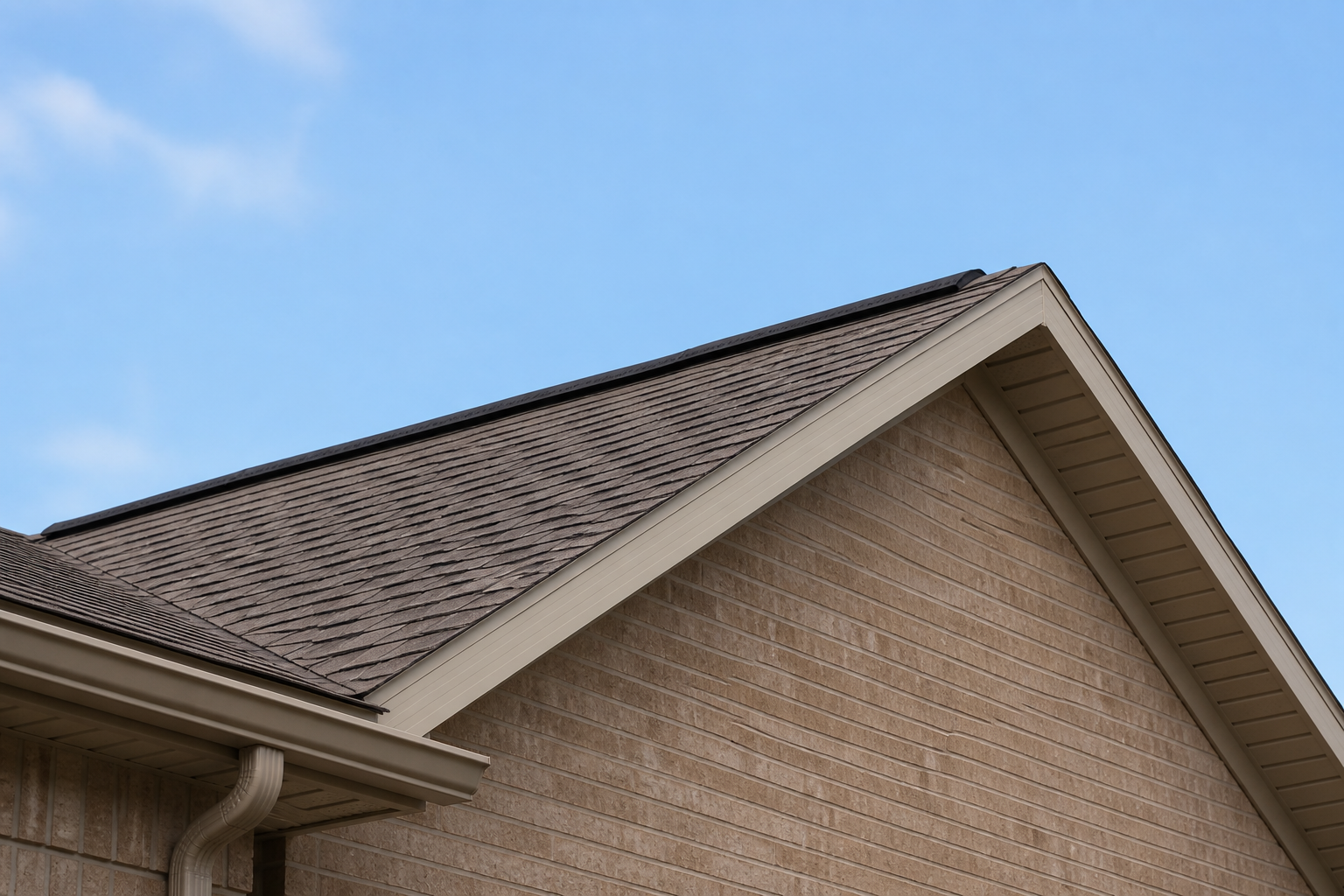
The International Residential Code sets the baseline in Section R806.2, minimum vent area: the minimum net free ventilating area must equal at least 1/150 of the area of the vented attic space. That ratio can be cut in half, to 1/300, if either of two conditions is met: a Class I or II vapor retarder is installed on the warm side of the ceiling (a pathway aimed at cold climates, not really relevant to Katy or Houston), or at least 40-50% of the required vent area sits in the upper portion of the attic — within 3 feet of the ridge — with the rest provided by eave or soffit vents. For a 1,500 square foot attic, that’s roughly 10 square feet of net free vent area at 1/150, or 5 square feet at 1/300.
Why Most Katy and Houston Homes Qualify for 1:300
The balanced-vent pathway to 1/300 is exactly how most modern ridge-vent-and-soffit-vent systems are designed, which is why most newer homes in our area are built to that standard rather than the stricter 1/150. It’s also why a roof with a ridge vent but blocked, painted-over, or missing soffit vents can fall out of code compliance even though a ridge vent is visibly present — the system only works, and only meets the reduced ratio, when both the intake and exhaust sides are actually open.
Does Unincorporated Harris County Enforce the Attic Ventilation Requirements?
Harris County has adopted the 2018 International Building Code, but only Chapters 2 through 10 — the commercial-oriented sections — with county amendments, and it does not run a general residential plan-review or permitting process for typical single-family reroofing outside a mapped floodplain, a point we cover in more depth in our guide to roof permit requirements in the Katy area. In practice, that means unincorporated Harris County isn’t inspecting your attic ventilation ratio on a routine reroof the way an incorporated city’s building department would.
Does Unincorporated Fort Bend County Enforce This?
The attic ventilation requirements are a different matter again one county west. Fort Bend County’s most recent published code adoption we could confirm covers the fire code (2021 International Fire Code, adopted for unincorporated areas in October 2023) rather than a general residential building code for single-family construction. As with Harris County, unincorporated Fort Bend County does not appear to run routine plan review or permitting for standard shingle reroofing, so the IRC ventilation ratio isn’t something a county inspector is checking on a typical job there either.
What About Houston, Katy, Sugar Land, and Other Cities?
Incorporated cities are a different story. The City of Houston has adopted the 2021 International Residential Code, which includes the R806.2 ventilation standard described above, and enforces it through its own permitting and inspection process. The City of Katy requires a permit for roof replacement as well (see our permit guide above for the details on that). If your home sits inside city limits anywhere in our service area, the ventilation ratio isn’t just an industry best practice — it’s an enforceable code requirement tied to your permit and final inspection.
Attic Ventilation Requirements: Enforcement by Jurisdiction
| Jurisdiction | Residential Plan Review for Reroofing? | IRC Ventilation Ratio Enforced? |
|---|---|---|
| City of Houston | Yes | Yes — 2021 IRC adopted |
| City of Katy | Yes (permit required) | Enforced through permit/inspection process |
| Unincorporated Harris County | No, outside floodplain | Not routinely inspected |
| Unincorporated Fort Bend County | No, outside floodplain/structural triggers | Not routinely inspected |
Why Manufacturers Enforce Ventilation Code Even When the County Doesn’t
Even where a county isn’t checking, your shingle manufacturer usually is, in effect. Full manufacturer warranties on architectural shingles are commonly conditioned on adequate attic ventilation meeting code-equivalent standards, since inadequate ventilation is one of the most common causes of premature shingle failure and can void warranty coverage regardless of where you live. The Department of Energy’s Building America program treats air sealing, insulating and venting attics as one combined strategy in hot climates, which is a useful frame if you are deciding what to spend on first. We go into how that warranty connection works in our full guide to attic ventilation methods that work in Texas heat, including the intake-versus-exhaust balance, and the symptoms to look for are covered in attic ventilation problems: the signs homeowners miss.
What We See in the Field
Almost every attic we open up in a home outside city limits has never had its ventilation ratio checked by anyone — it was whatever the original builder installed, sometimes correctly, sometimes not. We measure the actual attic square footage and existing net free vent area on every full inspection, not just a visual check for a ridge vent, because a roof can look properly ventilated from the ground and still fall well short of 1/300 once the soffit vents are counted (or found painted shut). That’s usually the difference between a roof that lasts its full warranty life and one that doesn’t.
Related All Out Roofing Resources
- Best Shingles for Texas Heat: A Contractor’s Comparison
- Attic Ventilation Problems: The Signs Homeowners Miss
- Roof Ventilation Services
- Roofing Services in Houston, TX
Frequently Asked Questions
Do I need a permit to fix my attic ventilation in unincorporated Harris or Fort Bend County?
Typically no, for the same reason routine reroofing usually doesn’t require one in those unincorporated areas — see our permit guide for the full jurisdiction breakdown.
How do I know if my attic meets the 1:300 ratio?
It requires measuring your actual attic floor area and adding up the net free area of every existing vent, intake and exhaust. This isn’t a visual estimate — we calculate it as part of a full roof inspection.
Can a ridge vent alone meet code?
No. A ridge vent only provides the exhaust side of the system. Without adequate intake (typically soffit vents), the system doesn’t achieve balanced airflow and won’t meet the 1/300 ratio even with a properly sized ridge vent installed.
Does inadequate ventilation void my shingle warranty?
It can. Most manufacturer warranties include ventilation requirements, and a claim can be denied or reduced if an inspection finds the attic was inadequately ventilated, regardless of what caused the shingle failure.
Does this code apply the same way to a repair versus a full replacement?
Ventilation is typically evaluated and corrected as part of a full replacement, when the roof deck is exposed and vents can be added or corrected. A repair to an isolated area usually doesn’t trigger a full ventilation review.
Not sure if your attic actually meets the ventilation ratio your shingles need? Schedule a free inspection and we’ll measure it and show you the numbers. Call (281) 769-4282.
By the All Out Roofing Team