How to Choose the Right Roofing Contractor
A Katy & Houston Homeowner’s Guide to Hiring with Confidence
The questions to ask a roofer before you hire one matter more in Texas than almost anywhere else. Between hurricane season, regular hail through Katy and Cypress, and a state that still does not license residential roofers, homeowners here carry more of the vetting burden than they should.
This guide is what we tell friends, family and neighbors when they ask how not to get burned: what to verify, what to ask, and which answers should send you looking for someone else. If you want the shorter, Katy-specific version, start with our guide on how to choose a roofer in Katy.
The Texas Roofing License Reality Most Homeowners Don’t Know
Here is the single most important fact for anyone hiring a roofer in Katy, Fulshear, Houston, or anywhere else in Texas:
Texas does not license residential roofing contractors.
There is no state license. The Roofing Contractors Association of Texas offers a voluntary registration (RCAT), and that’s it. Anyone with a pickup truck and a ladder can call themselves a roofer in Fort Bend or Harris County tomorrow morning.
This is why the checklist below matters more here than in states with mandatory licensing. In Texas, the credentials you should be checking are insurance, manufacturer certifications, local track record, and physical business presence — not a state license number, because there isn’t one to check.
Start with Insurance — And Verify It Directly
Ask any roofer for:
- General liability insurance (ask what the limits are, and make sure they make sense for the size of your job)
- Workers’ compensation coverage for every person who will set foot on your roof
Then — and this is the step most homeowners skip — call the insurance agent listed on the certificate. Ask them to confirm the policy is active. It takes three minutes. Fake or expired certificates are one of the most common issues we see when we audit a competitor’s proposal for a neighbor.
If a roofer has no coverage for the crew and someone is hurt on your property, you do not want to find out the hard way what that means for you. Ask, and get the answer in writing.
Red flag: “We’re a small company, we don’t carry workers’ comp.” Walk away.
Manufacturer Certifications — What They Actually Mean
Owens Corning, CertainTeed, GAF, and Malarkey all run certification programs. They matter because:
- Certifications require passing installation audits, not just paying a fee.
- Certified contractors can offer enhanced non-prorated warranties (labor plus materials) that non-certified contractors literally cannot sell you, even if they use the same shingles.
- If a manufacturer’s warranty is ever invoked, they’ll investigate the installer. Non-certified installs get denied constantly.
For example, an Owens Corning Preferred or Platinum Preferred contractor can register your roof for the Owens Corning Total Protection Roofing System warranty. A non-certified installer cannot — regardless of what they promise on the estimate. CertainTeed’s Master Craftsman and Select ShingleMaster programs work the same way, with system-level warranties that require certified installation.
Ask: “Are you certified with the manufacturer whose shingles you’re installing? Can I see the certificate?” Then verify it on the manufacturer’s website — every major brand has a “find a certified contractor” tool.
Local Presence — Not Just a Local Phone Number
After every major Gulf Coast storm — the May 2024 derecho, Hurricane Beryl in July 2024, every hail event that hits Cypress and Katy — dozens of out-of-state contractors flood the Houston market. They rent a mailbox in a UPS store, buy a local phone number, and knock doors for six months.
Here’s what to verify:
- Physical address you can drive to. Not a PO box, not a virtual office. Ask for the street address and drive past it.
- How long they’ve been at that address. A domain registered last month with a Fort Bend County address that also houses seven other LLCs is a storm chaser.
- Google Business Profile with review history spanning years, not weeks. Look at review dates, not just star count. A five-star average built entirely in the last 90 days after a hail storm is a pattern.
- Better Business Bureau accreditation and history — specifically for the Texas entity, not a parent company in another state.
Red flag: A door-knocker who “just happened to be in your neighborhood” after a storm and needs a signed contract today.
Understand What a Real Roof Inspection Looks Like
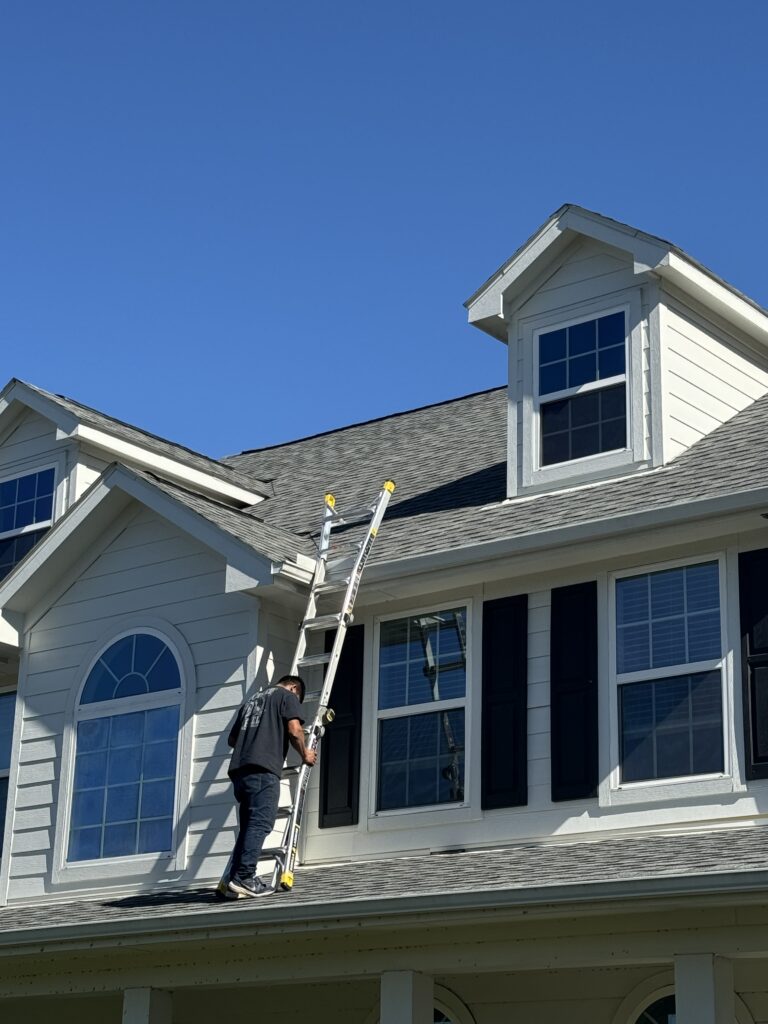
A proper Katy-area roof inspection takes 45 minutes to two hours depending on roof size and access. Here is what should happen:
On the roof:
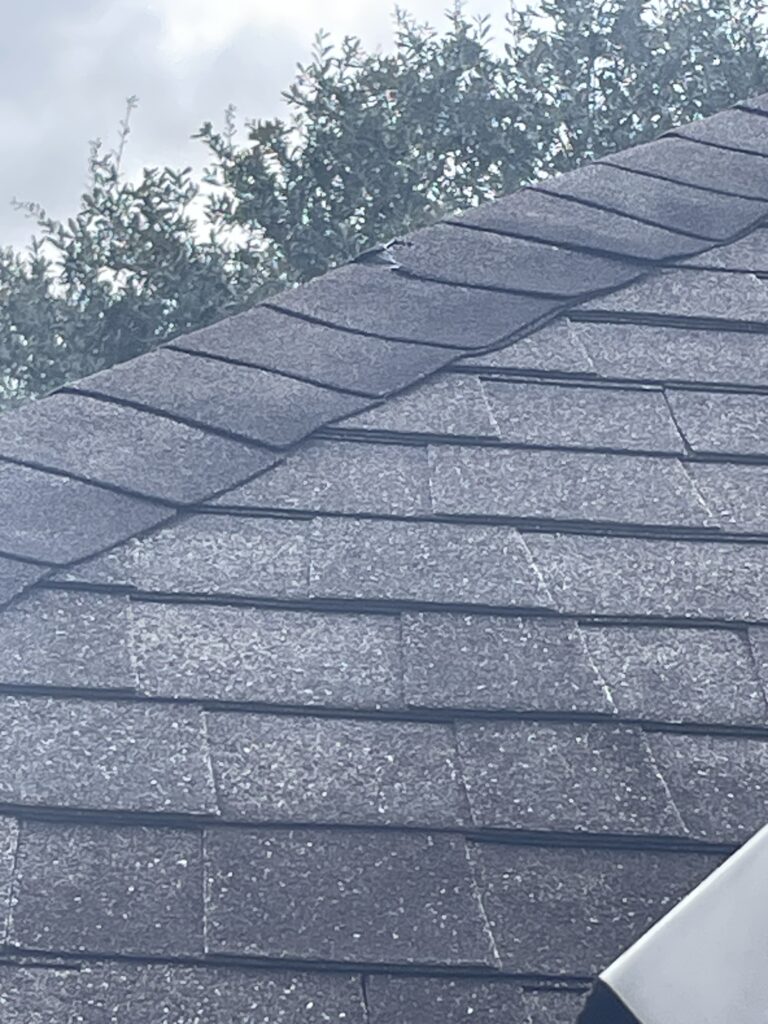
- Shingle condition, granule loss, seal integrity, and hail bruising documented photo-by-photo
- Flashing at every chimney, wall, valley, and penetration
- Ridge cap and hip cap condition
- Any prior repairs and how they were done
- Nail pattern (are the shingles nailed to spec — usually six nails in high-wind zones like ours?)
In the attic:
- Decking condition (is anything sagging, wet, or rotted?)
- Underlayment visible from below at problem areas
- Ventilation intake at eaves and exhaust at ridge — and whether the net free area math actually works (our guide to attic ventilation requirements in Harris and Fort Bend covers what the code asks for, and most shingle makers want intake and exhaust in balance)
- Insulation depth and any moisture staining on the underside of the decking
- Bathroom and dryer vent terminations — they should exit the roof, not dump into the attic (extremely common in Katy tract homes built 1995–2010)
If a contractor never opens the attic hatch, they didn’t inspect your roof. They looked at your shingles.
The Ventilation Question Nobody Asks
This is one of the most common things done wrong on Houston-area roof replacements, and poor ventilation can put a manufacturer warranty at risk.
Ask specifically: “How will you address ventilation on my roof, and what’s the intake-to-exhaust balance you’re targeting?”
A qualified answer sounds like: “You’ve got continuous soffit intake at 9 square inches per linear foot, and we’re replacing your box vents with a ridge vent that provides X square inches of exhaust. That gives us a balanced 50/50 system, which meets Owens Corning’s warranty requirements.”
An unqualified answer sounds like: “We’ll put some vents up there.”
Improper ventilation in the Houston climate causes:
- Shingles that wear out well before their rated life
- A hotter attic, which is hard on HVAC ducts and raises cooling costs
- Moisture accumulation, decking rot, and mold
Beware “Too Good to Be True” Pricing
Price depends on pitch, layers to tear off, decking condition and the shingle line. Our Texas roof replacement cost guide lays out current ranges and what moves them.
When one bid comes in far below the others for the same house, it usually means one or more of the following was skipped:
- Ice & water shield in valleys and around penetrations
- Full synthetic underlayment (vs. felt)
- Drip edge (required by code but frequently omitted)
- Starter strip (a critical, cheap component that fails first when skipped)
- Any decking replacement — priced at $0 in the estimate with the assumption they’ll upcharge you mid-project
- Proper ventilation retrofit
- Real workmanship warranty
Get three detailed line-item estimates. The middle bid is usually — but not always — the honest one. What you’re looking for is transparency, not the lowest number.
Five Questions to Ask a Roofer Before You Sign
These are the questions to ask a roofer every time, in this order:
- “Who will be my project manager, and will they be on-site during tear-off and dry-in?” — There should be a name, and that person should show up.
- “Walk me through your warranty. What’s covered by the manufacturer, what’s covered by you, and for how long?” — They should distinguish material vs. labor warranty without hesitation.
- “How will you handle ventilation on my specific roof?” — See section above.
- “What happens if there’s a leak six months after installation?” — Real answer: “Call us, we come out, we fix it under our workmanship warranty at no charge.” Bad answer: any hedging.
- “Can I have three references from jobs completed in this ZIP code within the last twelve months?” — Then call two of them.
The way they answer these — clear vs. evasive, specific vs. generic — tells you more than any brochure.
Storm Damage & Insurance Claims: What to Watch For
If you’re calling roofers because a storm hit, here’s what a professional does and doesn’t do:
A professional will:
- Document damage with dated, geotagged photos before you file
- Explain your policy’s replacement cost value vs. actual cash value provisions
- Meet the adjuster on your roof and advocate for a fair scope
- Tarp or dry-in your roof at no charge to prevent further damage while the claim is processed
- Provide a Xactimate-format estimate that speaks the adjuster’s language
A professional will not:
- Guarantee your claim will be approved
- Ask you to sign a contract before an inspection
- Offer to “waive your deductible” — this is illegal in Texas under Insurance Code §707
- Pressure you to file a claim you’re not sure about
- Say things like “insurance will pay for everything, don’t worry about the paperwork”
The deductible waiver pitch is the fastest way to identify a contractor you should not hire. It’s also fraud you can be pulled into as the homeowner.
HOA & Master-Planned Community Considerations (Katy/Fulshear Specific)
If you live in Cinco Ranch, Cross Creek Ranch, Firethorne, Cane Island, Fulshear Run, Weston Lakes, or any of the master-planned communities out here, your HOA almost certainly:
- Has an approved shingle color list
- Requires architectural review before the roof is replaced
- May require specific shingle brands or minimum warranty tiers
- Has a submission process that takes 2–4 weeks
A local contractor knows this and will handle the submission for you. An out-of-town roofer will start tearing off shingles and get you a violation letter. Ask specifically: “Have you submitted ARC packages for [my community] before?”
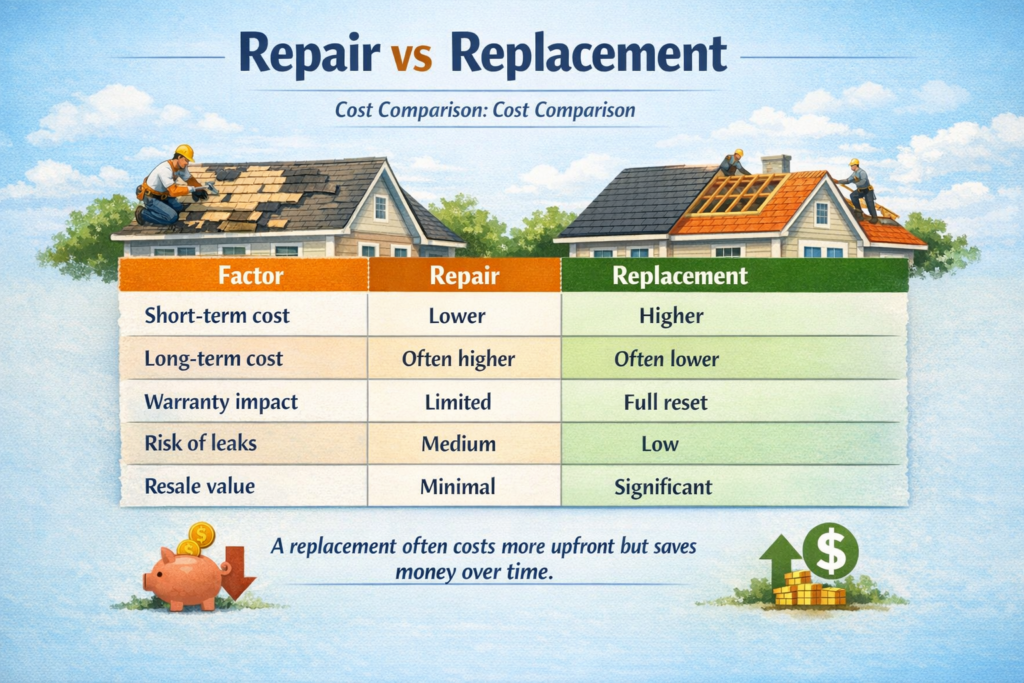
Repair vs. Replacement — The Honesty Test
If every contractor who inspects your roof says you need a full replacement, get a fourth opinion — especially if your roof is under 15 years old and hasn’t been through a major hail event.
A trustworthy contractor will tell you when a repair makes more sense. When a roof legitimately has years of life left, the honest answer is a repair and a return visit later. That conversation is what a workmanship reputation is built on in this market.
Workmanship Warranty — Read It, Don’t Just Nod
Every reputable Houston-area roofer offers some form of workmanship warranty. What varies wildly is:
- Length. 1 year is minimal. 5–10 years is standard for a Master Craftsman-level contractor. Lifetime workmanship warranties exist but read the fine print — they usually only cover the original homeowner and often exclude anything a manufacturer’s warranty covers.
- Transferability. If you sell within the warranty period, does it transfer? For most Katy homeowners who move within 7 years, this matters.
- What’s actually covered. Installation defects vs. any leak vs. any issue — huge differences.
- What voids it. Third-party work, satellite dish installs, and improper attic modifications commonly void workmanship warranties.
Get it in writing. If the warranty is verbal, it doesn’t exist.
Final Checklist: Before You Sign Anything
Before you sign a contract with any Houston-area roofing contractor, confirm:
- Certificate of general liability insurance verified with the agent by phone
- Workers’ comp certificate verified with the agent by phone
- Manufacturer certification verified on the manufacturer’s website
- Physical business address you have driven past
- Google Business Profile with review history over 12+ months
- Three references from your ZIP code within the last year — and you called two
- Written estimate itemizing: tear-off, decking allowance, underlayment type, ice & water shield, drip edge, starter strip, ridge/hip cap, ventilation plan, cleanup, and haul-off
- Ventilation plan explained in specifics (intake sq in, exhaust sq in, balance)
- Workmanship warranty in writing with length and transferability spelled out
- Payment schedule that does not require full payment before the job starts
- Contract signed by a named individual, not “management”
If every box is checked, you have done the work most homeowners skip. TDI’s own tips for avoiding contracting scams add two more: never sign a contract with blank spaces, and be wary of any contractor who wants a large or full down payment. For the tricks that show up after a storm, see our guide to roofing scams in Texas.
Frequently Asked Questions
Does Texas require a roofing license? No. As of 2026, Texas does not require a state-issued license for residential roofing contractors. Voluntary registration is available through the Roofing Contractors Association of Texas (RCAT), but it is not a legal requirement. This makes verifying insurance, manufacturer certifications, and local track record more important in Texas than in states with mandatory licensing.
How do I verify a roofing contractor’s insurance in Texas? Ask the contractor for certificates of general liability, then call the insurance agent listed on each certificate directly to confirm the policy is currently active. Do not accept a photocopy as sufficient verification.
Is it illegal for a roofer to waive my insurance deductible in Texas? Yes. Under Texas Insurance Code §707, it is illegal for a contractor to advertise or offer to pay, rebate, or waive an insurance deductible. Any contractor who offers this is proposing insurance fraud, and the homeowner can be held liable as a participant.
How long should a roof replacement take in the Houston area? Most residential roof replacements in Katy and Houston take 1–2 full days for a typical 2,500–3,000 sq ft home. Larger, steeper, or more complex roofs may take 3–4 days. Anyone quoting a half-day for a full tear-off and replacement is cutting corners.
Should I always choose the lowest roofing estimate? No. The lowest bid on a Houston-area roof replacement almost always excludes critical components — proper underlayment, ice & water shield, drip edge, adequate ventilation, or decking replacement allowances. Compare estimates line-by-line, not just totals.
Can a roofing contractor guarantee my insurance claim will be approved? No, and any contractor who guarantees claim approval is misleading you. Claim decisions are made by the insurance carrier’s adjuster. A qualified contractor can document damage professionally and provide a properly formatted estimate, but the outcome is never guaranteed.
What manufacturer certifications should I look for in a Texas roofer? Look for certifications from the manufacturer of the shingles being installed. Common credible programs include CertainTeed Master Craftsman and Select ShingleMaster, Owens Corning Preferred and Platinum Preferred, and GAF Master Elite. Certified contractors can register enhanced system warranties that non-certified contractors cannot offer.
How often should I have my roof inspected in the Houston area? Once per year at minimum, plus after any major storm event (winds over 50 mph or hail over 1 inch). Houston’s combination of heat, humidity, UV exposure, and severe weather ages roofs faster than most US markets.
Ready to Get a Second Opinion?
If you’ve already had a roofer out and something felt off, or you’re just starting the process and want a straight answer, we’ll come inspect your roof at no charge. We’ll open the attic, walk the whole roof, take photos, and tell you honestly whether you need a repair, a replacement, or nothing at all.
Call 281-769-4282 or request an inspection online.
Serving Katy, Fulshear, Cypress, Cinco Ranch, Cross Creek Ranch, Firethorne, Sugar Land, Richmond, Rosenberg, Missouri City, Spring, Tomball, Waller, and the greater Houston area.