Roofing scams in Texas follow the weather. A hailstorm rolls through Katy on a Tuesday, and by Thursday there are yard signs, flyers on doors and trucks with out-of-state plates working every street. Some of those crews are fine. Some are not, and the bad ones are good at sounding exactly like the good ones.
I run a roofing company in Katy, and I have spent a lot of time fixing roofs that someone else was paid to do. This guide covers the roofing scams we see most often, what Texas law actually says about them, and the simple checks that weed out most bad actors before you sign anything. None of this is meant to scare you off hiring a roofer. It is meant to help you hire the right one.
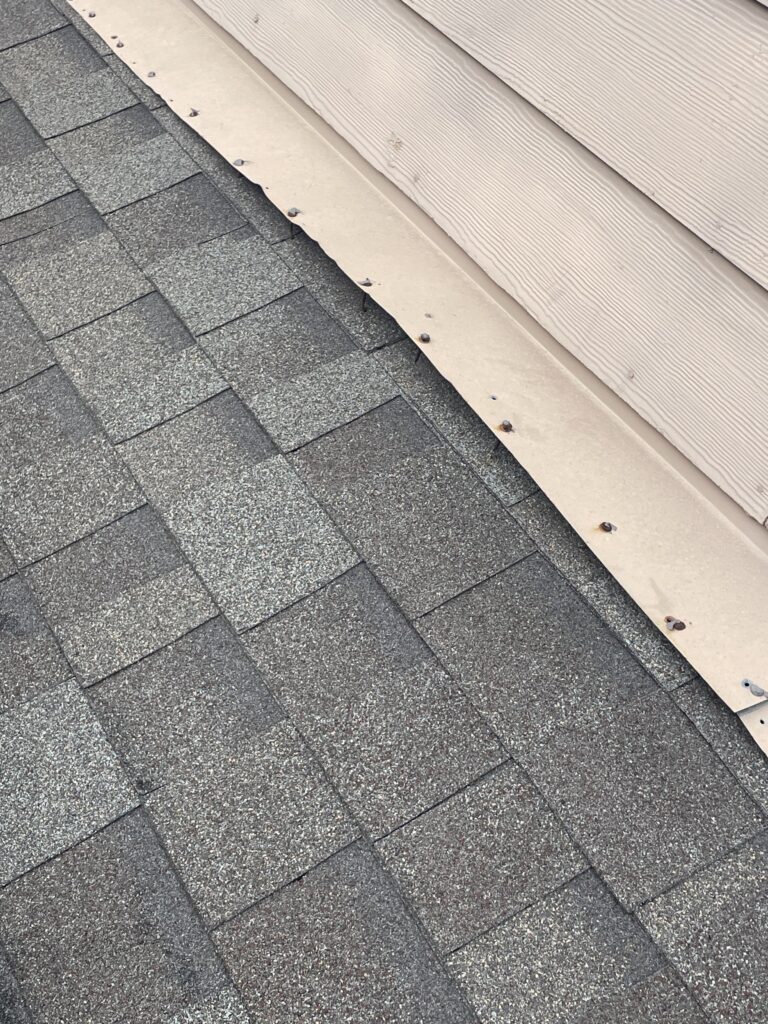
Why roofing scams spike after a Katy hailstorm
Storms create three things at once: real damage, insurance money and homeowners in a hurry. That mix is what draws in storm chasers. A crew can follow hail from city to city, sell as many roofs as possible in a few weeks, and be gone before the first leak shows up.
Our area gets hit often enough that this cycle repeats. Fulshear, Cinco Ranch, Cross Creek Ranch and the newer Katy subdivisions north of I-10 all see the same pattern after a big storm. A lot of roofs in those neighborhoods are the same age and were built by the same builders, so a canvasser can knock on fifty doors with one pitch.
Most roofing scams are not dramatic. They are small tricks in the paperwork, the payment schedule or the inspection. That is why they work.
Roofing scam #1: the “free roof” and the deductible waiver
The pitch goes like this: “Your insurance will cover it, and we will take care of your deductible.” It sounds generous. It is illegal in Texas.
The Texas Department of Insurance says plainly that it is against the law for a contractor to offer to waive an insurance deductible or to include the deductible amount in a bid. TDI also warns that your insurance company may ask for proof that you paid your deductible. So a roofer who “eats” your deductible is not doing you a favor. He is either padding the claim somewhere else or cutting corners on the roof to make the math work, and you are the one signing the claim.
There is no such thing as a free roof. If you want the details, our post on whether a roofer can waive your deductible in Texas walks through it.
Roofing scam #2: the contract dressed up as an estimate
This one catches careful people. A salesman finishes a quick look at the roof and hands you a tablet or a one-page form to “authorize the inspection” or “approve the estimate.” It is actually a contract.
TDI warns that scammers may call a contract an estimate or a release to get you to agree to work on your roof. Their advice is simple: read every page before you sign, and never sign a contract with blank spaces, because those can be filled in later with higher prices or different work.
Watch for one sentence in particular. TDI specifically says not to sign anything that reads “Homeowner agrees to the listed repairs for the value of insurance proceeds.” That language hands the contractor your entire insurance payment, whatever the actual work costs.
A real estimate lists the scope: how many squares, which shingle line, what happens to the decking, underlayment, drip edge, flashing and vents. If the paper in front of you only says “roof replacement per insurance,” it is not an estimate.
Roofing scam #3: big money up front
The oldest of the roofing scams is still the simplest. Take a large deposit “for materials,” then disappear, or show up weeks later with a different crew and cheaper shingles.
TDI tells homeowners to be wary of any contractor who asks for a large or full down payment. It also notes that after a disaster, it is against the law for out-of-town contractors to request a down payment before they start work. On the windstorm side, TDI’s guidance on making repairs after a storm lists contractors who accept only cash or require money before materials arrive on site as ones to avoid, and says not to make your final payment until the work is finished.
Payment terms tell you a lot about a company. A local roofer with an established supplier account does not need your money to buy shingles.
Roofing scam #4: damage that appears during the inspection
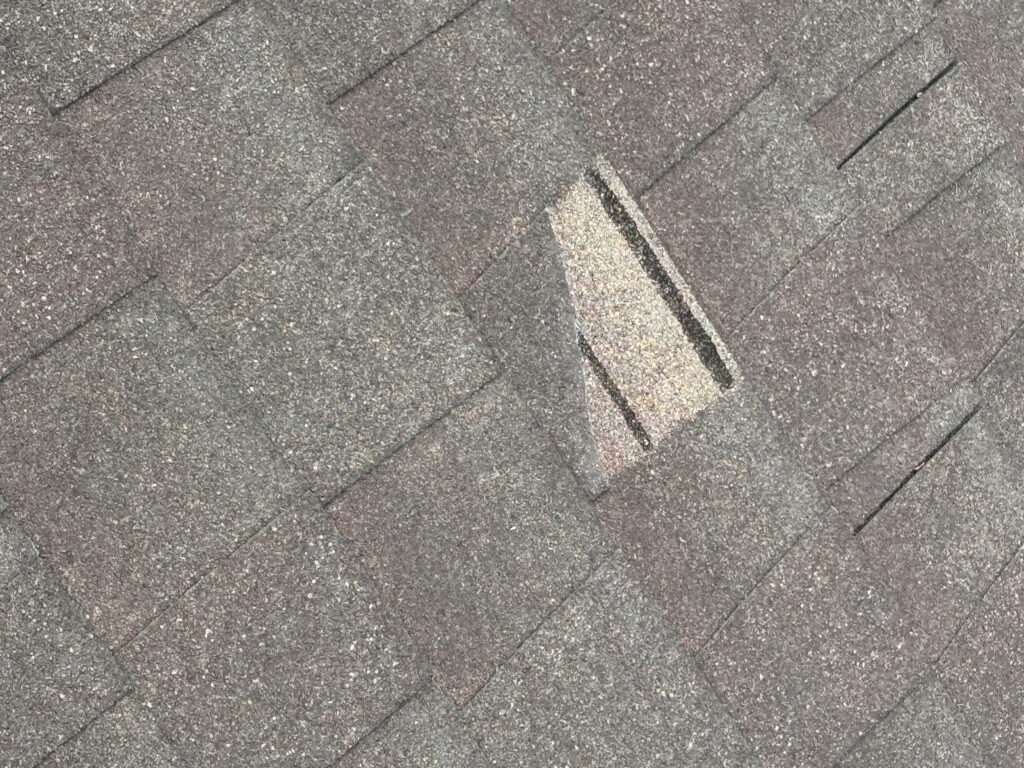
Most inspections are honest. But we do hear from homeowners who were shown photos of “hail hits” that turned out to be scuffs, foot traffic or blistering from age. In the worst cases, damage is made on the roof with a tool or a boot heel and then photographed.
You can protect yourself without climbing a ladder:
- Ask for photos that show where each mark is, not just close-ups. A wide shot of the slope, then the close-up, then a chalk circle around the spot.
- Look for damage on soft metals too. Real hail usually leaves marks on gutters, downspouts, vents and AC fins, not only on shingles.
- Ask whether every slope was checked, and why the “damage” is only on one.
- Get a second opinion before you file a claim if the first inspection felt rushed.
Filing a claim that was not needed can follow you. Our guide to whether to call your insurance company or a roofer first explains why.
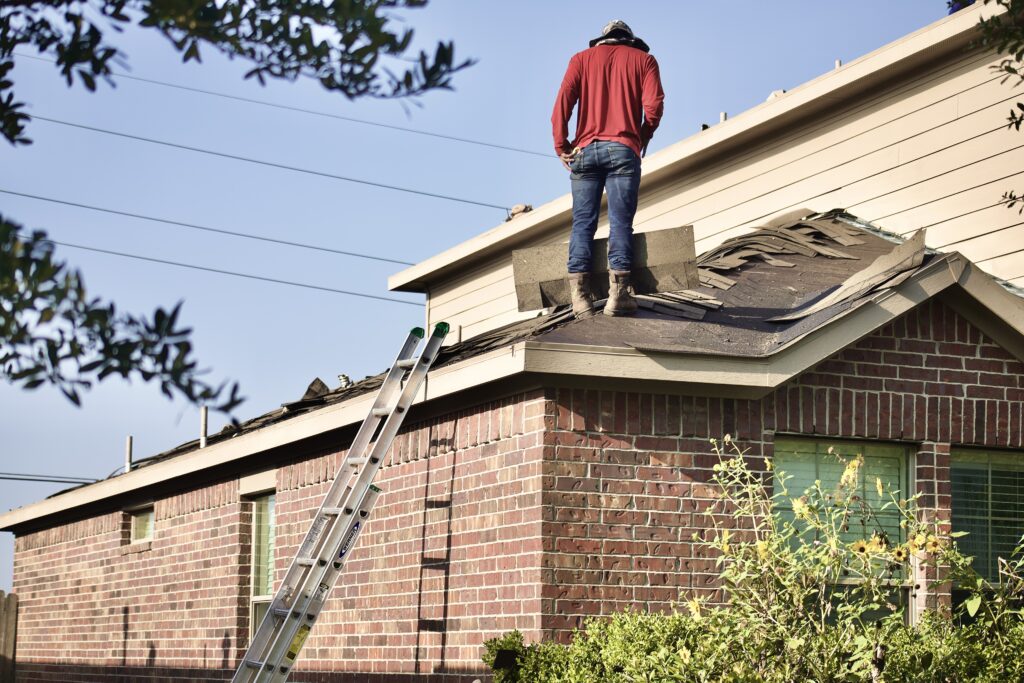
Roofing scam #5: the storm chaser who won’t be here next year
Some storm crews do decent installation work. The problem is what happens after. A workmanship warranty is only as good as the company that stands behind it, and a company with no local office is hard to find when a flashing detail starts leaking eighteen months later.
TDI’s list of contractors to avoid includes ones that have only out-of-state references, no local physical address, or are not established, along with contractors who go door-to-door offering repairs. Common signs on our streets:
- A truck with out-of-state plates and a magnetic sign
- A local phone number that forwards to a call center
- An “office” address that is a hotel, a mailbox store or an empty lot
- Reviews that all appeared in the same few weeks
- A company name that changed since the last storm
Reviews still help, but read them for dates and detail. Look for reviews from past years, not only last month, and look for the company on more than one site.
How to check a roofer before you sign
You do not need a law degree to avoid roofing scams. You need about thirty minutes and a few phone calls.
- Insurance. Ask for a certificate of liability insurance, and call the agent listed on it to confirm it is current. Ask about workers’ compensation or the equivalent coverage for the crew on your roof.
- A real address. Drive by it if you have to. A local office and a local supplier account are what make a warranty worth something.
- References you can call. Ask for two or three jobs in your part of town from more than a year ago, so you can hear how the roof has held up.
- More than one bid. TDI suggests at least three bids, on company letterhead with a phone number and address, so you can spot prices that are too high or too good to be true.
- The permit. Ask who pulls it. Whether one is required depends on your exact address; our guide on roof permits in Katy explains how to check.
- Manufacturer standing. Shingle makers certify installers, and those programs are easy to verify on the manufacturer’s own site.
What an honest roofer does differently
The easiest way to spot roofing scams is to know what normal looks like. A legitimate roofer will usually:
- Show you damage on the slope and in the gutters, and tell you when there is none
- Give you a written scope you can compare line by line with other bids
- Tell you to call your insurance agent before signing anything tied to a claim
- Collect payment on a schedule tied to work actually done
- Put the workmanship warranty in writing, with the company’s address on it
- Give you time to think
For the full process, start with our main guide on how to choose a roofer in Katy, then use our list of questions to ask a roofer before you hire one.
Already signed with a roofer you are unsure about?
Do not panic, and do not pay anything more yet. Then work through these steps:
- Read the whole document you signed, including the back and any fine print, and keep a copy.
- Call your insurance agent or adjuster and tell them which contractor is involved. Ask what they need from you.
- If a contractor offered to waive or cover your deductible, TDI says to find a new contractor and report it to the Texas Attorney General at 800-621-0508.
- For insurance questions, TDI’s help line is 800-252-3439.
- If something does not add up, an attorney can tell you what your contract actually commits you to. We cannot give legal advice, and you should not take it from a salesman either.
Most bad contracts are easier to deal with before work starts than after the old roof is in a dumpster.
Not every knock on the door is a roofing scam
To be fair, plenty of honest companies canvass after a storm, and a neighbor’s referral can come with a knock on the door. Door-knocking by itself does not make a company a scam.
What matters is behavior. Does the company push you to sign that day? Does it promise a free roof? Does it want money before it does any work? Does it get vague when you ask for an address or an insurance certificate? Those are the signs that matter, whether the contact came from a flyer, a website or a guy in a polo shirt on your porch.
It also works the other way. A slick website and a local phone number do not prove anything on their own. Check the same things for everyone, including us.
Get a second opinion before you sign
If a storm crew has told you your roof needs replacing and you are not sure, we are happy to take a look and tell you what we see, including when the answer is that you do not need a roof. We serve Katy, Fulshear, Cypress, Richmond and west Houston. Call All Out Roofing at (281) 769-4282, or request a roof inspection online.
About the author
About the author — Brent Burgin is the owner and operator of All Out Roofing, a licensed local roofing contractor serving Katy, Houston, Cypress, Fulshear, and surrounding communities. Brent has lived in the Katy/Fulshear area since age 7 and is also a licensed Texas real estate agent (TREC #630213, with Terra Point Realty since 2013) — a cross-domain background that helps homeowners think through roof decisions in the context of their home’s overall value and any pending real estate transactions. Brent is a CertainTeed Master Craftsman and Shingle Quality Specialist, and All Out Roofing also installs GAF and Owens Corning shingle systems.
All Out Roofing, LLC — 25220 Kingsland Blvd, Ste 100, Katy, TX 77494. Available 24/7 for storm response.