
If you own a home in Katy, Fulshear, Cypress, Sugar Land, or anywhere across the greater Houston area, your roof has already taken a beating this year. Between the May 2024 derecho that put 100+ mph winds through Harris and Fort Bend counties, the springtime hail cores that regularly hammer the I-10 and Grand Parkway corridors, and the wind-driven rain that trails every Gulf tropical system, the greater Houston roofing market sees more storm claims per capita than almost anywhere in the country.
But here’s the part most homeowners get wrong: your roof can be badly damaged without a single missing shingle in the yard.
Bruised shingle mats, broken sealant strips, cracked pipe boots, and displaced granules don’t announce themselves. They quietly shorten the life of your roof by years — sometimes decades — and by the time the leak hits the ceiling, the insurance claim window may already be closed.
This guide walks you through how storms actually damage a roofing system, what a real post-storm inspection looks for, the difference between insurable storm damage and normal wear, and how to make the repair-versus-replacement call correctly. It’s written by the team at All Out Roofing — a CertainTeed Select ShingleMaster and Master Craftsman contractor based in Katy — and it reflects what we actually see on Houston-area roofs every week.
Why Houston-Area Roofs Take So Much Storm Punishment
Homeowners moving to Katy or Fulshear from other parts of the country are often surprised at how aggressive Texas weather is on shingles. A few reasons this region is unusually rough on roofs:
- Frequent large-hail events. The National Weather Service Houston/Galveston office reports hail 1″ or larger in the Houston CWA in most years — with 2″+ events (golf ball to tennis ball) occurring somewhere in the metro nearly every spring.
- Straight-line wind and derecho exposure. The May 16, 2024 Houston derecho produced measured wind gusts above 100 mph in central Harris County. Squall lines regularly push 60–80 mph gusts across Fort Bend during spring convective season.
- Tropical systems. Even inland Katy and Fulshear catch the outer bands of Gulf tropical systems — long-duration wind-driven rain is arguably harder on flashing and sealant seams than a short hurricane.
- UV and thermal cycling. Houston shingles bake to surface temperatures of 150°F+ in summer, then get hit with sudden 40°F swings. That thermal cycling stresses the sealant strip that holds every shingle down.
- Southern-slope wear pattern. In the Houston area, the south and west slopes take the worst UV exposure and the highest prevailing storm winds. Damage patterns rarely look uniform across all slopes.
Historical data from the National Weather Service Houston/Galveston Office confirms this region sees severe hail events nearly every spring.
The takeaway: even if your neighbor’s roof looks fine, yours may not be — and vice versa. Roof damage in this region is often localized to specific slopes, specific manufacturing runs of shingles, and specific storm tracks.
Everything You Need to Know About Roofing – All Under One Roof
How Hail Actually Damages a Roofing System
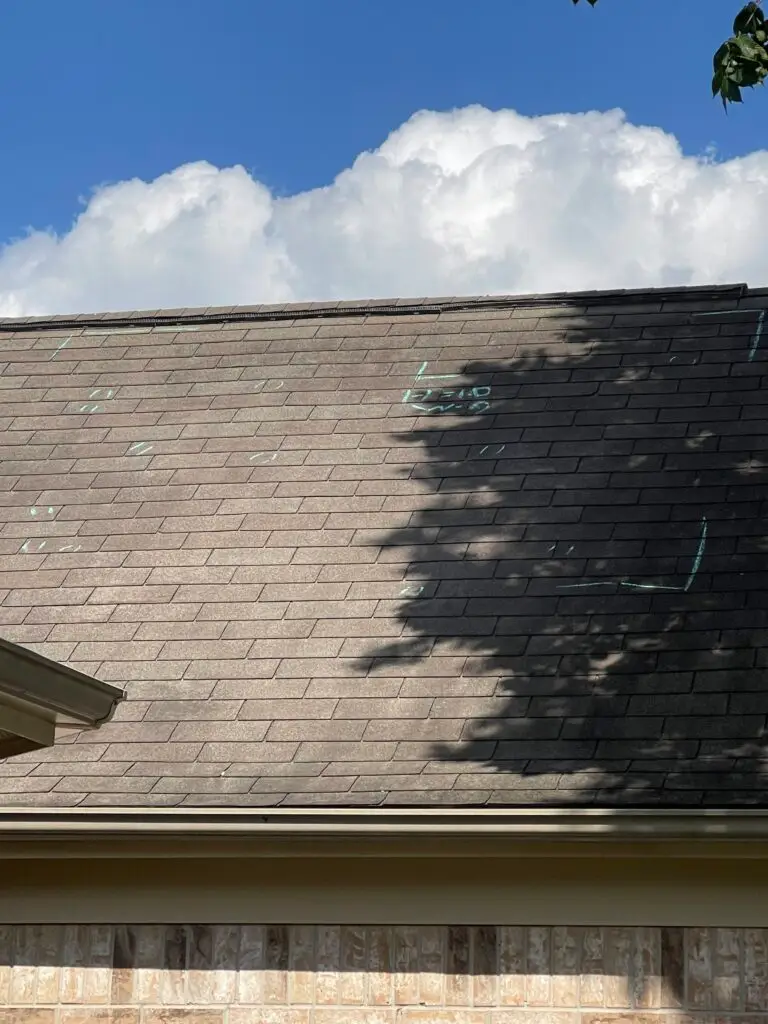
Hail damage is not primarily a leak problem — at least not right away. It’s a shingle mat integrity problem.
An asphalt shingle is a composite: a fiberglass mat, saturated with asphalt, then coated with mineral granules that protect the asphalt from UV. When hail strikes, the granules absorb the impact and often chip loose, and the asphalt-fiberglass mat underneath fractures.
What professional inspectors look for after hail:
1. Granule loss and bruising Hail impacts leave circular spots where granules are displaced, exposing the black asphalt underneath. Under a bruise, the mat is often soft to the touch (a “bruise” that indents like a soft spot on a piece of fruit) — that’s evidence the fiberglass mat has fractured, even if the shingle looks otherwise intact.
2. Cracked or split shingles Larger hail — typically 1.5″ and up — can crack shingles straight through. These are easy to spot from close range but often invisible from ground level.
3. Damaged soft-metal components Hail leaves crisp, dimpled impact marks in soft metals: aluminum vents, drip edge, valley metal, flashing, gutters, and the fins on the outdoor AC condenser unit. Soft-metal damage is one of the most important corroborating signs — because unlike a shingle, an aluminum vent doesn’t develop dents from age. Dents in a vent cap are hail, period.
4. Cracked pipe boots and vent flashing The rubber boots around plumbing vents crack under hail impact. So do plastic ridge vent covers and turbine bases.
5. Test square documentation On a proper hail inspection, we mark off a 10′ × 10′ test square on each slope, count impacts by size, photograph the pattern, and note directional bias. This is what stands up to adjuster scrutiny — random photos of “bad-looking” shingles don’t.
The insidious part: why hail damage often doesn’t leak immediately
A bruised shingle mat may continue to shed water for months or even years. But two things happen underneath:
- UV penetrates the exposed asphalt through the granule-loss spots, accelerating oxidation and brittleness.
- Moisture works into the fractured mat during every rain event, freezing/thawing (yes, even in Texas) and weakening the mat further.
The roof is on an accelerated aging clock. What was a 25-year shingle now has maybe 8–10 years left. That’s why insurance policies contemplate hail damage as a total replacement scenario when damage exceeds a threshold — not because the roof leaks today, but because its useful life has been compressed.
How Wind Damages a Roofing System
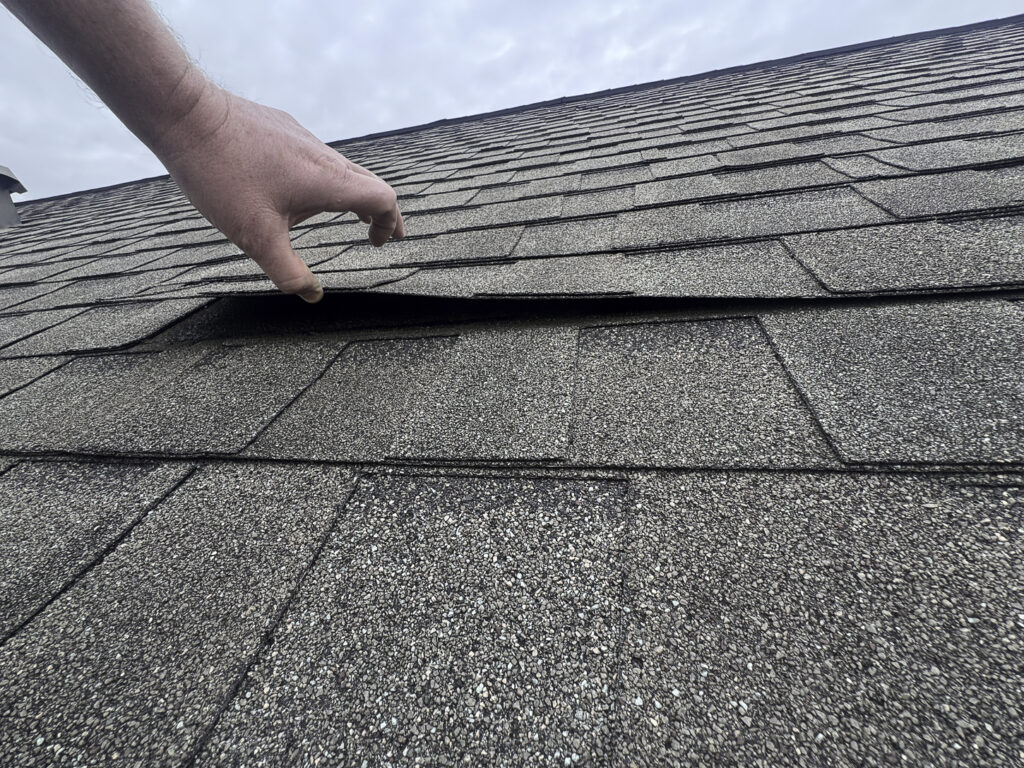
Wind damage is a different mechanism entirely. It attacks the sealant strip — the strip of factory-applied adhesive that bonds each shingle to the one below it.
When wind lifts the trailing edge of a shingle hard enough, the sealant strip breaks. Once that bond is broken, the shingle can never re-seal itself the same way. It’s now a hinge, waiting for the next storm to peel it back further.
Signs of wind damage:
- Creased shingles — a horizontal crease across the shingle where wind folded it upward before it fell back. Often the biggest single indicator adjusters look for.
- Missing tabs — obvious, but only the tip of the iceberg. For every fully-lost shingle, you often have 5–10 more with broken seals nearby.
- Lifted or “unbonded” shingles — you can sometimes see a subtle line where a row is no longer flat against the roof.
- Ridge cap displacement — ridge caps are the first thing wind attacks. Missing or shifted ridge caps almost guarantee sealant damage elsewhere.
- Exposed underlayment or nailheads — if wind removed a shingle entirely and you can see the black felt or synthetic underlayment, that’s active leak risk.
Why wind damage is worse than it looks
A wind event that only removes 2–3 shingles from your roof has almost certainly broken the seals on dozens more. Those shingles are cosmetically fine today, but functionally they are already failed — they just haven’t been peeled off yet. This is why “we just need three shingles replaced” is usually the wrong repair after a real wind event.
Storm Damage vs. Normal Roof Wear: The Distinction That Matters
This is where insurance claims are won and lost. Adjusters and public adjusters both look for the same distinction, and homeowners often make the mistake of describing normal wear as storm damage — which undermines the legitimate storm-caused findings elsewhere on the roof.
| Storm Damage | Normal Wear & Tear |
|---|---|
| Sudden, event-driven | Gradual, age-driven |
| Damage clustered on storm-facing slopes | Uniform across all slopes |
| Circular impact marks with crisp edges | Rounded, diffuse granule loss |
| Corroborating soft-metal damage | No dents in vents, gutters, AC fins |
| Random pattern of bruises | Predictable pattern along shingle edges |
| Damage inconsistent with roof age | Damage consistent with roof age |
A well-written inspection report distinguishes these two categories explicitly. Overstating findings to try to get a claim approved is a good way to have the entire claim denied.
What to Do in the First 72 Hours After a Storm
Timing matters more than most homeowners realize. Texas insurance policies generally expect prompt reporting, and delaying inspection can:
- Allow moisture intrusion to spread from a small compromise to significant interior damage
- Weaken documentation (the further from the storm date, the harder it is to isolate cause)
- Push you past your carrier’s claim reporting window
- Complicate the “sudden and accidental” characterization that most policies require
Recommended sequence:
- From the ground, look for obvious signs — missing shingles in the yard, downed limbs, gutter debris, granule piles at downspout outlets, dented vents visible from below.
- Photograph the property from all four sides with time-stamped photos. Even if you don’t file a claim, this establishes a baseline.
- Check the attic during the next rain event for any moisture. Look at rafters, decking underside, and around plumbing/vent penetrations.
- Do not climb the roof yourself. Steep pitches, hidden bruising, and post-storm decking damage make DIY roof inspection genuinely dangerous.
- Schedule a professional inspection within 2–4 weeks of the storm. Waiting past 6 months creates real problems for claim documentation.
- Do not sign a contingent contract with a door-knocker before you understand your roof’s condition. Get a written inspection report first.
What a Professional Post-Storm Inspection Actually Covers
At All Out Roofing, our post-storm inspection follows a structured walkthrough — exterior first, then roof surface, then flashing and penetrations, then ventilation, then gutters, then attic. Every finding is photographed and referenced. Full detail is in our roofing inspection process, but here’s what a proper inspection includes:
Exterior walk-around
- Soft-metal damage assessment (vents, gutters, downspouts, garage door, AC condenser fins, mailbox, window screens)
- Fence and siding impact marks that corroborate direction and severity of hail
Roof surface (per slope)
- Test square documentation on each slope showing impact count and size
- Granule loss patterns and directional bias
- Cracked, creased, or missing shingles
- Sealant strip integrity check on the leading edges
Flashing and penetrations
- Pipe boot condition
- Chimney flashing, step flashing, counter-flashing
- Valley metal
- Skylight seals
Ventilation
- Ridge vent, turbine, and box vent condition
- Attic ventilation adequacy (a hail-damaged ridge vent can hide as “just cosmetic”)
Gutters, fascia, soffit
- Impact denting
- Gutter separation from fascia
- Fascia and soffit damage
Attic and interior
- Decking moisture indicators
- Visible daylight through decking (a shingle blow-off dead giveaway)
- Stains around penetrations
- Ventilation air movement
The report we deliver includes labeled photos tied to every finding, a Good/Better/Best replacement option set (if replacement is warranted), and a plain-English recommendation. We describe damage factually — we don’t promise claim approval, because no honest roofer can guarantee what an adjuster will decide.
Repair vs. Full Replacement: How the Call Actually Gets Made
Not every storm-damaged roof needs replacement. But the “just fix the spots that leaked” instinct often costs more in the long run.
Repair is the right call when:
- Damage is genuinely isolated to a small area
- The roof is under ~10 years old and the rest of the field is intact
- Matching shingles are still available from the same manufacturer and color line
- No sealant-strip damage has been detected in the wider field
- Underlayment and decking are intact
Replacement is the right call when:
- Damage crosses multiple slopes
- Impact count in test squares exceeds carrier thresholds
- The roof is already in the last third of its useful life
- Wind has broken sealant strips across multiple courses
- The shingle line is discontinued (very common with 15+ year old roofs — matching becomes impossible)
- Multiple prior repairs are already visible
Insurance adjusters use similar criteria. If the damage crosses the threshold, most Texas policies replace the roof — even the undamaged slopes — because a patch job with mismatched shingles is neither functionally sound nor aesthetically acceptable.
For a full walkthrough of the decision, see our guide on roof repair vs. roof replacement.
Storm Damage and Your Roof Warranty
Storm damage itself doesn’t void your manufacturer warranty. But improper storm repairs will.
CertainTeed and other major manufacturers require:
- Correct materials (matching shingle line, correct underlayment, correct fasteners and placement)
- Approved repair methods per the manufacturer’s technical bulletins
- Documentation of the repair (kept by the contractor and the homeowner)
- In some cases, work performed by a certified contractor for extended coverage to remain valid
A cash-deal repair done by an out-of-area storm chaser using generic shingles is very likely voiding your warranty even if the roof looks fine afterward. This is one reason we recommend using a locally-based, manufacturer-certified contractor for any storm repair.
More detail in our roof warranties for Texas homeowners guide.
Insurance Claim Considerations Specific to Texas
Texas homeowners insurance is unusual in a few ways worth knowing before you file:
- Named-peril vs. all-risk policies. Most Texas HO-3 policies cover wind and hail as named perils. Some policies now carry separate wind/hail deductibles that are a percentage of dwelling coverage — often 1% or 2%, which on a $500K home means a $5,000–$10,000 deductible before your carrier pays a dime.
- RCV vs. ACV. Replacement Cost Value pays for a new roof; Actual Cash Value pays only depreciated value. Check which one your policy has before you need it.
- The two-year statute (Texas Insurance Code §542A.003). You generally have to file within a limited period, and many carriers push for even faster reporting. Delay costs coverage.
- Post-loss duties. You have an obligation to mitigate further damage — meaning if a small leak turns into a ceiling collapse because you didn’t tarp it, the carrier can deny the additional damage.
- You do not have to accept the adjuster’s number. If the adjuster’s scope misses documented damage, that’s what a supplement or re-inspection is for. A good contractor can meet the adjuster on the roof — often the single most productive step in the process.
We describe damage factually in our reports and never promise a claim outcome. But we do provide the documentation adjusters need to make a fair assessment, and we’ve walked hundreds of Katy and Fulshear homeowners through the claim process.
Red Flags Homeowners Frequently Miss
Even without a professional inspection, these are worth checking:
- Granule piles at downspout outlets. A handful of granules after a new roof settles is normal. Cups full after a storm is not.
- Dented AC condenser fins. Almost never caused by anything except hail. Strong corroborating evidence for a claim.
- Small circular holes in window screens. Hail can punch through screens without breaking glass. Another corroborating indicator.
- Dents in the top of the mailbox or trash cans. Same story.
- Interior ceiling stains that “come and go.” These often indicate slow flashing failure — a very common storm-damage pattern.
- Attic light through the decking. Any daylight visible from the attic is a shingle blow-off or nail pop.
- Shingle edges lifting or curling where they used to lie flat.
One of these signs on its own may not be conclusive. Three or four together warrants a professional look.
FAQs
Can hail damage a roof without causing leaks?
Yes — and this is actually the most common scenario. Hail primarily damages the shingle mat, not the underlayment. A hail-damaged roof may continue to shed water for months or years while its useful life is being cut short by 30–70%. The insurance and warranty implications matter well before any leak appears. This is why hailstorms are often followed by claims even from homeowners whose ceilings are dry.
How soon should I inspect my roof after a storm?
Ideally within 2–4 weeks. Insurance policies expect prompt reporting, damage documentation becomes weaker over time, and small compromises can worsen with subsequent rain events. If the storm was recent and severe (measurable hail, gusts over 60 mph, or a nearby derecho track), sooner is better. Avoid climbing the roof yourself — post-storm decking can be compromised and steep-slope work without fall protection is genuinely dangerous.
Do all hailstorms damage roofs?
No. Hail size matters. Pea-sized (0.25″) and dime-sized (0.7″) hail rarely damages modern architectural shingles. Quarter-sized (1″) hail can damage shingles depending on age, angle, and wind speed. Golf-ball-sized (1.75″) and larger hail almost always damages roofs to some degree, and 2″+ hail is a near-certain replacement scenario. Wind speed accompanying the hail is a big factor — wind-driven hail hits at a shallower angle and does more damage than hail that falls vertically.
Can wind damage shingles without blowing them off?
Absolutely — this is the most-missed form of wind damage. Wind breaks the sealant strip that bonds each shingle to the one below it. Once that seal is broken, the shingle is functionally failed even though it may still be sitting flat. It can no longer resist future uplift the way it was designed to. A field of shingles with broken seals is what leads to progressive shingle loss in each subsequent storm. This is why “we only lost three shingles” often understates the actual damage significantly.
Is storm damage always covered by insurance?
Not always. Coverage depends on your policy type (named peril vs. all risk), your specific wind/hail deductible, whether the damage exceeds that deductible, whether the roof was already at end-of-life (some policies exclude roofs over a certain age), and whether the damage is characterized as sudden storm-caused versus gradual wear. Even when coverage applies, ACV vs. RCV determines how much you actually receive. Reviewing your declarations page before storm season is one of the highest-value things a Houston homeowner can do.
How much does a post-storm roof inspection cost?
Reputable local contractors, including All Out Roofing, typically perform post-storm inspections at no charge. If a company wants to charge you for an initial inspection before any work is contemplated, that’s unusual for the Houston market. We do not charge for storm inspections, and we deliver a written report you can use whether or not you file a claim.
Should I file a claim if I’m not sure there’s damage?
Get a professional inspection first. Filing a claim that gets denied still shows up on your CLUE (Comprehensive Loss Underwriting Exchange) report and can affect future premiums and even insurability. The right sequence is: professional inspection → written documentation → then a conversation with your carrier if damage supports it.
Does All Out Roofing help with the insurance process?
Yes — we provide documentation, meet adjusters on the roof when needed, and walk homeowners through the process. We do not act as public adjusters (that’s a licensed role we don’t hold), and we don’t promise claim outcomes. What we can do is make sure the damage is documented correctly and completely, which is the single biggest factor in a fair adjuster determination.
Get Your Roof Inspected
If a recent storm has come through Katy, Fulshear, Cypress, Sugar Land, or anywhere in greater Houston, don’t wait for a leak to tell you your roof needs attention. Bruised shingles and broken sealant strips don’t announce themselves — but they do shorten the life of your roof and cost you money whether or not you file a claim.
Call All Out Roofing at (281) 769-4282 or request a free inspection at alloutroofs.com. We are CertainTeed Select ShingleMaster and Master Craftsman certified, locally owned in Katy, and we’ve inspected roofs in every ZIP code in Fort Bend and Harris County.
Your Roof. Our Mission.