
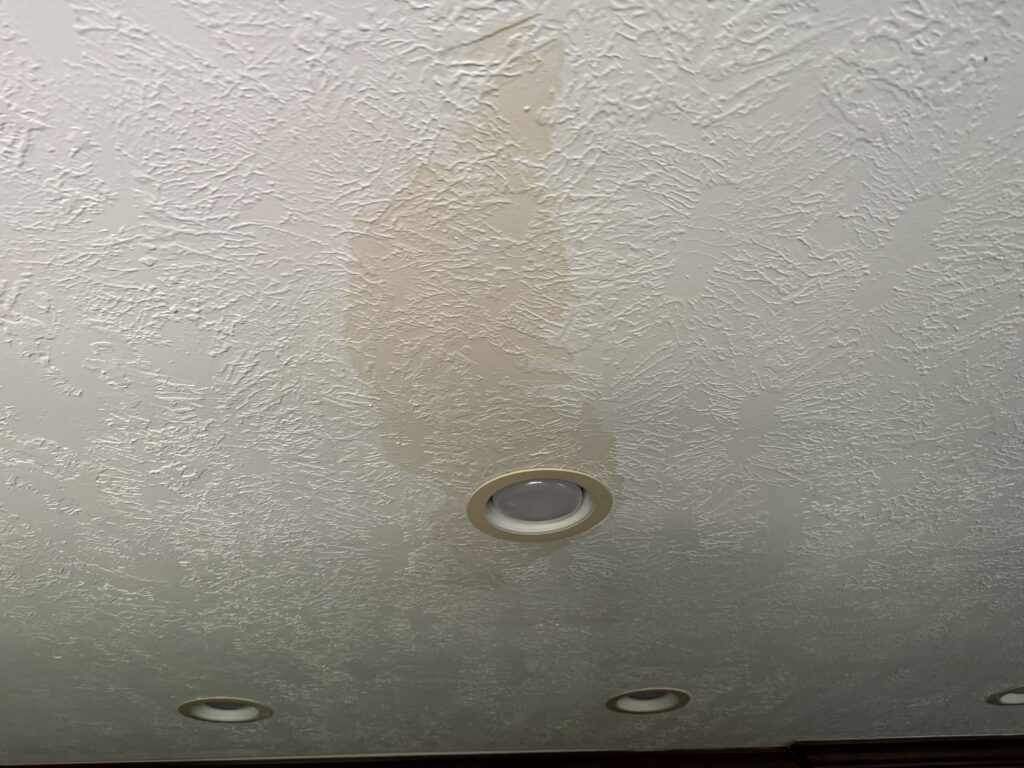
Almost every roof leak detection call I take starts the same way. There is a brown ring on a ceiling, usually in a hallway or a closet, usually noticed two or three days after the rain that caused it. The homeowner points up at the stain and asks what the hole above it is going to cost to fix.
The honest answer is that there is probably no hole above it. In twenty years of opening up Katy and Fulshear roofs, the water almost never enters directly above where it shows up. It enters somewhere else, travels, and comes through the ceiling at the first place gravity lets it. Chasing the stain instead of the entry point is how homeowners end up paying for two repairs and still having a leak.
So this is the piece I wish more people read before they call anybody: where roof water actually gets in, why the field of your shingles is rarely the culprit, and what a competent roofer does to find the real source.
Why roof leak detection starts inside the house
Water that gets past your shingles lands on the underlayment or the decking, and then it does what water does — it runs downhill along whatever surface it lands on. On a typical Katy roof that means it tracks down the slope of the decking, hits a rafter, and runs along the rafter until it reaches a low point. That low point might be twelve or fifteen feet from where it entered.
Which is why roof leak detection that starts on the roof is mostly guesswork. It starts in the attic, in daylight, with the lights off and a flashlight in hand. Daylight coming through a nail hole is not a leak, but daylight around a pipe penetration probably is. Dark staining down a rafter, rusted nail shanks, a chalky white mineral trail on the decking — those are the map. You follow the trail uphill to where it begins, mark that spot, measure off the ridge and the nearest gable, and then go find the same spot on the outside of the roof.
Homes with spray foam under the decking, or with no attic access over the room in question, make this harder and sometimes turn it into a cut-and-look job. That is a real cost, and it is worth knowing before a roofer quotes you a flat fee for “finding the leak.”
The five places roof leaks actually start
On asphalt-shingle roofs in this area, five spots account for the overwhelming majority of what I find.
Pipe boots. The rubber collar around your plumbing vent stacks is the single most common failure I see, and it is not close. The rubber is the shortest-lived component on your roof — a hard fifteen or twenty years of Texas UV and it splits at the top of the collar. The pipe is still there, the shingles around it look perfect, and a quarter-inch crack in a rubber seal is putting water into your ceiling. A replacement boot is a cheap part.
Flashing at walls and chimneys. Anywhere the roof plane dies into a vertical surface — a chimney, a dormer, the wall of a second story over a garage — the seal is metal flashing, not shingles. Section R903.2 of the International Residential Code requires flashing at those intersections, at valleys, and around penetrations for exactly this reason. When flashing is reused on a reroof instead of replaced, or when step flashing gets face-nailed and caulked instead of woven into the courses, it leaks. Caulk is a five-year fix pretending to be a permanent one.
Valleys. Two roof planes meeting means the water volume from both is funneled into one channel. Valleys move more water than any other part of the roof, so any defect there gets tested every single storm. Debris packed in a valley is its own problem, because it dams water and holds it against the shingle edge long enough to wick sideways.
Exposed fasteners. Any nail head sitting on top of a shingle instead of under the next course is a future leak with a sealant clock on it. Satellite dish mounts, old antenna brackets, and solar attachment points are the usual suspects. So are the nails a previous repair left behind.
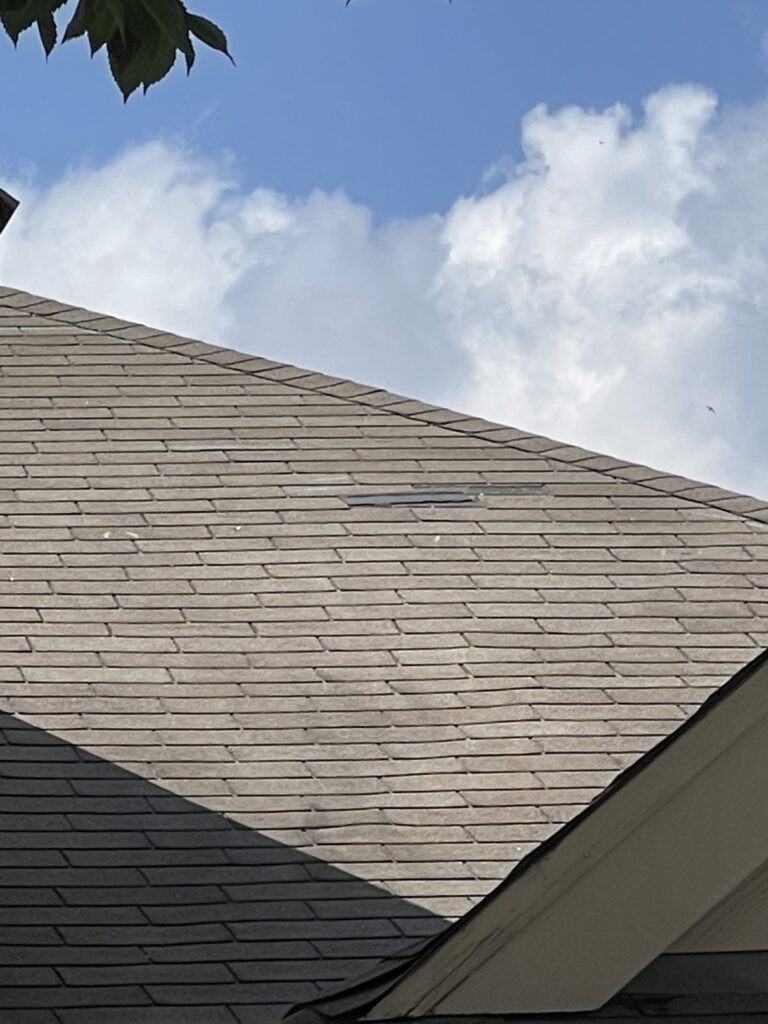
Wind-lifted shingles at the perimeter. Along rakes and eaves, wind gets under the leading edge and breaks the tar seal. The shingle lays back down and looks fine from the ground, but it no longer seals, so wind-driven rain pushes up underneath it. This is what I look for first after a storm, and it is the damage most homeowners cannot see from the driveway.
What it usually is not: the middle of the roof
The field — the big open expanse of shingles between the penetrations and the edges — is the part of your roof that is doing the least dramatic work and failing the least often. Shingles overlap, water sheds, and unless something physically broke the surface, that area holds.
Hail is the exception that matters here. A hail bruise fractures the mat under the granules, and it can take a year or two before that bruise becomes a hole. That delay is why a roof can pass a casual look and still be compromised, and it is why the storm-damage inspection is a different exercise from leak hunting. We walk through what each layer of a shingle does, and what happens when each one fails, in our breakdown of what is actually under your shingles.
The practical version: if a roofer tells you a field shingle in the middle of a slope is the source of your hallway leak, ask him to show you the entry point in the attic. There is usually a better explanation ten feet uphill.
How a roofer runs roof leak detection on a Katy house
A real roof leak detection visit has an order to it, and if the person you hire skips straight to the ladder, that tells you something.
Interior first. Where is the stain, how big, and is it still wet? A soft, expanding stain means active water. A hard, dry, well-defined ring with a yellow edge may be months old and already repaired by somebody else.
Attic second. Lights off, flashlight on, tracing stains uphill to the entry. This is where the leak is usually solved.
Roof third, at the location the attic pointed to. Boots, flashing, valley, fasteners, seal integrity at the perimeter — in that order.
Water testing when the attic is ambiguous. One person with a hose on the roof, starting low and working uphill in sections, one person in the attic watching. It is slow and it is the only way to be certain on a leak that only shows up in a driving rain from one direction.
What you should get at the end is photographs of the actual entry point, not a verbal summary and a price. Photo documentation is the standard on any inspection we do, and it is the thing that lets you get a second opinion without paying for a second inspection. Our roof inspection checklist covers what a full inspection should include beyond the leak itself.
The leaks that are not roof leaks
A meaningful share of the water I get called about never came through the roof at all.
Condensation on ductwork. Cold flex duct running through a 130°F attic sweats. If the vapor jacket is torn or a fitting was never sealed, that condensate drips onto the sheetrock below and makes a stain that looks exactly like a roof leak. The tell is that it appears on humid days rather than rainy ones.
The air handler drain pan. A clogged condensate line backs up into the secondary pan and overflows. Almost always shows up as a ceiling stain directly under the unit, and it happens in August when it has not rained in two weeks.
Attic condensation from poor ventilation. When moist air cannot escape the attic, it condenses on the underside of the decking in winter and rains back down. If the staining is spread out and diffuse rather than tracked down one rafter, ventilation is the first thing I check. We covered how intake and exhaust are supposed to work in our guide to attic ventilation methods for Texas heat.
None of these is a roofing repair, and you should not pay for one. An honest roofer will tell you the answer is an HVAC call.
What to do before the roofer gets there
- Photograph the stain with a phone, and again a day later, so its growth is documented
- Put a container under an active drip and pierce a bulging ceiling with a small screwdriver to let it drain in one spot rather than collapse
- Move what is under it, and pull back carpet if the water is reaching the floor
- Note the date, the storm, and the wind direction while you remember them
- Look in the attic from the hatch if it is safe, without stepping between the joists
- Do not get on the roof in the rain to look, and do not let anyone tarp it who will not show you insurance
When a roof leak becomes an insurance question
This is where roof leak detection stops being a repair question and starts being a paperwork question, so it is worth knowing the rule before you call anybody.
The Texas Department of Insurance puts it plainly: most homeowner policies cover sudden and accidental water damage, while damage from gradual leaks or seepage — and any mold that comes with it — is usually excluded. A pipe boot that cracked from age and dripped for two seasons is the second category. A shingle section torn off in a windstorm last Tuesday is the first.
That distinction is also why dates matter. TDI’s own guidance on insurance and your roof notes that carriers pay differently based on a roof’s age and condition, and that your wind and hail deductible is often higher than the rest of your policy. Document the storm, file promptly if there was one, and do not let a contractor talk you into filing a claim on a worn-out boot. If the leak turns out to be age rather than weather, the real question becomes whether to patch it or plan a replacement — we lay out how we make that call in roof repair vs roof replacement.
Most of what I have described here costs a few hundred dollars to fix if you catch it in the boot or the flashing stage, and several thousand if you catch it after the decking has been wet for a year. Wet OSB loses its structure and has to come out, which turns a half-day repair into a section of replacement. That is the whole argument for chasing a small stain now.
If you have one and you want someone to find the actual source, we will come look and photograph what we find, whether the answer is a $30 part or something bigger. Call All Out Roofing at (281) 769-4282. A few immediate steps that limit the damage before we arrive are in our four practical tips for a leaky roof.
About the author
About the author — Brent Burgin is the owner and operator of All Out Roofing, a licensed local roofing contractor serving Katy, Houston, Cypress, Fulshear, and surrounding communities. Brent has lived in the Katy/Fulshear area since age 7 and is also a licensed Texas real estate agent (TREC #630213, with Terra Point Realty since 2013) — a cross-domain background that helps homeowners think through roof decisions in the context of their home’s overall value and any pending real estate transactions. All Out Roofing is a CertainTeed Select ShingleMaster and installs GAF and Owens Corning shingle systems.
All Out Roofing, LLC — 25220 Kingsland Blvd, Ste 100, Katy, TX 77494. Available 24/7 for storm response.