
Most homeowners ask about a roof repair cost the way they ask about a dental cleaning. They want the number, and then they want to know whether it can wait until after the holidays. The number is usually smaller than they expected. The waiting part is where it gets expensive.
I have spent a lot of years on roofs in Katy, Fulshear and Cypress, and the single most common thing I see is not storm damage. It is a small, boring, entirely fixable problem that somebody looked at eighteen months ago and decided to deal with later.
So here is the honest version: what a roof repair cost actually pays for, how the bill changes as a problem ages, which repairs genuinely can wait a season, and what deferring one does to your insurance policy. That last part is the one almost nobody sees coming.
What a roof repair cost actually covers
A repair bid is not one number. It is four, bundled together, and understanding the four is how you tell a fair quote from a bad one.
Access and setup. Getting a crew, a ladder and materials to your roof. This is mostly fixed — it costs nearly the same whether we replace one pipe boot or twelve. It is why a single small repair often feels expensive per square foot and why batching two small repairs into one visit is almost always cheaper than two visits.
The actual failed component. A pipe boot, a section of step flashing, a run of valley metal, a few courses of shingles. Materials here are usually the smallest line on the bid.
What is underneath it. Underlayment, and below that the decking. Nobody can price this accurately from the ground, which is why an honest repair quote carries a decking contingency and a dishonest one does not.
Restoring the water path. A roof is a layered system that sheds water downhill. Repairing one piece means re-integrating it with everything above and below it. A repair that looks fine but breaks the shingle-over-underlayment-over-flashing sequence will leak again, usually in the next hard rain from the same direction.
We walk through how those layers stack and what each one does in what is actually under your shingles. It is worth five minutes before you read a bid.
The three stages, and why the bill jumps between them
Almost every deferred roof problem moves through the same three stages. The roof repair cost roughly triples at each step, and the jumps are not gradual — they are cliffs.
Stage one: the surface only. A cracked boot, lifted flashing, three blown shingles, a popped nail. Water is getting past the shingle but has not soaked anything structural yet. This is a half-day job for two people. In this market most single-point repairs at this stage land somewhere in the low hundreds of dollars, and the spread depends mostly on pitch and access rather than materials.
Stage two: the decking is wet. The underlayment has been carrying water for a few months and the OSB below it has started to soften. Now we are cutting out sheets of decking, re-nailing to the rafters, replacing underlayment across a wider area than the original leak, and re-shingling to blend. Same leak, multiplied labor. This is where a repair typically moves from hundreds into the low thousands.
Stage three: it is inside the house. Wet insulation that has lost its R-value and needs to come out. Stained or sagging drywall. Sometimes framing. In our humidity, often microbial growth that needs a remediation contractor, not a roofer. At this stage the roofing portion is frequently the smallest line on the total bill.
The thing to understand about stage two is that it is invisible from your living room. There is no ceiling stain yet. The only way to catch it is from the attic side or from the roof, which is the entire argument for the annual roof inspection being the cheapest line item in roof ownership.
Why a Texas summer is the accelerant
A deferred repair in a mild climate ages slowly. Here it does not.
Attic temperatures on a Katy afternoon in July routinely run 130°F to 150°F. That heat cooks the asphalt in the shingle and the sealant in every repair, drives the thermal cycling that widens small gaps into larger ones, and bakes moisture out of wet decking only to have the next storm re-wet it. Wet, dry, wet, dry — that cycle delaminates OSB faster than sustained soaking does.
Then there is the rain pattern. We do not get gentle, steady rain. We get three inches in ninety minutes, sometimes driven sideways. A gap that a drizzle would never find becomes a funnel in that kind of event.
So the practical rule I give people: a roof problem found in October and fixed in October is a different problem than the same one carried through to May. The calendar matters more here than it does almost anywhere else, which is why we lay the year out season by season in our Katy roof maintenance calendar.
What deferring a repair does to your insurance
This is the cost nobody puts in the column, and it is often the largest one.
Texas homeowners policies cover sudden and accidental damage. They do not cover wear, deterioration or damage that results from a lack of maintenance — that distinction is built into the policy form, and the Texas Department of Insurance lays out the general shape of it in its homeowners insurance FAQ. A shingle blown off by a named storm is a claim. The same shingle missing for two years, with rotted decking beneath it, is maintenance.
That matters in three specific ways.
A future storm claim can be reduced or denied. When an adjuster finds long-term water staining under the shingle, deteriorated decking and a repair that was clearly needed long before the date of loss, the pre-existing condition gets carved out of the claim. You may still get paid for the storm damage. You will not get paid for the part you let ripen.
Roof condition affects whether you keep the policy. Carriers in this state have been steadily tightening on roof age and roof condition, and TDI’s guidance on what to look for when your home policy is up for renewal is worth reading before you get a surprise. An inspection photo showing obvious deferred damage is a reason to non-renew or to move you to an actual cash value roof endorsement.
Getting moved to actual cash value is expensive. On a replacement cost policy the carrier pays what a new roof costs today. On actual cash value they pay depreciated value, and on a fifteen-year roof that difference is most of the roof. TDI explains the mechanics in replacement cost or actual cash value, and we go through what it means locally in our post on ACV versus RCV on a Katy roof.
So the real roof repair cost of waiting is not just the bigger repair. It can be the difference between a covered claim and an uncovered one, years later, on damage you had nothing to do with.
The deferred repairs that cost the most
Not every neglected item escalates at the same rate. These five are the ones I see turn into real money most often in this market:
- Cracked pipe boots. The rubber collar around a plumbing vent dries out and splits, usually between years eight and twelve. It is one of the cheapest repairs on a roof and one of the most common sources of a slow attic leak, because the water runs down the pipe and into the insulation instead of showing on a ceiling.
- Failed step flashing at a wall. Where a roof plane meets a vertical wall — a chimney, a dormer, a second-story elevation. Water gets behind the siding and travels, so by the time it appears indoors it is nowhere near the actual failure.
- Open or short-nailed valleys. Valleys carry the highest water volume on the roof. A repair done badly here fails fast, and the damage runs the full length of the valley rather than staying at one point.
- Missing or damaged drip edge. Water wicks back onto the fascia and the decking edge instead of clearing into the gutter. This one rots the perimeter of the roof quietly for years and is a frequent surprise on tear-off day.
- Blocked soffit vents. Not a leak at all, but it bakes the shingles from below and shortens the roof's service life across the whole plane. If you are going to fix one thing that is not currently leaking, fix this one.
When waiting is actually the right call
I would rather be straight with you than sell you something, so here are the cases where I tell people to hold off.
Your roof is within two or three years of replacement anyway. Spending real money on a repair to a roof that is going to be torn off shortly is money you will not get back. In that situation I would rather do a minimal watertight patch to get you through the season and put the planning energy into the replacement. We lay out how that decision gets made in repair or full replacement in Texas.
The damage is cosmetic. Algae streaking, minor granule loss on a young roof, a slightly uneven shingle course. These look worse than they are and do not progress into a leak.
You are inside an active insurance claim. Do not authorize permanent repairs before the adjuster has documented the loss. Emergency mitigation to stop active water intrusion is expected and generally reimbursable. A full repair done before documentation can complicate the claim.
A storm is forecast this week. Sometimes the right sequence is tarp now, repair after. A rushed repair in bad conditions is a repair you pay for twice.
What does not belong on that list: an active leak, exposed decking, or anything where water is currently reaching the attic. Those do not improve with time, and the roof repair cost only goes one direction.
How to figure out which situation you are in
You can do most of the triage yourself without getting on the roof, which I would rather you did not do anyway.
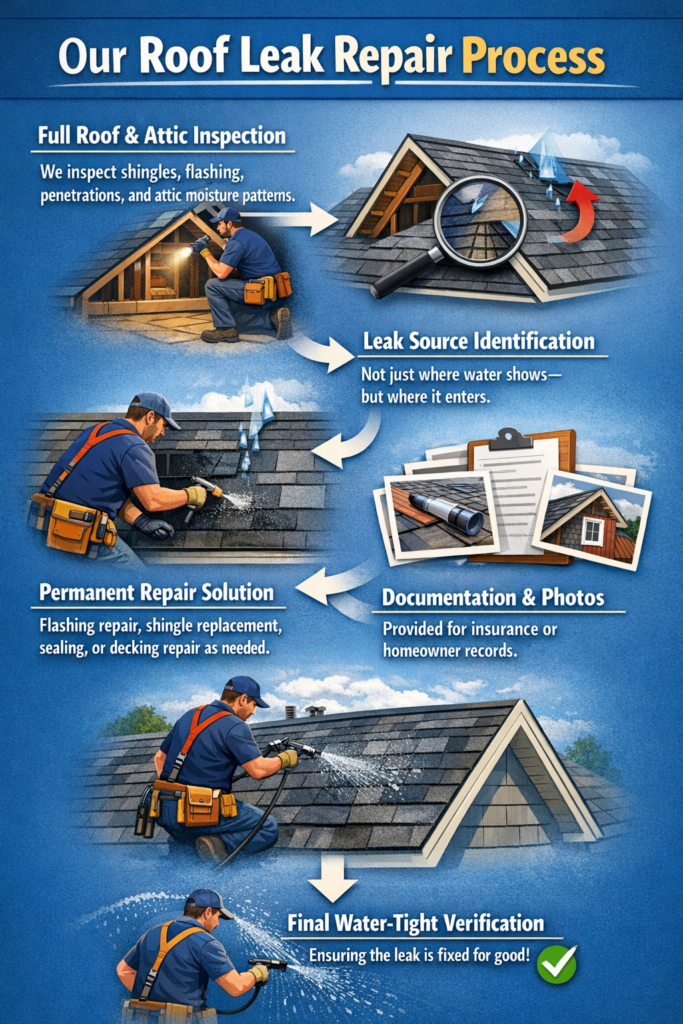
Go into the attic with a flashlight on a bright day. Look at the underside of the decking around every penetration — vents, pipes, the chimney chase. You are looking for dark staining, a white or chalky mineral trail, or daylight. Press on any stained plywood with a thumb. Firm is stage one. Spongy is stage two, and that changes the urgency completely.
Then walk the perimeter outside and look at the gutters. A heavy load of granules after a roof is past ten years old is normal wear. A sudden heavy load on a young roof is not. Check the fascia for soft spots and staining, which is usually drip edge or gutter, not shingle.
If you find spongy decking or a wet stain, get it looked at now rather than at your convenience. If everything is firm and dry, you have time, and you can schedule the fix around your own calendar instead of the weather’s. That is the whole difference between a roof repair cost and a roof replacement cost, and it is usually decided months before anybody calls a roofer.
If you want a second set of eyes on it, we will come look and tell you straight — including when the honest answer is that it can wait until spring. Call us at (281) 769-4282 whenever it suits you.
About the author
About the author — Brent Burgin is the owner and operator of All Out Roofing, a licensed local roofing contractor serving Katy, Houston, Cypress, Fulshear, and surrounding communities. Brent has lived in the Katy/Fulshear area since age 7 and is also a licensed Texas real estate agent (TREC #630213, with Terra Point Realty since 2013) — a cross-domain background that helps homeowners think through roof decisions in the context of their home’s overall value and any pending real estate transactions. All Out Roofing installs CertainTeed, GAF, and Owens Corning shingle systems.
All Out Roofing, LLC — 25220 Kingsland Blvd, Ste 100, Katy, TX 77494. Available 24/7 for storm response.