
Can a roofer waive my deductible in Texas? Short answer: no. A roofing contractor cannot legally waive, absorb, rebate, or pay any part of your insurance deductible — and if you sign paperwork saying you paid a deductible you didn’t pay, you can be exposed too.
If a roofer knocks on your door after a hailstorm and offers to “cover your deductible” or promises you a “free roof,” what they’re actually offering is illegal in Texas — and it can put you in a worse spot than it puts them.
Can a roofer waive my deductible in Texas? We hear that question a lot at All Out Roofing, especially in Katy, Fulshear, and Cypress after storms move through Fort Bend and Harris County. Homeowners aren’t asking because they’re trying to do something shady. They’re asking because a stranger just made them a very tempting offer, and they want to know if it’s real.
Here’s the straight answer, plus what you should actually do to make your out-of-pocket cost as manageable as possible without stepping into fraud.
The short answer: can a roofer waive my deductible in Texas?
No. In Texas, a contractor cannot legally waive, absorb, rebate, or pay any portion of your insurance deductible. Since 2019, doing that is a criminal offense for the contractor — and misrepresenting it to your insurance carrier can expose the homeowner to insurance fraud as well.
Here’s how we explain it in person when a homeowner asks:
“I completely understand why you’re asking. But in Texas, we can’t legally waive or credit your insurance deductible on this roof. Your deductible is the portion of the claim you’re responsible for. What we can do is make sure the insurance scope is accurate, identify anything they may have missed, and help you understand exactly what your carrier is paying for. We always look for legitimate ways to keep your out-of-pocket costs reasonable — but we’re not going to put you or All Out Roofing in a bad position by doing something with the deductible that isn’t legal.”
That’s the whole thing in one paragraph. The rest of this article is why it matters, what your real options are, and how to spot the pitch when you hear it.
Why the “we’ll eat your deductible” offer is a trap
Think about the numbers for a minute.
If your deductible is $5,000 and one contractor is willing to make $5,000 disappear just to get your job — where is that money coming from?
It has to come from somewhere. There are only two places it can come from: the work itself, or the invoice. That’s it. There is no third option.
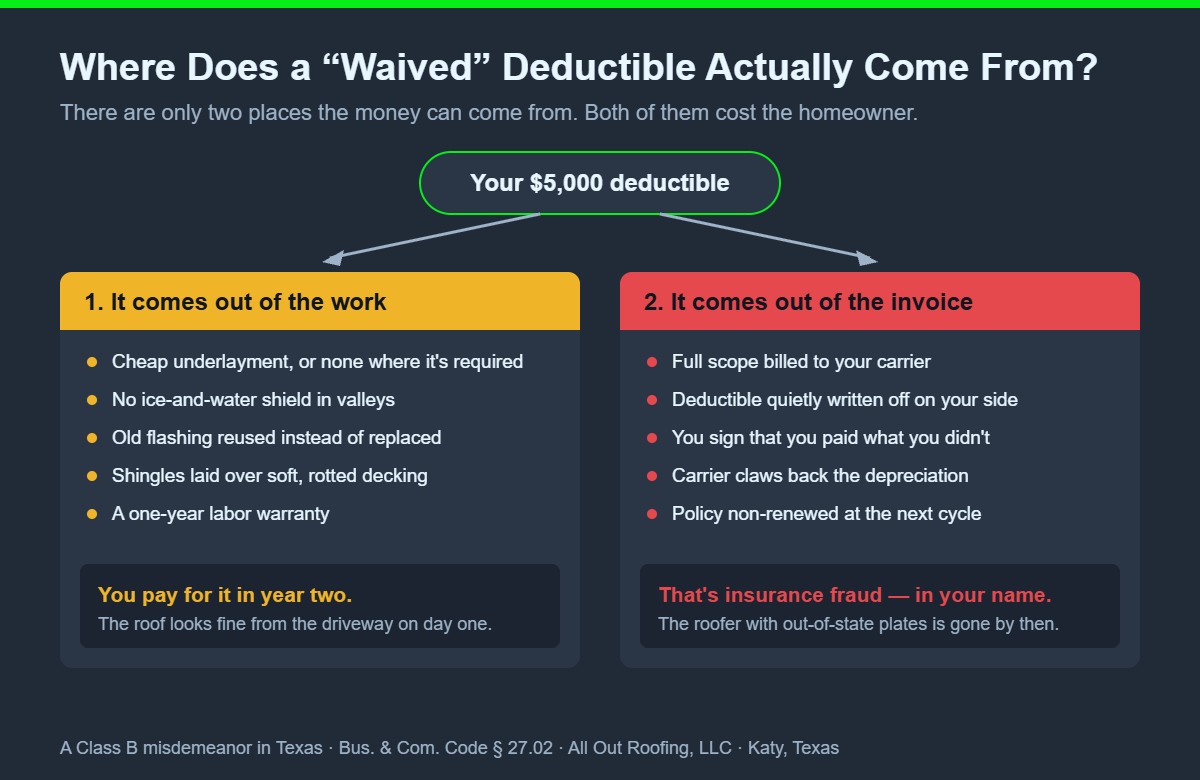
When the money comes out of the work, here’s what typically gets cut:
- Cheaper synthetic underlayment (or none at all in places it’s required)
- No ice-and-water shield in valleys or around penetrations
- Skipping proper starter strip and hip/ridge cap shingles — using cut-up three-tabs instead
- Under-driving or over-driving nails, or using the wrong nail pattern (four nails instead of six on high-wind exposures)
- No drip edge, or drip edge only on the eaves and not the rakes
- Reusing old flashing around the chimney and vents instead of replacing it
- Skipping decking repairs and shingling over soft, rotted, or split wood
- Downgraded ventilation or no ventilation upgrade at all
- One-year labor warranty instead of a proper workmanship warranty
Any one of those cuts a few hundred dollars. Stack four or five of them and there’s your $5,000 — plus profit. The roof looks fine from the driveway on day one, and problems don’t show up until year two, year five, or the next serious wind event.
When the money comes out of the invoice, the contractor bills the insurance company for the full scope and quietly writes off the deductible on your side. That is the moment insurance fraud happens — and it happens in the homeowner’s name, not just the contractor’s.
What “insurance fraud” actually means for you
This is the part that gets glossed over in the driveway pitch.
When a homeowner signs paperwork saying they paid a deductible they didn’t actually pay, and the contractor submits an invoice reflecting the full scope, the insurance carrier has been given a false document to justify a payment. That’s fraud, and Texas carriers have gotten sophisticated about spotting it. Here’s what can happen months after the roof is on:
- The carrier compares the sworn statement or final invoice to what you actually paid and claws back the difference — usually the recoverable depreciation, which can be several thousand dollars.
- The claim gets partially reversed or denied outright.
- Your policy gets non-renewed at the next cycle, and other Texas carriers see that history when you shop coverage.
- In serious cases, the Texas Department of Insurance fraud unit gets involved, and the homeowner is named alongside the contractor.
Meanwhile, the roofer who made the pitch is often working out of a rental truck with out-of-state plates. By the time the letter arrives, they’re gone. You’re the one holding the paperwork.
A real example — the other direction
We had a homeowner in the area a while back with a fair-sized roof. Material prices had climbed on us mid-job, but we still came in a little under the insurance scope. When we sent the final invoice showing what they actually paid, the homeowner was upset — because they’d expected to pocket the difference between the insurance check and our price.
That’s the mindset the deductible-waiving pitch feeds, and it’s worth naming clearly: the insurance money is not a windfall. It’s earmarked for the specific damage the carrier approved. The deductible is your share of that cost, and the invoice is supposed to reflect what was actually charged and paid. When a contractor tells you otherwise — even framing it as a favor — they’re setting you up to hold a bag you didn’t know you were carrying.
The law, in plain English
You don’t need to memorize the statute, but here’s the gist so you know it’s not something we invented to sound reasonable.
In 2019, Texas passed House Bill 2102, which strengthened Texas Business & Commerce Code § 27.02. Under that section, a seller — including a roofing contractor — commits a Class B misdemeanor if they advertise, promise, or actually pay, waive, absorb, rebate, or otherwise decline to charge or collect a homeowner’s insurance deductible on work paid for with insurance proceeds.
The same section also requires that any contract over $1,000 expected to be paid from insurance proceeds carry a written notice, in at least 12-point boldfaced type, telling you that it’s a violation of Texas law for a contractor to pay or waive your deductible. And House Bill 2102 added Chapter 707 to the Texas Insurance Code, which lets your carrier require reasonable proof that you actually paid your deductible before it releases payment.
Practical translation: if a roofer offers to eat your deductible in Texas, they’re breaking the law. If you go along with it and sign paperwork saying you paid what you didn’t, you may be too. The law exists because this scam got bad enough — especially in hail country — that the state stepped in.
What we can legitimately do instead of waiving your deductible in Texas
The honest answer to “can a roofer waive my deductible in Texas” is no — but that isn’t the end of the conversation. There are real, legal ways to make a roof replacement affordable, and here’s what we actually offer at All Out Roofing:
- Financing the deductible. This is our strongest alternative. We work with Acorn Finance and other legitimate lenders so you can spread the deductible out over time instead of paying it in one lump. Same roof, same claim, same insurance money — just a payment plan for your portion. Most homeowners qualify quickly, and terms are transparent.
- Good, Better, and Best options. Not every roof has to be spec’d the same way. We’ll walk you through system tiers so you can match materials and upgrades to your budget and how long you plan to stay in the home. All three tiers are built to code and warranty-backed — we just give you the real trade-offs instead of one take-it-or-leave-it number.
- In-house payment plans when outside financing isn’t a fit. If you don’t qualify with a lender, we can sometimes set up a payment plan directly with us for the deductible. It’s not a workaround for the law — it’s just recognizing that not everyone can write a $2,500 or $5,000 check the day the roof goes on.
- Supplement requests when the insurance scope is short. If your carrier missed something — code items, damaged decking, drip edge, proper ventilation, flashing — we document it and submit a supplement. That’s not “getting around the deductible.” That’s making sure the scope reflects the actual work required to put the roof back right.
How to spot the pitch when you hear it
If someone in your driveway just told you they’d take care of your deductible, you’re probably searching the same thing every other homeowner searches after a storm: can a roofer waive my deductible in Texas. Here’s what that pitch sounds like — you’ll usually hear one of these:
- “We’ll cover your deductible.”
- “Sign here and it’s a free roof.”
- “We’ll make it look like the deductible is included.”
- “Don’t worry about your out-of-pocket, we’ll handle it on the invoice.”
- “We do this all the time, everyone does it.”
Any of those is a red flag. A licensed, insured Texas roofer who plans to be around next year is not going to say them.
Green flags — what a legitimate roofer looks like
Since we spend a lot of time telling homeowners what to avoid, here’s the flip side. When you’re vetting a roofer after a storm, look for:
- A local address you can drive to. Not a P.O. box. Not just a truck.
- Texas-based liability and workers’ comp insurance, with certificates they’ll send you on request.
- A written contract that clearly states you’re responsible for the deductible — that’s the law, and honest roofers put it in writing.
- Manufacturer credentials and a real workmanship warranty measured in years, not months.
- References from your actual area — Katy, Fulshear, Cypress, Richmond, wherever — not just five-star reviews from three states away.
- A willingness to walk you through the insurance scope line-by-line without pressuring you to sign anything on the first visit.
If the roofer in your driveway can’t check most of those boxes, that’s your answer.
What if you already signed something?
Plenty of people look up “can a roofer waive my deductible in Texas” only after they’ve already signed something, and they all want to know the same thing: is it too late? Usually not — but don’t panic, and do act quickly.
When a contractor solicits you at your home and you sign there rather than at their place of business, Chapter 601 of the Texas Business & Commerce Code generally gives you until midnight of the third business day after signing to cancel, by mailing or delivering written notice to the contractor. That window is short and the details matter, so:
- Notify the contractor in writing (email plus certified mail) that you’re canceling, and keep proof of the date.
- Call your insurance carrier and let them know before any invoice is submitted in your name.
- If the roofer pushes back or has already started work, talk to a Texas consumer attorney or the Texas Department of Insurance.
Better to have an awkward phone call now than a fraud investigation next year.
The bottom line: can a roofer waive my deductible in Texas?
Your deductible is yours. A roofer telling you otherwise is either breaking the law or planning to — and the person left holding the paperwork afterward is almost always the homeowner, not the contractor.
So when someone asks us “can a roofer waive my deductible in Texas,” our answer is always the same: no, and the better question is “what are my real options to make this manageable?” That’s a conversation we’re happy to have any day of the week.
If you’ve got an open claim, you’re weighing an offer that feels off, or you just want a second set of eyes on your insurance scope before you sign anything — call All Out Roofing at (281) 769-4282. We’ll walk you through it straight, no pressure, and we’ll tell you the truth even when it costs us the job.
Got an Offer That Doesn’t Feel Right?
We’ll review your insurance scope and your contract with you before you sign anything — free, and with no pressure to use us.
All Out Roofing, LLC · 25220 Kingsland Blvd, Ste 100, Katy, TX 77494
Frequently Asked Questions
Can a roofer waive my deductible in Texas?
No. Under Texas Business & Commerce Code § 27.02, strengthened by House Bill 2102 in 2019, it is a Class B misdemeanor for a contractor to advertise, promise, pay, waive, absorb, or rebate any portion of a homeowner’s insurance deductible on work paid for with insurance proceeds. A homeowner who signs paperwork claiming they paid a deductible they did not pay can also be exposed to insurance fraud.
What should I do if a roofer offers to cover my deductible?
Walk away. The money has to come from somewhere — either shortcuts on your roof, or a fraudulent invoice submitted in your name to your insurance carrier. Either way, the homeowner is the one left holding the paperwork when problems surface.
How can I afford my deductible without breaking the law?
Legitimate options include financing the deductible through lenders like Acorn Finance, choosing from Good, Better, and Best roof system tiers to match your budget, and in some cases setting up a payment plan directly with your contractor.
This article is general information for Texas homeowners, not legal advice. If you’re facing a specific claim dispute or contract problem, talk to a Texas attorney.