
Rental property roof maintenance is the easiest thing on an investment property to defer, and the most expensive thing to defer for long. I work on both sides of this. I own and operate a roofing company (All Out Roofs) and I’m also a licensed Texas real estate agent with our brokerage in Fulshear, where I’ve closed 75+ residential leases over the past decade. That combination is unusual, and it changes how I think about the roof on a rental property. A rental roof is a different problem than a primary-residence roof — the economics, the timing, the tenant relationship, and the insurance treatment are all specific in ways most landlords don’t realize until they’ve had a problem.
This post is for landlords who own one or a handful of rental houses in the Katy, Fulshear, Richmond, or Cypress area — either professionally-managed or self-managed. Whether you’re a long-time investor or you inherited a property, or you moved out of your first house and turned it into a rental, the roof questions are similar. Here’s what actually matters.
Why rental property roof maintenance is a different problem
You don’t live there. Small issues that a homeowner would spot in a week — a stain on a ceiling, a shingle in the yard after a storm, a musty smell in a closet — can go weeks or months before you find out about them. By then a $600 repair has become a $6,000 sheathing-and-insulation replacement.
Your tenant’s incentive isn’t your incentive. A good tenant reports issues promptly. A distracted tenant assumes someone else will notice. A tenant approaching lease-end has zero incentive to flag a small problem. Your maintenance system needs to account for the actual behavior, not the theoretical behavior.
The economics of repair vs. replace shift. On your own home, you might replace a roof at 18 years to keep it looking nice for the next 20. On a rental, you’re weighing the cost against the rent it produces and the tax treatment. A 22-year-old roof on a rental generating $2,400/month cash flow is a different decision than the same roof on your own house.
Insurance handling is different. Landlord policies (typically dwelling fire / DP-1 or DP-3 in Texas) have different roof coverage than homeowner policies. Some have shorter statute-of-limitations windows for claims. Some exclude ACV depreciation differently. Understanding what your specific policy actually covers before a storm hits — not after — is worth an hour with your agent.
A realistic annual rental property roof maintenance framework
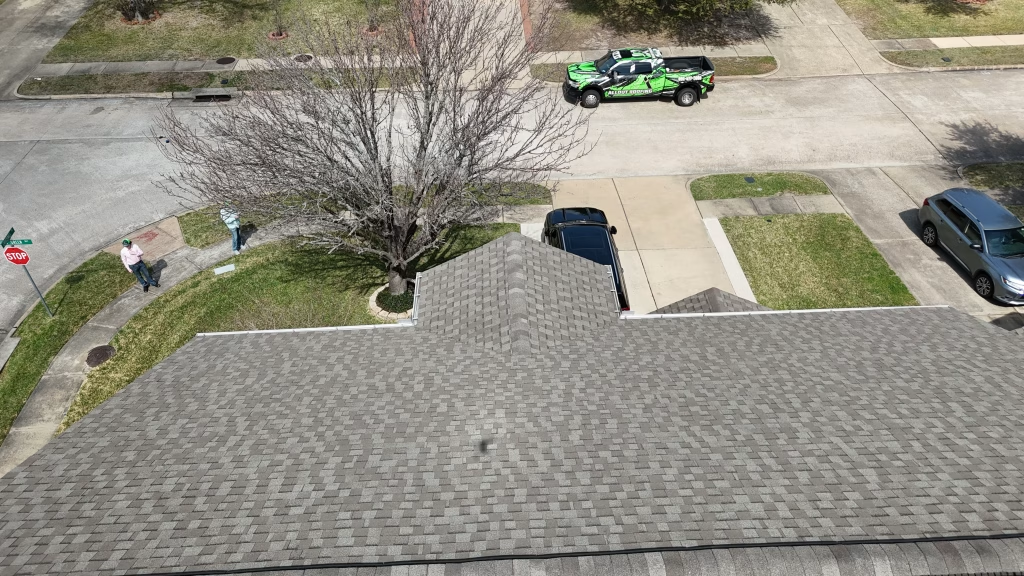
For a typical asphalt-shingle rental in this area, here’s what a reasonable annual roof maintenance program looks like — the kind that catches issues while they’re cheap:
Annual inspection (once a year, roofer on the roof). Not a drone flyover, not a visual from the yard. Someone up there checking flashings, pipe boots, ridge vents, valleys, and shingle condition. Cost in this market: $150-$300 for a standard single-story rental if it’s not tied to a repair estimate, often free if the roofer expects to eventually replace the roof for you. This alone prevents most of the “surprise” $8,000 repair calls I take.
Semi-annual gutter clean. Overflowing gutters cause fascia rot, which turns into decking rot, which turns into a roof edge replacement. Costs $125-$200 per visit if you outsource; a lot less if the tenant handles it as part of the lease (see below).
Post-storm walkaround after any significant wind or hail event. In Katy and Fulshear, that’s typically 2-4 storms a year worth checking. Some tenants will do this themselves and text you photos; some will not. If your tenant isn’t going to, budget for a post-storm inspection call. Same rule as an annual — $150-$300 or free if you have a standing relationship with a roofer.
Reserve fund for the actual replacement. A 25-30 year asphalt shingle roof in this climate typically hits replacement between year 18 and year 24 depending on shingle grade, install quality, and storm exposure. For a 2,000-2,500 sq ft rental, replacement is currently running $12,000-$22,000 depending on shingle grade, pitch, and complexity. If you set aside $60-$90/month per rental in a roof reserve fund starting from year 1 of ownership, you’ll have the replacement paid for when it comes due. Most landlords don’t do this and then it’s a bad surprise.
Total maintenance budget: $300-$600 per year on the running maintenance side, plus the reserve contribution for eventual replacement. Cheap. And it dramatically reduces the number of $5K-$15K “surprise” costs across a rental portfolio. Treat rental property roof maintenance as a fixed annual line item rather than an emergency, and a single storm stops being a cash-flow event.
The tenant-lease side — what to put in the lease
I write and negotiate residential leases in this market regularly. Here’s what actually works on the roof and exterior maintenance side:
Landlord responsibility (industry standard, keep it): Roof, structural components, exterior walls, foundation. Windstorm and hail damage. Any structural or system defects.
Tenant responsibility (worth specifying): Gutter cleaning if they have easy roof access and it’s specified in the lease (some landlords do this, some don’t — either is fine, but be explicit). Reporting any visible roof damage, ceiling stains, or leaks within a specified window (I like 5 business days from discovery). Not allowing anyone on the roof without landlord permission (this comes up more than you’d think — satellite techs, cable installers, tenants themselves trying to hang holiday lights).
Access rights (this is where a lot of leases are weak): Landlord’s right to enter the property for roof inspection with reasonable notice. Texas Property Code requires notice for most non-emergency entries; a well-written lease specifies the notice window (48 hours is standard) and the acceptable methods (email plus text is typical). This matters when you need to send a roofer over on short notice after a storm.
Storm damage protocol: A short paragraph specifying what the tenant should do if they suspect storm damage — take photos, notify landlord within 24 hours, don’t attempt DIY repair — heads off a lot of miscommunication. Insurance claims can hinge on documentation from the first 48 hours.
Insurance requirements: Landlord carries dwelling coverage; tenant carries renters insurance. Requiring tenant renters insurance in the lease is standard practice now and protects both parties (tenant’s belongings are their responsibility; renters insurance is $10-$25/month and covers them).
If any of this is missing from a lease template you’re using, it’s worth updating. I’ve seen too many disputes that a paragraph in the lease would have prevented. If you want an experienced set of eyes on your lease template — from someone who both writes leases and works on the roofs — that’s a conversation I have regularly with landlord clients. A lease that spells out who does what on rental roof maintenance prevents most of these arguments before they start.
Insurance: what your dwelling policy actually covers on the roof
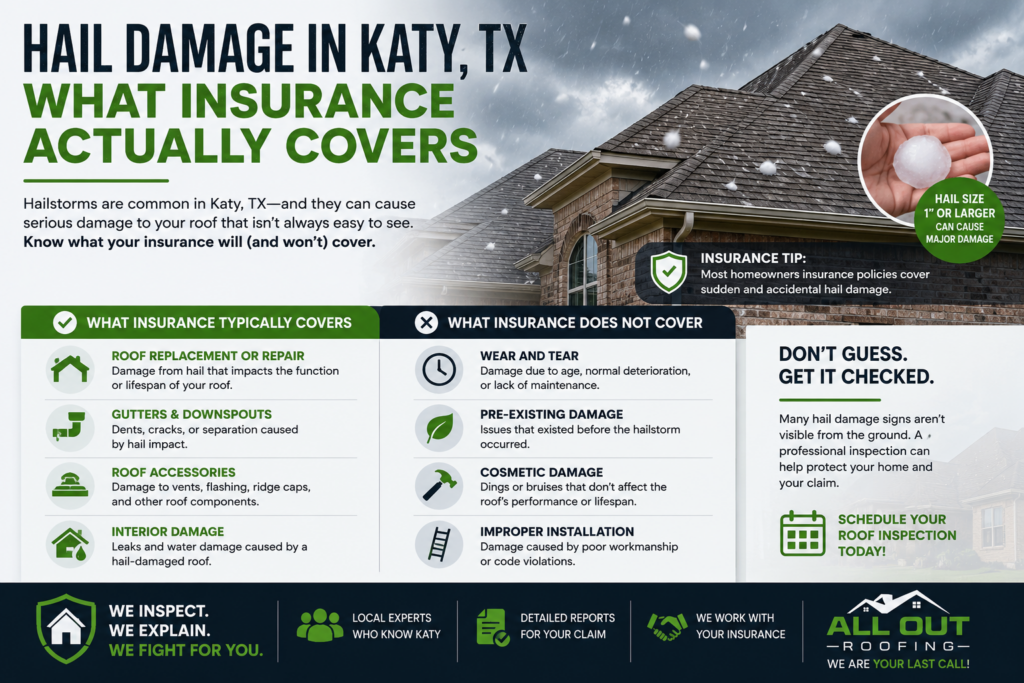
Most landlord policies in Texas are one of three types:
DP-1 (basic dwelling policy): Named-perils only. Covers specific listed events (fire, wind, hail, etc.). Roof damage from unlisted causes may not be covered. Cheapest premium, biggest gaps.
DP-2 (broad form): Named-perils plus a broader list. Still name-based, but the list is longer. Middle ground on premium and coverage.
DP-3 (special form): Open-perils on the dwelling (covers anything not specifically excluded). Named-perils on personal property (which matters less on a rental if you’re not furnishing it). This is the most similar to a homeowner HO-3 policy and the one I recommend to most landlords with rentals over $150K in value.
The roof-specific things to look at on any of these:
- Actual cash value vs. replacement cost. ACV means depreciation is deducted. On a 15-year-old roof, that can cut a payout by 50%. On rental properties specifically, some carriers default to ACV on the roof even when the rest of the dwelling is RCV.
- Wind/hail deductible. Often a percentage of dwelling coverage (1%, 2%, or 5%). On a $300,000 rental with a 2% deductible, that’s $6,000 out of pocket before the policy pays anything.
- Ordinance and law coverage. If a roof replacement triggers an updated building code requirement (new decking, updated underlayment, new drip edge), does the policy cover the code-upgrade cost? Not always by default.
- Vacancy exclusion. If the property sits vacant for more than a specified window (often 60 days between tenants), some policies pause or reduce coverage. Worth knowing if you’re between leases.
- Statute of limitations on claims. Texas allows generally two years from date of loss for most claims, but specific policies may set shorter windows. Don’t sit on a storm claim.
Spend one hour with your insurance agent — not to shop, just to actually read the current policy — and you’ll know whether the coverage matches the risk. This alone catches more problems than any other single move. It is also worth an hour with the Texas Department of Insurance home insurance guide, because the policy language decides how much of your rental property roof maintenance a carrier will ever reimburse.
Tenant damage vs. storm damage — how to tell the difference
Sometimes the tenant reports “we have a leak” and you’re not sure whether it’s a maintenance issue, a storm issue, or a tenant-caused issue. This matters because who pays depends on the answer.
Signs it’s storm damage (landlord’s problem, likely insurance-covered):
– Recent significant wind or hail event on the NOAA record
– Visible shingle loss or lifted shingles in a pattern (usually on the windward side)
– Impact marks on shingles, gutters, soft metal (a hail claim signature)
– Multiple houses in the same street reporting similar issues
– Damage location aligned with the storm’s direction
Signs it’s normal wear (landlord’s problem, but likely not insurance-covered):
– Roof is 18+ years old with no recent storm
– Cracked or curled shingles across the whole roof, not concentrated in one area
– Granule loss (bald spots) from age
– Flashings that have dried out and cracked at pipe boots
– Pipe boot cracks (common on 10-15 year old rentals — cheap fix, but ignored becomes an interior leak)
Signs it’s tenant-caused (potentially tenant responsibility):
– Roof damage in a location where the tenant had access (holiday lights nailed into shingles, satellite dish drilled through shingles, damage from someone walking on a slope they shouldn’t have)
– Interior water damage caused by tenant plumbing (bathtub overflow, washer supply leak) that’s been mistaken for a roof leak
– Damage from unauthorized modifications
The middle category — normal wear-and-tear — is the one that leads to the most homeowner vs. tenant confusion. It’s the landlord’s problem, but it’s not going to be paid by insurance. This is why the reserve fund matters. A 20-year-old rental roof that fails from age gets replaced on your dime — knowing that ahead of time and having the money set aside is a very different experience than being surprised by it. Documented rental property roof maintenance — dated photos from every annual inspection — is what settles this middle category.
The repair-vs-replace decision on a rental property roof
The most common question I get from landlords: “Should I patch it or replace it?”
The rule of thumb I use:
Almost always repair when:
– Roof is under 12 years old and damage is localized
– Damage is a discrete storm event on a shingle system with life left
– Full replacement won’t happen for another 5+ years and the repair costs less than a year’s insurance deductible
Almost always replace when:
– Roof is 20+ years old with multiple issues
– Repairs have become annual (you’ve paid for 3-4 patches in the last 3 years)
– Insurance has moved to ACV or is non-renewing on age
– You’re planning to sell within 12 months and the roof age is a listing-price problem (see the cross-domain note below)
Judgment call in between:
– Roof is 15-19 years old with a specific claim-worthy storm event
– Repairs would cost 30-50% of the replacement cost
– Tenant turnover is coming up and the property could re-lease at a higher rent post-replacement
The judgment-call zone is where the cross-domain lens matters. If I’m looking at a 17-year-old roof on a rental that’s turning over in 4 months, and the roof would list the property $8K-$15K stronger on the resale side, and the current tenant is fine with a scheduled replacement mid-lease, the math often favors replacing now — even without insurance coverage. Not because the roof “has to” be replaced, but because the timing lines up. I’ve talked more than a few landlord clients through exactly this. On a rental, that call gets easier when you have a rental property roof maintenance record showing what was inspected and repaired each year.
The one rental roof maintenance investment that consistently pays back
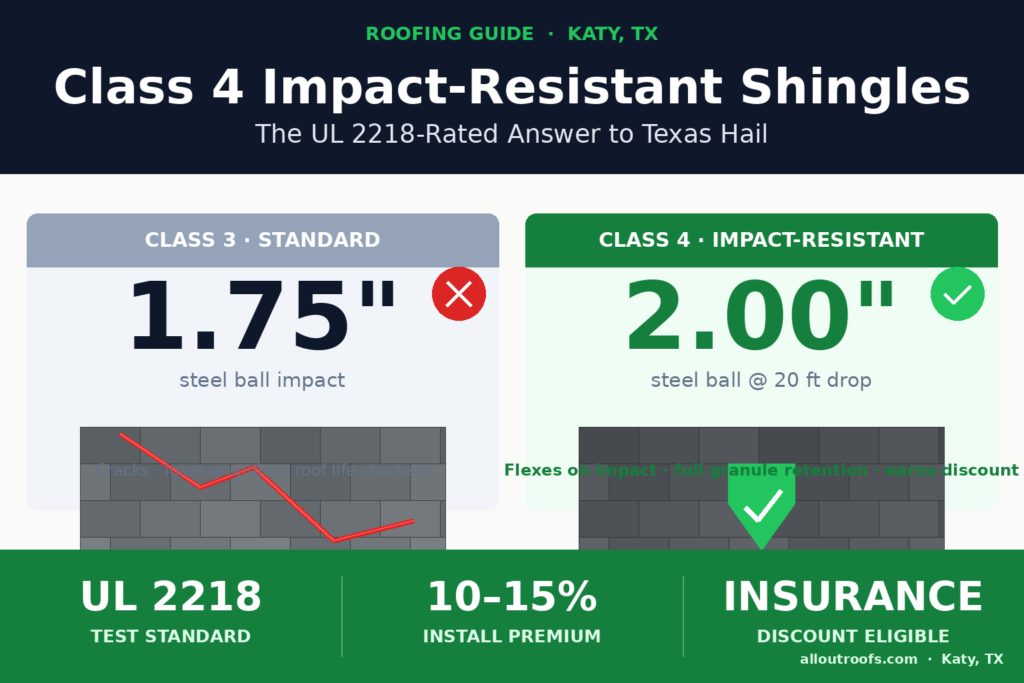
Impact-resistant shingles (Class 4). At current pricing in this market, upgrading from a standard Class 3 architectural shingle to a Class 4 impact-resistant shingle costs an additional $1,000-$2,500 on a typical 2,000-2,500 sq ft rental at replacement time. In exchange:
- Most Texas homeowner and dwelling insurance policies offer a windstorm/hail discount for Class 4 shingles — often 15-30% off the wind/hail portion of the premium (IBHS publishes impact-test rankings for asphalt shingles.)
- The shingles have measurably better hail performance in this climate (this is not marketing — the UL 2218 impact rating is a real test)
- On resale, the “impact-resistant shingles” line item on a listing is a real value signal for buyers in this market who are increasingly aware of the insurance issue
The premium discount alone often pays back the upgrade cost within 5-7 years, and everything after that is money in your pocket. On a long-hold rental, it’s the closest thing to a no-brainer decision I can point to on the roof side. It is the one upgrade that lowers your rental roof maintenance cost and your premium at the same time.
Where the cross-domain lens matters
If you own rental property in this market, at some point you’re going to think about selling one or more of them. The roof and the sale are more connected than most landlords assume. A few things I see regularly: Rental property roof maintenance is where those two conversations meet.
- Roof age is one of the top three questions a buyer’s inspector will flag. Anything over 15 years gets a report note. Anything over 20 gets a repair-or-replace conversation.
- Insurance transferability is a real issue. A buyer who can’t get insurance on the property because of roof age has to bail on the deal. This kills more sales than people realize.
- The math of “replace before listing” vs. “credit at close” is specific. Sometimes credit is cheaper. Sometimes replacement gets you a higher list price by more than the replacement cost. It’s a spreadsheet, and the answer varies by property.
That’s a longer conversation for another post. But if you’re thinking about the sale side of a rental — even 12-24 months out — the roof is worth planning for now, not scrambling for at listing.
About the author
Brent Burgin is the owner and operator of All Out Roofing, a licensed local roofing contractor serving Katy, Houston, Cypress, Fulshear, and surrounding communities. Brent has lived in the Katy/Fulshear area since age 7 and is also a licensed Texas real estate agent (TREC #630213, with Terra Point Realty since 2013) with a residential leasing practice that includes 75+ closed leases in this market. That cross-domain background — active roofer, active landlord-side real estate practice — is unusual and it shapes how he thinks about rental-property roof decisions. All Out Roofing installs CertainTeed, GAF, Tamko, Owens Corning shingle systems and an economy shingle.
If you own rental property in the Katy, Fulshear, Richmond, or Cypress area and want a walkthrough on the roof — no pressure, no charge — call us at (281) 769-4282 or reach out through the contact form. If you also want a read on the lease-side or eventual-sale-side implications, that’s the same phone call. We can talk through both.
All Out Roofing, LLC — 25220 Kingsland Blvd, Ste 100, Katy, TX 77494. Available 24/7 for storm response.