
Hail Damage Roof Repair in Katy & Houston, TX
Hail Damage Roof Repair: Inspection, Insurance & Replacement
Texas leads the nation in hail damage claims year after year, and the Katy–Fulshear–Cypress corridor sits squarely inside the state’s most active hail belt. When a storm rolls through, the damage isn’t always the kind you can see from the driveway. Hail can bruise shingles, strip protective granules, fracture roofing materials, and dent metal components in ways that don’t leak on day one — but silently shorten the life of your roof by five, ten, even fifteen years.
At All Out Roofing, we’ve been inspecting and replacing hail-damaged roofs across the greater Houston area since 2023. We’re a Katy-based, locally owned contractor with CertainTeed Master Craftsman and Shingle Quality Specialist credentials, and every roof is installed to manufacturer specifications. That matters when insurance is involved, because our documentation is the kind adjusters take seriously.
If a recent storm rolled through your neighborhood, this page walks you through what hail actually does to a roof, how to spot damage, how insurance claims work in Texas, and when it’s time to call us out for a free inspection.
Your Roof. Our Mission.
📞 Call (281) 769-4282 for a free hail damage inspection.
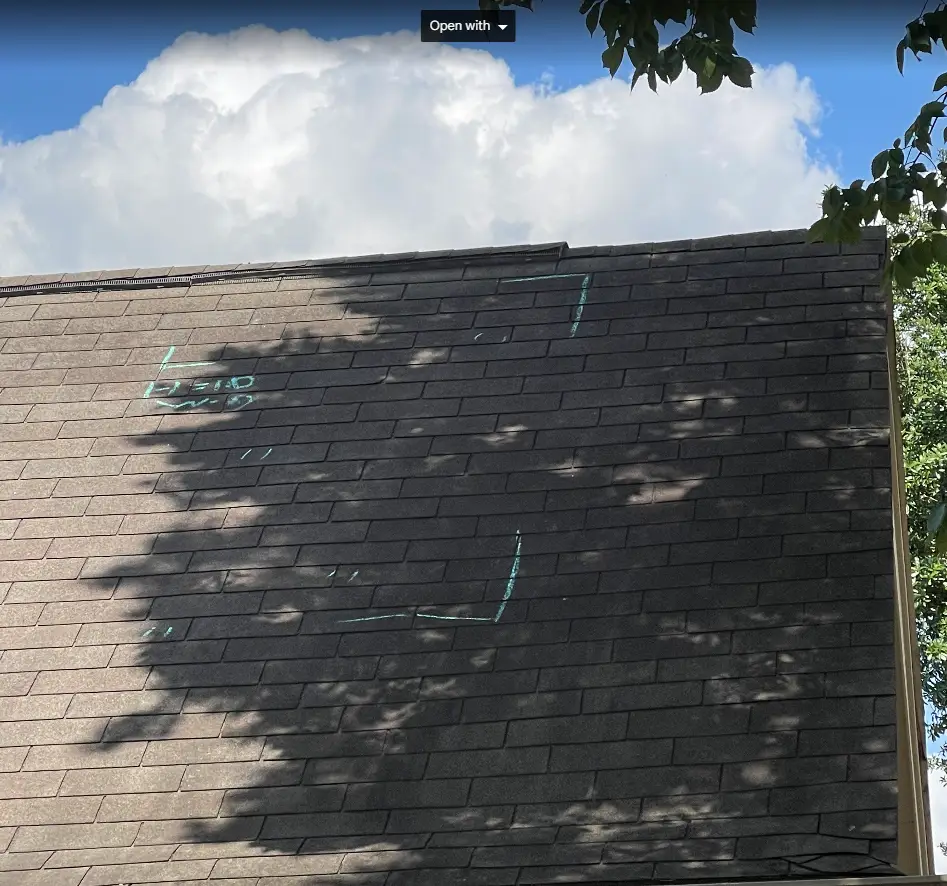
Living in Texas Hail Alley: What Homeowners Need to Know
Texas consistently ranks as the #1 state in the country for hail damage claims, and the Houston metro sees some of the most frequent and severe hail events in the state. The 2024 and 2025 storm seasons brought multiple significant hail events to Fort Bend, Harris, and Waller Counties, and the 2026 spring season has already produced several damaging storms across our service area.
Communities like Cross Creek Ranch, Firethorne, Cinco Ranch, Cane Island, Bridgeland, Fulshear, and the Villages of Cypress Lakes are all located in zones that regularly experience hail events large enough to cause functional roof damage — meaning damage that affects how the roof performs, not just how it looks.
The tricky part: hail damage is cumulative. A roof that was hit by pea-sized hail three years ago and quarter-sized hail last spring has been compromised twice, even if you never noticed. Each event weakens the shingle mat and accelerates granule loss. That’s why homeowners in this region should have their roofs inspected after every significant hail event, not just the ones that produce visible dents on the truck.
Check Texas Hail Reports for Your Address →
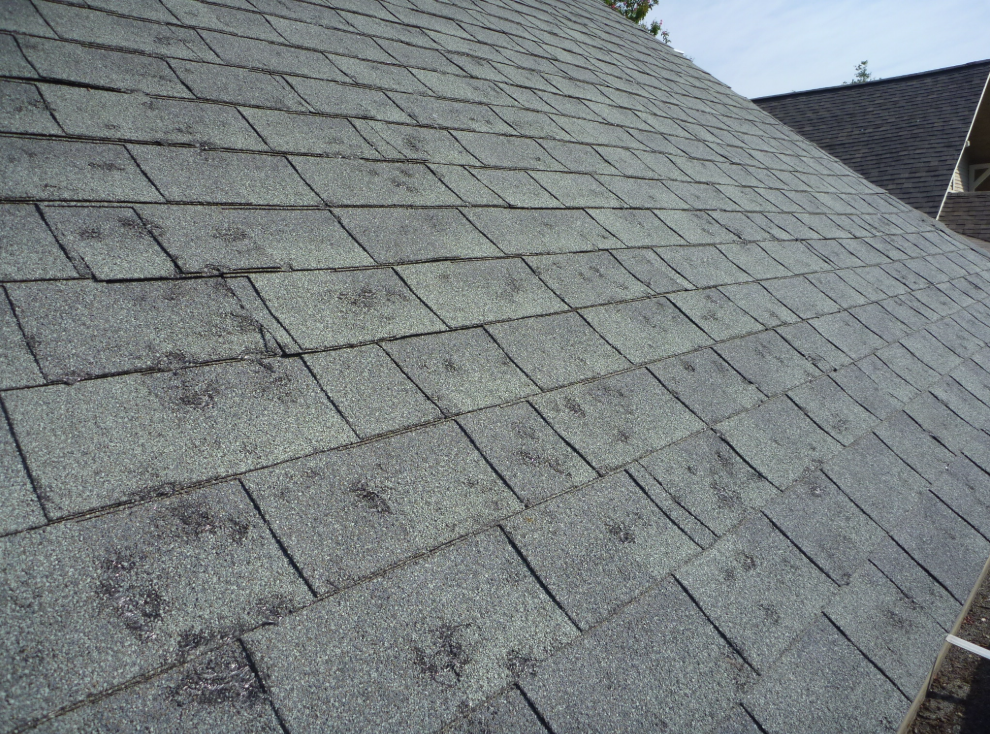
How Hail Damages Your Roof (Even When You Can’t See It)
Hail damage varies with hail size, wind speed, storm duration, angle of impact, and the age and material of the roof itself. On asphalt shingles — the most common residential roofing in Texas — hail causes damage in four primary ways:
- Bruising: The impact fractures the fiberglass mat beneath the shingle surface. From above, the bruise may only appear as a soft, darker spot. Underneath, the shingle’s structural integrity is broken.
- Granule loss: Hail knocks loose the ceramic granules that protect the asphalt from UV radiation. Once those granules are gone, the exposed asphalt bakes in the Texas sun and ages years in a matter of months.
- Cracks and fractures: Older or brittle shingles can crack outright on impact, leaving splits that allow water intrusion during the next storm.
- Dents on metal components: Vents, flashing, ridge caps, gutters, gutter guards, HVAC fins, and metal roofing panels can all be dented or compromised. These are often the easiest signs to spot from the ground.
What most homeowners don’t realize: a hail-damaged roof that isn’t leaking today can still be a failed roof within 18 to 36 months. UV exposure and thermal cycling accelerate the deterioration of a compromised shingle mat, and by the time water reaches your attic or ceiling, you’re often past the insurance filing window.
Hail Size and Roof Damage Severity Guide
The size of the hail — not just its presence — determines the likelihood of functional damage. Here’s what we generally see across our inspections:
| Hail Size | Comparison | Typical Roof Damage |
|---|---|---|
| ½” | Marble / Pea | Minor granule loss, usually cosmetic |
| ¾” | Penny / Nickel | Granule loss, possible bruising on older roofs |
| 1″ | Quarter | Functional damage threshold — insurance carriers commonly recognize damage at this size |
| 1¼” | Half Dollar | Widespread bruising, cracked shingles likely |
| 1½” | Walnut / Ping-Pong Ball | Significant functional damage; full replacement often warranted |
| 1¾” | Golf Ball | Severe damage across most of the roof |
| 2″+ | Tennis Ball / Baseball | Catastrophic damage; roof, siding, windows, and vehicles typically all affected |
Even sub-1″ hail can cause functional damage on roofs that are 10+ years old or on lower-grade 3-tab shingles. Age, material quality, and previous storm history all factor in.
Signs Your Roof Has Hail Damage
Never climb on your roof to check for hail damage. Beyond the safety risk, walking on a hail-damaged roof can cause additional shingle damage and complicate an insurance claim.
Here’s what you can safely check from the ground:
Around the property:
- Dents in your gutters, downspouts, or gutter guards
- Dents in metal flashing, vents, or ridge caps visible from the ground
- Dented AC condenser fins on your outdoor unit
- Damaged window screens, siding, garage doors, or fence tops
- Pockmarks or dents on vehicles that were parked outside during the storm
- Bruises or holes in outdoor cushions, deck furniture, or grill covers
At the base of downspouts:
- Piles of small ceramic granules — these look like coarse black sand and are the shingle’s protective coating washed off by rain
Inside your home:
- Fresh water stains on ceilings or in the attic (usually a later-stage symptom)
- Daylight visible through the roof deck when you’re in the attic (severe)
If you spot any of these — or if your neighbors are having roofs replaced — schedule a professional inspection right away. Insurance carriers have filing deadlines, and the closer you are to the storm date, the smoother the claim.
👉 Schedule a Free Hail Damage Inspection
According to research from the Insurance Institute for Business & Home Safety (IBHS), hail impacts can cause functional roof damage even when leaks are not immediately visible, leading to premature roof failure over time.
What to Do After a Texas Hailstorm — Step-by-Step
The first 72 hours after a hailstorm matter. Here’s the sequence we recommend to homeowners:
- Document the storm. Save weather alerts, screenshots of local news coverage, and any photos or video you took during the storm. Note the exact date and time.
- Photograph ground-level damage. Walk your property with a phone camera. Photograph dented gutters, damaged screens, dented vehicles, and any debris — but stay off the roof.
- Check with neighbors. If houses on your street are being inspected or already have “Roof Replacement” signs going up, your roof was likely in the same impact zone.
- Schedule a professional inspection. Call us at (281) 769-4282. We’ll document the damage with photographs, measurements, and a written report suitable for your insurance carrier.
- Do not file the claim before the inspection. If there’s no damage, there’s no reason to file. If there is damage, our report gives you leverage in the claim conversation.
- File the claim promptly. Most Texas policies require you to file within a reasonable time, and some carriers push that window as tight as one year. Sooner is always better.
- Meet the adjuster with your contractor present. This is one of the most important steps. We attend the adjuster meeting on your behalf so nothing gets missed.
📞 (281) 769-4282 — We can typically inspect within 24–48 hours of a major storm event.
Filing a Hail Damage Insurance Claim in Texas
Texas has some of the more contractor-unfriendly insurance regulations in the country, largely due to House Bill 1774, which passed in 2017 and reduced penalty interest and attorney’s fees for late claim payments. What that means for homeowners: you have to file correctly, and you have to file with proper documentation, or you risk a lowball payout or an outright denial.
Here’s what to know:
- Deductibles are usually percentage-based. Wind and hail deductibles in Texas are typically 1%, 2%, or 3% of your dwelling coverage — not the flat $500 or $1,000 many homeowners assume. Check your declarations page before filing.
- ACV vs. RCV coverage matters. Actual Cash Value policies pay depreciated value; Replacement Cost Value policies pay full replacement (usually in two checks — one at claim approval, one after work is completed). We help homeowners understand which they have.
- Do not authorize temporary or permanent repairs before the adjuster inspects — unless the damage is causing active interior water intrusion. Any modification to the roof before the adjuster inspection can weaken your claim.
- Get every damaged component documented. Adjusters sometimes miss vents, flashing, ridge caps, gutters, or damage to secondary structures like garages and sheds. Our inspection reports include all of them.
We work directly with adjusters from every major carrier — State Farm, Allstate, Farmers, USAA, Travelers, Nationwide, Liberty Mutual, Progressive, Chubb, and more. Our job is to make sure the scope of loss reflects the actual damage.
Full Insurance Claim Assistance →
Hail Damage vs. Wind Damage: What’s the Difference?
Most Texas storms produce both, but they show up differently on your roof and are diagnosed differently on inspection.
| Wind Damage | Hail Damage | |
|---|---|---|
| What it looks like | Lifted, creased, or missing shingles | Bruised, cracked shingles; granule loss; dented metal |
| Underlying failure | Seal strip failure between shingles | Shingle mat fracture; loss of UV protection |
| When it leaks | Often immediately or in the next rain | Often 6–36 months later |
| Where damage concentrates | Windward slopes; edges; ridge | Random pattern across all exposed slopes |
| Common secondary damage | Fascia, soffit, gutters torn loose | Screens, siding, HVAC fins, vehicles dented |
Many storms leave both types of damage on the same roof, and insurance treats them under the same “wind and hail” peril. Our inspections document both.
Why Homeowners Choose All Out Roofing for Hail Damage
- CertainTeed Master Craftsman — the highest tier of installer certification CertainTeed offers
- CertainTeed Shingle Quality Specialist — team-level product training certification
- Locally owned in Katy, TX — we live and work in the neighborhoods we serve
- Insurance-ready documentation — reports written to the standard adjusters expect
- We meet the adjuster with you — one of the highest-leverage steps in the claim process
- No pressure, no gimmicks — if you don’t have damage, we tell you so
- Financing available — Acorn Finance from 6.49% APR, plus GoodLeap options for deductible or upgrade financing
- All Out Armor Club — membership program for ongoing roof protection and maintenance
According to research from the Insurance Institute for Business & Home Safety (IBHS), impact-rated roofing products can reduce hail damage severity dramatically. As part of our replacement recommendations, we often walk homeowners through Class 3 and Class 4 impact-rated shingle options — some of which qualify for insurance premium discounts in Texas.
Our Free Hail Damage Inspection: What to Expect
When you schedule an inspection, here’s what happens:
- Scheduling call: We confirm the appointment, usually within 24–48 hours of your request.
- On-site walkthrough: Our inspector arrives in a marked All Out Roofing vehicle, in uniform, with credentials.
- Exterior inspection: We photograph gutters, siding, windows, vents, HVAC, and secondary structures.
- Roof inspection: Our inspector safely climbs the roof (with proper harnessing) and photographs every slope, flashing detail, penetration, and damaged shingle.
- Attic inspection: When accessible, we check the attic for prior leaks, ventilation issues, and signs of decking damage.
- Report delivery: You receive a full photo report — usually the same day or next business day — along with our written recommendation.
- Next steps: If damage warrants a claim, we walk you through filing. If it doesn’t, we tell you plainly.
No obligation. No pressure. Your Roof. Our Mission.
📞 Call (281) 769-4282 or Book Online →
Schedule a Free Hail Damage Roof Inspection
If your home in Katy, Fulshear, Houston, Spring, or Cypress was recently hit by a hailstorm, don’t wait for leaks to appear.
✔ No-obligation inspection
✔ Insurance-ready documentation
✔ Experienced local storm damage professionals
Not sure how bad the storm was in your neighborhood? Check the Houston-area hail map for recent hail reports near you.
Schedule a Free Hail Damage Inspection
Hail Damage Roof Repair FAQs
How do I know if my roof has hail damage?
Hail damage usually appears as bruised shingles, granule loss piling up at downspouts, cracked or fractured shingles, and dented vents, flashing, ridge caps, or gutters. Ground-level indicators like dented gutters, damaged screens, or granules in the gutter run are strong clues, but a professional inspection is the only reliable way to confirm functional damage.
How big does hail have to be to damage a roof?
One-inch hail (quarter-sized) is the threshold most insurance carriers use to recognize functional damage on asphalt shingles. Smaller hail can still cause damage on older or lower-grade shingles, especially in storms with high wind speeds.
Does hail damage always require a full roof replacement?
Not always. Small, isolated damage can sometimes be repaired. But widespread bruising, damage on older roofs, or damage across multiple slopes typically warrants a full replacement — and insurance carriers usually approve it under those conditions.
Is hail damage covered by homeowners insurance in Texas?
Yes, in nearly every standard Texas homeowners policy. Hail damage falls under the “wind and hail” peril and is one of the most commonly approved claim types in the state. Deductibles are usually a percentage of dwelling coverage (1%, 2%, or 3%), so review your declarations page before filing.
How long do I have to file a hail damage claim in Texas?
Most Texas policies require the claim to be filed within one year of the storm event, and some carriers push for even shorter windows. Sooner is always better — the closer you file to the storm date, the smoother the claim.
Will filing a claim raise my insurance rates?
In Texas, single hail damage claims typically don’t raise premiums, because hail is considered an act of nature, not the homeowner’s fault. Multiple claims across a short window can affect rates, but a single storm claim usually doesn’t. Check with your agent for your specific policy.
What’s the difference between ACV and RCV coverage?
Actual Cash Value (ACV) pays out the depreciated value of your roof — often a fraction of what a new roof costs. Replacement Cost Value (RCV) pays full replacement cost, typically in two checks: one when the claim is approved (minus depreciation and deductible), and a second “depreciation release” check after work is completed. RCV is what you want, and we help you make sure you’re getting what your policy owes you.
Can I get a new roof without paying my deductible?
No. In Texas, it is illegal for a roofing contractor to waive, absorb, or rebate a homeowner’s insurance deductible. Any contractor who offers to do so is violating Texas law and putting your claim at risk. We follow Texas law to the letter, and we offer financing to help homeowners cover the deductible responsibly.
How long does a hail damage roof replacement take?
Most residential hail replacements in the Katy/Houston area take one to two days once materials are on-site. Timing from claim approval to installation typically runs one to three weeks, depending on carrier processing and material availability.
Do you work with my insurance company?
Yes. We work with every major insurance carrier operating in Texas and are experienced with the claim scope conversation. We attend the adjuster meeting on your behalf and document any damage the adjuster may have missed.
Ready to Get Started?
If a storm rolled through your neighborhood, don’t wait for the leak to show up in your living room ceiling. Hail damage worsens with every UV cycle, every rainstorm, and every temperature swing — and insurance windows close fast.
✔ Free, no-obligation inspection ✔ Insurance-ready documentation ✔ CertainTeed-certified installers ✔ Locally owned, Katy-based
📞 Call (281) 769-4282 📧 info@alloutroofs.com 📍 25220 Kingsland Blvd, Ste 100, Katy, TX 77493
Schedule Your Free Hail Damage Inspection →