If you have stood in your attic in July around three in the afternoon, you already know the problem an attic radiant barrier is meant to solve. It is 135°F up there, your air conditioner has been running since ten in the morning, and the flex duct carrying cold air to your bedrooms is snaking through the middle of it.
A radiant barrier is one of the more effective things you can do about that. It is also one of the most oversold products in my trade, and the gap between what it actually does and what it gets advertised as doing is wide enough to be worth a whole post.
Here is the honest version: what a radiant barrier is, the real numbers on what it saves, when it is worth installing in a Katy home, and when it will do almost nothing for you.
What an attic radiant barrier actually is
Heat moves three ways. Conduction is heat traveling through a solid. Convection is heat carried by moving air. Radiation is heat traveling as infrared energy across open space, which is how the sun heats your roof and how your roof deck then heats everything below it.
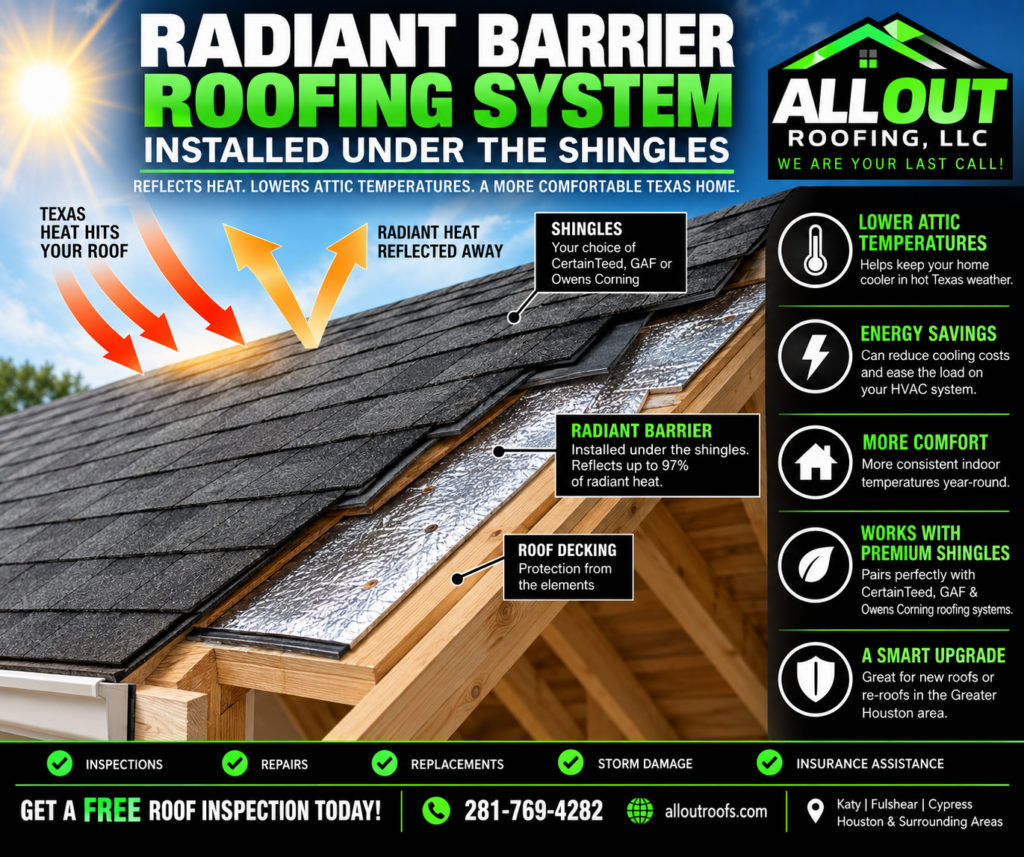
Regular attic insulation — the blown fiberglass or cellulose on your attic floor — is good at slowing conduction and convection. It does very little about radiation. That is the gap a radiant barrier fills. It is a reflective aluminum surface, installed facing an open air space, that bounces infrared energy back toward the roof deck instead of letting it radiate down into your attic.
The critical detail, and the one most homeowners miss: it only works facing an air gap. Lay reflective foil flat on top of your insulation where it can collect dust and touch the material below and you have mostly wasted your money. It has to face open space, and it has to stay reasonably clean.
There are three ways it gets installed in our area:
Foil-faced roof decking. The radiant barrier is bonded to the OSB at the factory, foil side down. This only happens during a reroof or new construction, because it is the decking. It stays clean forever and it is the version I like most.
Staple-up foil. Sheets stapled to the underside of the rafters, foil facing down into the attic. Retrofit-friendly, works well, and it is labor-intensive in a low-clearance attic.
Spray-applied reflective coating. Sprayed onto the underside of the decking. Faster to install in tight attics, and generally less effective than true foil because the emissivity is not as low.
The U.S. Department of Energy’s Energy Saver guide to radiant barriers is a good neutral primer if you want the physics without a sales pitch attached.
The real numbers
This is where I part ways with a lot of the marketing.
The U.S. Department of Energy’s Building America program has the clearest published figures, and they are refreshingly direct about the overselling. A radiant barrier system can reduce the heat flowing from your attic into your house by roughly 40%.
Forty percent sounds enormous, and this is exactly where the sales pitch usually stops. The DOE guidance does not stop there. It goes out of its way to say what that number does not mean: it does not mean a 40% cut in your energy use. The attic is one component of your total cooling load. Cut that one component by 40% and you typically land at 8% to 12% of annual cooling costs.
On a Katy summer bill, 8% to 12% of cooling is real money, and it recurs every year for the life of the house. It is not a product that pays for itself in one season, and anybody who tells you otherwise is quoting you the 40% number without the context.
Two caveats from the same DOE guidance decide whether you are at the top or the bottom of that range:
Your existing insulation level. If your attic is already at R-30 or better, there is less heat flow left to block, and the barrier’s contribution shrinks. If you can see the tops of your ceiling joists when you look across the attic floor, you are under-insulated — and adding insulation is a cheaper first move with a better return than a radiant barrier.
Where your ductwork runs. This is the one that matters most in Katy. If your air handler and ducts are in the attic — and in most homes here built in the last thirty years, they are — then lowering the attic air temperature means your cold air is traveling through a cooler space and arriving colder. That benefit stacks on top of the ceiling heat reduction, and it is the single biggest reason radiant barriers perform better in Houston-area homes than national averages suggest.
DOE points to Oak Ridge National Laboratory’s radiant barrier calculator if you want to model your specific house rather than take a contractor’s word for it. I would rather you run it.
When it is worth it in a Katy home
The honest decision tree I use:
Strong candidate. Ducts in the attic, insulation at or below R-19, single-story or with bedrooms directly under the attic, and a roof that gets full afternoon sun. This is a large share of the older Katy housing stock, and the comfort difference in upstairs rooms is usually noticeable, not just theoretical.
Good candidate, but do insulation first. Ducts in the attic but insulation is thin. Bring the insulation up to current levels, then add the barrier. Doing it in that order costs less and gets you more.
Marginal. Already at R-38, ducts in conditioned space, heavily shaded roof. The physics still works, but the payback stretches out far enough that I would not push it.
Do this instead. If your attic is under-ventilated, fix that first. A radiant barrier in an attic with no working exhaust path is treating a symptom. Balanced intake and exhaust is the foundation everything else sits on, and I walk through how that actually works in our guide to attic ventilation methods that work in Texas heat. There is also a fair amount of bad information circulating on this topic, which we sorted through in the attic ventilation problems homeowners miss.
What it costs, and the one lever that changes everything
Radiant barrier pricing depends on attic square footage, how much headroom the crew has to work in, and which of the three install methods fits your house. A low-clearance attic full of ductwork takes far longer to staple than an open, walkable one, and that labor difference is most of the spread between quotes. Rather than quote you a number that will not match your house, I would rather come measure it.
But there is one lever worth knowing about before you get any quotes.
If you are replacing your roof anyway, the foil-faced decking option costs a fraction of what a retrofit costs later. The decking is coming off regardless. Upgrading to foil-faced OSB is a material upgrade on a line item you are already paying for, with no additional labor to access the space. The same barrier installed as a standalone retrofit two years later means paying a crew to get into your attic and work overhead in the heat for a day or two.
So the sequencing advice is simple. If your roof has years left, price the staple-up retrofit on its own merits. If your roof is near the end — or a storm just took it — that is the cheapest radiant barrier you will ever buy, and it should be a line item on the bid. Our 2026 roof replacement cost guide for Katy covers how the rest of that pricing breaks down.
What it will not do
A few things I want to set straight, because I get asked:
It will not fix a hot upstairs caused by duct leakage. If your ducts are leaking conditioned air into the attic, you are paying to cool the attic. A radiant barrier lowers the temperature of the space you are wasting air into. Seal the ducts.
It will not replace insulation. They address different heat-transfer mechanisms. A barrier is a supplement to adequate insulation, never a substitute for it.
It will not lower your bill in winter by much. The benefit is overwhelmingly a cooling-season benefit. In our climate that is most of the year, so it still pencils out — but do not expect a January difference.
It does not void your shingle warranty, which is the question I get most often. Properly installed foil-faced decking or staple-up foil does not trap heat against the shingles in any way manufacturers penalize, provided your attic ventilation is adequate. That last clause is doing real work, which is why ventilation comes first.
Where to start
Go up in your attic on a hot afternoon and look at three things: how deep your insulation is, whether your ducts are up there, and whether you can feel or see any air movement at the ridge and the soffits. Those three observations tell you most of what you need to know about whether a radiant barrier is your next dollar or your fourth dollar.
If you want a second set of eyes on it, we will come look and tell you straight — including when the answer is that your money is better spent on insulation or duct sealing than on anything we would install. That happens often enough that I would rather say it up front. Call us at (281) 769-4282 whenever it works for you.
About the author
About the author — Brent Burgin is the owner and operator of All Out Roofing, a licensed local roofing contractor serving Katy, Houston, Cypress, Fulshear, and surrounding communities. Brent has lived in the Katy/Fulshear area since age 7 and is also a licensed Texas real estate agent (TREC #630213, with Terra Point Realty since 2013) — a cross-domain background that helps homeowners think through roof decisions in the context of their home’s overall value and any pending real estate transactions. Brent is a CertainTeed Master Craftsman and Shingle Quality Specialist, and All Out Roofing also installs GAF and Owens Corning shingle systems. Attic questions are his favorite kind, because the answer is so often cheaper than the caller expected.
All Out Roofing, LLC — 25220 Kingsland Blvd, Ste 100, Katy, TX 77494. Available 24/7 for storm response.