
Somebody asks me about asphalt vs architectural shingles just about every week, usually standing in a driveway pointing up at a roof. It is a fair question with a confusing name, and the confusion costs people money — either they pay for an upgrade the house did not need, or they take the cheapest line on the bid sheet without knowing what they gave up.
So here is the straight version of asphalt vs architectural shingles. What each one actually is, how they differ in ways you will notice, what your builder most likely nailed to your house, and when spending more makes sense in Katy specifically.
There are houses where the cheaper shingle is the right call, and I will tell you which ones.
Why the asphalt vs architectural shingles comparison is worded wrong
Start here, because one sentence clears up most of it: architectural shingles are asphalt shingles.
Asphalt is the material. Nearly every residential shingle in Katy is an asphalt shingle — a fiberglass mat saturated in asphalt, surfaced with mineral granules. So when people compare asphalt vs architectural shingles, what they are really comparing is two styles of asphalt shingle:
3-tab. A single flat layer cut with two slots, so each strip reads as three tabs and the finished roof looks like a grid of uniform rectangles.
Architectural, also called dimensional or laminated. Two or more layers bonded together and cut irregularly, so the roof carries shadow lines and depth.
The trade did not help by letting “asphalt shingle” drift into meaning “the cheap 3-tab kind” in casual use. If a salesman says he is quoting you asphalt and cannot tell you whether it is 3-tab or laminated, that is your first question — and how he answers it tells you something. If you want the cross-section, we took a shingle apart layer by layer in what is actually under your shingles.
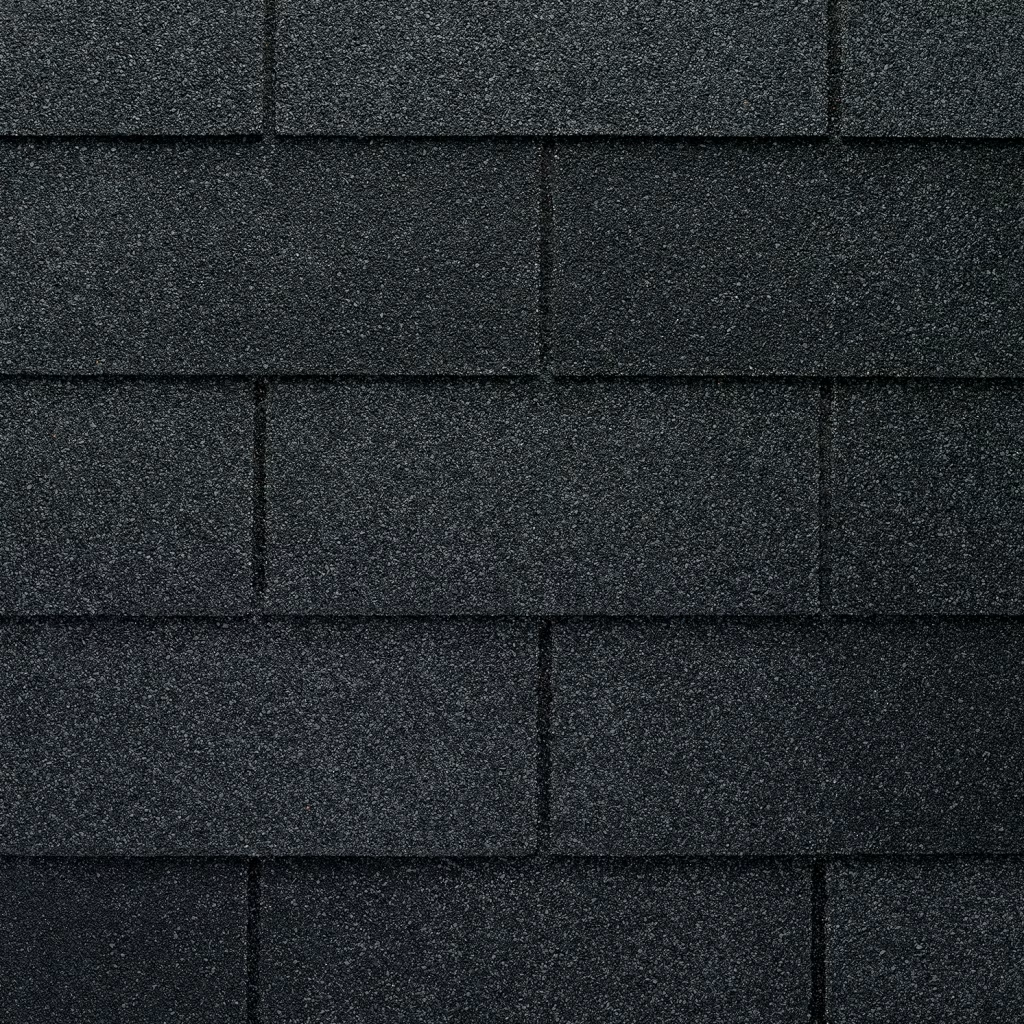
The 3-tab shingle, and why your builder liked it
A 3-tab shingle is one layer of mat, roughly an eighth of an inch thick, cut so a 36-inch strip presents three tabs. It was the default residential shingle in this country for decades and it is still manufactured today.
In an asphalt vs architectural shingles quote, this is the low line. What it has going for it: it is the cheapest shingle on the truck, it is light, and on a simple gable roof it goes down fast. Put that on a builder’s budget across six hundred houses in a 1998 subdivision and the math is hard to argue with. Nobody was cheating anybody. It was the standard.
What it does not have is weight, wind rating, or much of a warranty. Most 3-tab lines carry a 20- to 25-year limited warranty and a wind rating in the 60 to 70 mph range. Katy sees gusts past that in an ordinary spring squall line, never mind a landfalling hurricane. A 3-tab roof also telegraphs every dip in the decking, because there is no second layer to break up the plane.
The failure I see most often on 3-tab here is not dramatic. Tabs go brittle under UV, the sealant strip lets go, a 55 mph gust lifts a course off a rake edge, and then it rains into the attic.
The architectural shingle, and what the extra layer buys
An architectural shingle laminates a second layer — sometimes a third — onto the base mat in a staggered pattern. That is the whole trick, and it changes four things at once.
Weight. Meaningfully heavier per square than 3-tab, depending on the line. Heavier shingles lie down better and give wind less to grab.
Wind rating. Most current laminated lines are rated to 110 mph, and to 130 mph when they are installed with the manufacturer’s enhanced nailing pattern and matched starter and hip-and-ridge products. That last clause is where crews cut corners, so get it in writing on the proposal.
Warranty. Usually a limited lifetime warranty rather than 25 years, with longer algae and wind coverage attached.
Appearance. The irregular cut throws shadow lines, which hides minor decking imperfections instead of announcing them.
The lines we install most in this market are CertainTeed Landmark, GAF Timberline HDZ, and Owens Corning Duration. All three are mid-grade laminated shingles, all three are good products, and the difference between them matters far less than whether the crew nails inside the right zone and flashes your valleys and pipe boots correctly. That is not false modesty about materials. It is where the leaks actually come from, and it is the part of asphalt vs architectural shingles that no product brochure covers.
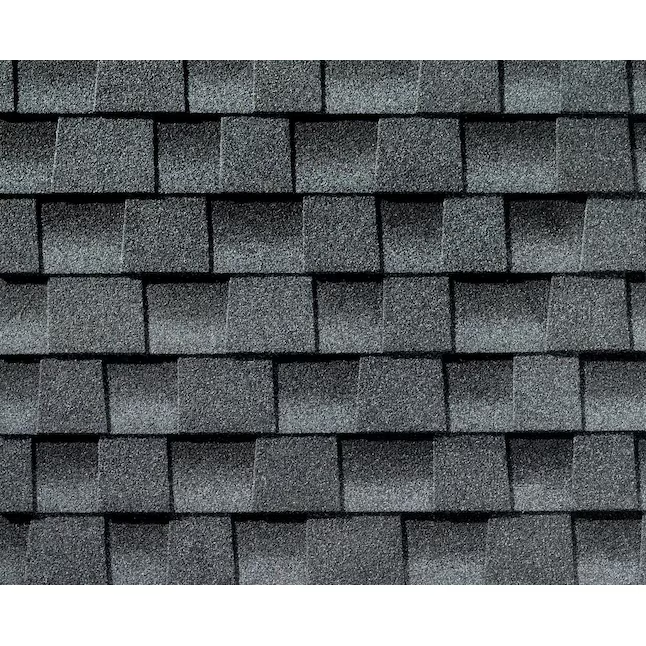
Asphalt vs architectural shingles on a Katy roof: what actually differs
Set the two side by side on a house here and the decision comes down to five things. Not ten. Five.
- Wind. Roughly 60 to 70 mph on most 3-tab lines against 110 to 130 mph on a laminated line installed to spec. On the Gulf Coast this is the difference that matters most, and it is the one homeowners weigh least.
- Hail. Neither style is impact-rated by default — that is a separate product tier, and Texas carriers publish premium credits for qualifying impact-resistant products through the Texas Department of Insurance. We compared the Class 4 options in our impact-rated shingle comparison for Katy.
- Heat. Granule color drives solar reflectance more than the shingle's style does, which the Department of Energy's guide to cool roofs lays out plainly. A light 3-tab can run a cooler attic than a dark laminate.
- Service life. In our UV and humidity, a 3-tab roof commonly gives 15 to 18 usable years, where a mid-grade laminate tends to reach the low to high twenties before it is a candidate for replacement.
- Resale and HOA. Laminated is the visual norm across most Katy master-planned communities now, and some architectural guidelines effectively require it — we walked through how that approval works in HOA shingle approval in Cinco Ranch, Cross Creek Ranch and Bridgeland.
Asphalt vs architectural shingles: when the upgrade pays
The asphalt vs architectural shingles upgrade pays clearly in four situations. You are tearing the roof off anyway, so the labor is already spent and you are only paying the material delta. You plan to stay more than about five years. You have a tall, wind-exposed elevation or a two-story with a lot of rake edge. Or your HOA’s guidelines push you there regardless. Our 2026 roof replacement cost guide for Katy shows where that material delta lands against the rest of the job.
It does not pay much on a detached garage, a shed, or a workshop, where neither wind exposure nor resale is really at issue. It does not pay on a low-slope porch roof, which needs a different system altogether and where shingles of any tier are the wrong answer.
And here is the one I will push on, because it is the most common mistake I see on a bid sheet. If your budget stretches to exactly one upgrade, spend it below the shingle, not on it. Synthetic underlayment, proper drip edge, new valley metal, replacing soft decking, and getting the attic ventilation balanced will keep water out of your house longer than moving from a good 3-tab to a good laminate will. The shingle is the part you can see. It is not the part that usually fails first.
What the shingle grade does at resale
I hold a Texas real estate license alongside the roofing company, which means I have sat on both sides of this table, and the honest read on asphalt vs architectural shingles is narrower than roofing ads suggest.
Nobody pays a premium for a laminated roof. What happens instead is that the wrong roof costs you at the negotiating table. A buyer’s inspector notes shingle type and remaining life in the report. An appraiser notes roof condition. A carrier underwrites the buyer’s new policy on roof age and material, and if that policy comes back expensive or declined, your deal slows down or dies — something we covered when Texas carriers started restricting coverage on older roofs. The Texas Department of Insurance publishes its own plain-language guidance on how roofs and policies interact, and it is worth ten minutes before you list.
So a 17-year-old 3-tab roof rarely reads as a feature. It reads as a line item the buyer’s agent asks you to credit. We went through the numbers on that dynamic in how roof age affects home value in Katy. If you are two or three years from listing and the roof is near the end, the right order is usually to replace it before you list rather than to negotiate it after an inspection.
How to tell what you have from the ground
Settling asphalt vs architectural shingles on your own house does not take a ladder. Stand at the curb and look at the pattern. A grid of uniform rectangles with clean horizontal seams is 3-tab. An irregular, broken-up surface with visible shadow bands is laminated.
Then walk to a gable end and look at the edge of the roof in profile. A single thin layer along the rake is 3-tab. A doubled, thicker edge is laminated. If your house was built in Katy before roughly the mid-2000s and nobody has reroofed it, 3-tab is the likely answer. If a previous owner reroofed after one of the hail events since, asphalt vs architectural shingles was probably already decided in favor of laminated, and the closing documents or the HOA approval file may still name the product.
If you would rather not guess, we will come look and tell you what is up there, what condition it is in, and whether an upgrade is worth it when the time comes. Sometimes the answer is that the roof has seven good years left and you should spend the money on your attic instead. Call us at (281) 769-4282 whenever it suits you.
About the author
About the author — Brent Burgin is the owner and operator of All Out Roofing, a licensed local roofing contractor serving Katy, Houston, Cypress, Fulshear, and surrounding communities. Brent has lived in the Katy/Fulshear area since age 7 and is also a licensed Texas real estate agent (TREC #630213, with Terra Point Realty since 2013) — a cross-domain background that helps homeowners think through roof decisions in the context of their home’s overall value and any pending real estate transactions. All Out Roofing is a CertainTeed Select ShingleMaster, a credential held by fewer than 1% of roofing contractors, and installs GAF and Owens Corning shingle systems.
All Out Roofing, LLC — 25220 Kingsland Blvd, Ste 100, Katy, TX 77494. Available 24/7 for storm response.