
ACV vs. RCV Roof Insurance in Texas
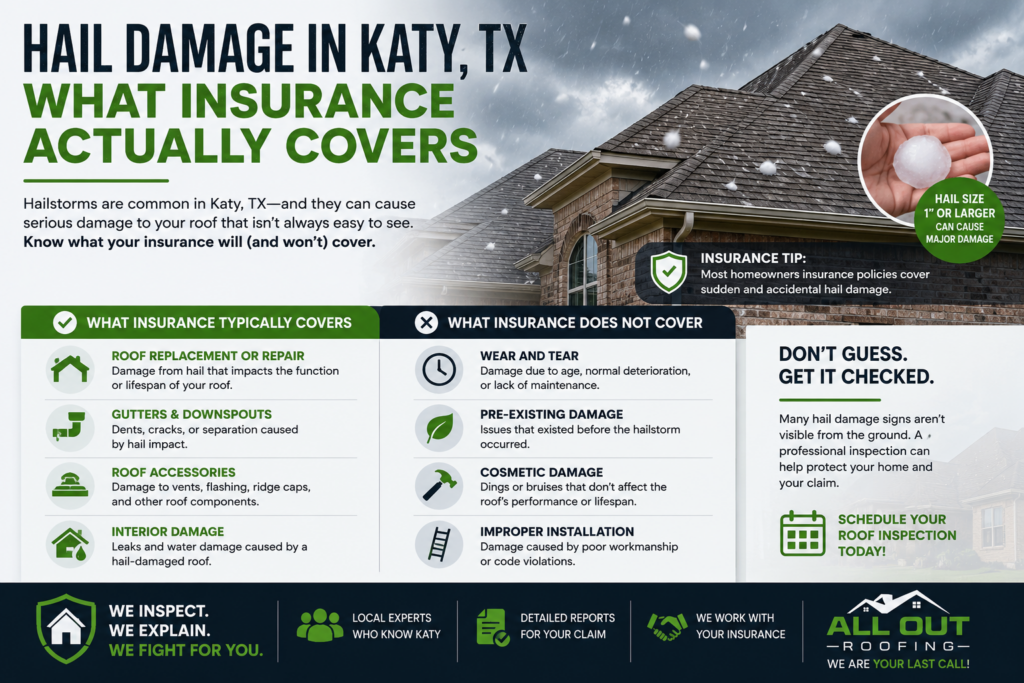 ACV vs RCV roof insurance is the single most important distinction in your Texas homeowners policy — and the one most homeowners never actually read until they have a claim. Whether that policy pays roof damage on an Actual Cash Value (ACV) basis or a Replacement Cost Value (RCV) basis is what determines every dollar of a payout. The difference between the two on a real claim can be $10,000 or more on a typical Katy-area house. And which one you have has changed for a lot of local homeowners in the past two years without them realizing it.
This page walks through what ACV vs RCV roof insurance actually means, how to tell which one you have, when a carrier will move you from one to the other, and what the practical difference is on a real roof claim in this market.
ACV vs RCV Roof Insurance: The Plain-English Definitions
Replacement Cost Value (RCV): The insurance carrier pays what it costs today to put a new roof back on your house. If your roof is 15 years old and gets damaged in a hail storm, the carrier pays for a new roof at current material and labor prices. Your age doesn’t reduce the payout.
Actual Cash Value (ACV): The insurance carrier pays what your roof was worth on the day of the damage — which is the replacement cost minus depreciation for age and wear. A 15-year-old roof on a 30-year shingle system has depreciated by roughly 50%, so the carrier pays about half of what a full replacement would cost.
The difference in a real claim can be enormous.
Real example — 15-year-old roof, 30-year shingle, hail damage, $18,000 replacement cost:
- RCV coverage: Carrier pays $18,000, less your deductible ($2,500). Net to you: $15,500.
- ACV coverage: Carrier pays $18,000 × (100% – 50% depreciation) = $9,000, less your deductible ($2,500). Net to you: $6,500.
- Same roof, same storm, same policy limits. Different payout by $9,000.
That gap grows with the age of the roof. On a 20-year-old roof, ACV depreciation might run 60-70%, cutting the payout further. On a 25-year-old roof, it can approach 90% — at which point the depreciated payout falls below the deductible entirely and you get $0.
How to tell which type of roof insurance you have
The words “Actual Cash Value” or “Replacement Cost” will appear somewhere on your policy declarations page — usually under the dwelling coverage section, sometimes on a separate endorsement page. Common places to find it:
On the main declarations page. Look for a line labeled “Dwelling A” or similar with either “RCV” / “Replacement Cost” or “ACV” / “Actual Cash Value” next to it.
On a roof-specific endorsement. In the last few years, more Texas carriers have started adding a separate endorsement page specifically for roof coverage. Your dwelling coverage might be RCV overall, but the roof line might be ACV. Read this like a mini-policy.
On a “settlement basis” line. Some policies use language like “settlement will be made on an actual cash value basis” or “replacement cost coverage subject to depreciation for roofs over X years old.” Read for what the specific words say, not what the marketing summary says.
If you can’t tell from your declarations page, call your agent and ask directly: “Is my roof covered on an ACV or RCV basis? Please put the answer in writing.” You want that in writing, not verbally, because if there’s a dispute at claim time, the written record matters.
When a carrier will move you from RCV to ACV
A homeowner who’s had RCV coverage for years might find they’ve been moved to ACV without a policy replacement — the carrier changed the terms at renewal. The triggers we see:
Roof age crosses a threshold. Most carriers have an internal cutoff — often 10, 15, or 20 years — above which the roof is moved from RCV to ACV. When your roof passes that threshold, the change applies at the next renewal cycle. Notice is usually included in your renewal packet but easy to miss.
Claim history hits a threshold. Multiple prior claims (roof or otherwise) can trigger a coverage change at renewal.
Statewide carrier repositioning. In the past three years, several major carriers in Texas have moved large blocks of policies from RCV to ACV as a statewide response to rising loss costs. This isn’t specific to you — it applies to everyone in the affected block.
Discretionary underwriter decision. In some cases, the carrier’s underwriter reviews a policy at renewal and elects to modify the roof coverage based on documentation, aerial imagery of the roof, or claim history in the surrounding area.
If your carrier is making this change, they’re required to give you notice — usually 30-60 days before the change takes effect. Read your renewal packet carefully. If you see language about “settlement modification,” “roof coverage endorsement,” or “actual cash value settlement,” that’s the change. You have a window to either accept it, negotiate to keep RCV (sometimes possible with proof of a recent roof replacement), or shop for a different carrier.
Why you might see a partial change — RCV on the dwelling, ACV on the roof
Some carriers have gotten creative and are keeping the dwelling on RCV while moving specifically the roof to ACV. In these hybrid policies, if a tree falls through your house, the framing and interior get RCV treatment. If hail damages the roof, the roof line gets ACV treatment.
This structure is fine as long as you understand it — but many homeowners don’t realize their policy has been split this way until they have a claim. The declarations page will usually say “Coverage A: Replacement Cost” but then a separate endorsement page adds the roof-specific ACV modification. Both pages together are the actual policy.
The wind/hail deductible interaction
ACV coverage on the roof gets even more painful when you factor in a separate wind/hail deductible. Many Texas policies have a percentage-based wind/hail deductible (1%, 2%, sometimes 5% of dwelling coverage) that applies specifically to windstorm and hail claims, separate from the standard deductible on other claims.
Example — $500K dwelling coverage, 2% wind/hail deductible, ACV on a 20-year roof:
- Replacement cost of the damaged roof: $18,000
- ACV after depreciation (~60% on a 20-year roof): $7,200
- Wind/hail deductible: 2% × $500,000 = $10,000
- Net insurance payout: $0 — the depreciated ACV is less than the deductible
That’s not a hypothetical. That’s the actual math a lot of homeowners in Katy master-planned communities are running into right now. On an ACV policy with a percentage wind/hail deductible on an older roof, the roof coverage may not pay out at all in a real claim scenario. You may be paying premiums on coverage that doesn’t cover you in the situation you’d need it in.
Understanding this before it happens is important. If the numbers on your specific policy work out like the example above, you have real options — replace the roof preemptively to reset the coverage back to RCV, shop for a different carrier that will write RCV on an older roof (surplus lines carriers sometimes will), or price the risk explicitly and decide. If a sale is on the horizon, that same roof age shows up in the negotiation too — here’s how roof age affects home value in Katy.
What the “recoverable depreciation” clause does
Some ACV policies include a recoverable depreciation clause. Here’s how it works: the carrier pays the ACV up front, and you have a specified window (typically 6-12 months) to actually complete the roof replacement. If you replace the roof within that window and submit documentation, the carrier pays the depreciation amount as a second check — bringing your total payout up to the RCV number.
This is essentially “ACV on paper, RCV in practice, if you replace within the window.” It’s a middle-ground approach that some carriers use to reduce fraud (claim payments that never turn into actual replacements) while still delivering something close to RCV to homeowners who follow through.
Read your specific policy carefully. Recoverable depreciation is not universal — some ACV policies include it, some don’t. If yours does, know what the deadline is and plan accordingly.
How to shop for coverage that still writes RCV on an older roof
If your current carrier has moved you to ACV and you don’t want it, you have a few options:
Independent insurance agent. An independent agent (not captive to one carrier) can compare 8-15 carriers at once. They usually know which carriers are actively writing RCV on older roofs in your ZIP code this quarter — that changes.
Surplus lines / non-admitted carriers. These carriers (Lloyd’s of London syndicates, some Texas-domiciled specialty companies) will write policies that standard carriers won’t. Premiums are usually higher. Coverage is real. Sometimes the right answer for a 20-year-old roof.
TWIA — Texas Windstorm Insurance Association. Primarily coastal, but relevant if your issue is specifically the windstorm portion of coverage rather than the full policy. TWIA has its own rules.
Preemptive replacement. If the roof is at end of life anyway, replacing it now resets your coverage terms across most carriers. This isn’t always the cheapest option in the short term, but it can be the cleanest.
What to do before your next renewal
Two things worth doing at least 90 days before your policy renews:
1. Read the current policy carefully. Confirm ACV vs RCV, wind/hail deductible amount, roof-specific endorsements, and recoverable depreciation status. Write down what you find.
2. Get a recent roof inspection with written documentation. If your roof is in decent shape, that inspection report is what you’ll use to negotiate with your current carrier or to shop other carriers. We do these for free in the Katy area. Even if you’re not planning to file a claim, having a recent condition report in your file changes the underwriting conversation.
These two moves together — knowing your policy and having a recent roof condition report — put you in a much stronger position at renewal than the average homeowner.
When to get us involved with your ACV vs RCV roof insurance claim
If you have a claim in motion and the carrier is denying, lowballing, or specifically citing ACV depreciation as the reason for a reduced payout, call us. We work with adjusters on claims every week. We can tell you honestly whether the carrier’s estimate is fair, whether a supplement is warranted, and whether the claim is worth pushing.
If you’re not in a claim but you’re trying to figure out whether your current policy is going to cover you if hail hits next spring, we’re happy to look at your policy and the roof together and walk through the math. No sales pitch — sometimes the answer is “your roof is fine, keep your current policy, budget for a replacement in 5-7 years.” Sometimes it’s “your policy has real gaps, here are the options.”
Call us at (281) 769-4282 or reach out through the contact form. Free roof inspection either way.
Related pages:
– Roof Insurance Claim Process
– Texas Roof Insurance Deductible — Who Pays What
– Actual Cash Value vs Replacement Cost Roof (blog post)
– Why Texas Insurers Deny Hail and Wind Roof Claims
Authoritative external sources:
– Texas Department of Insurance — Consumer Bill of Rights
– Texas Windstorm Insurance Association
All Out Roofing, LLC · 25220 Kingsland Blvd, Ste 100, Katy, TX 77494 · Available 24/7 for storm response.