
If your homeowners insurance renewal came in the mail this year and something felt different — a higher deductible, a new schedule endorsement about your roof, or a straight-up non-renewal letter — you’re not imagining it. Older roof insurance in Katy has changed fast, and it has changed for almost everyone. Texas insurance carriers have been quietly tightening how they handle older roofs for the past two years, and the pressure is picking up. We’ve been on more than 60 Katy-area roofs in the last four months alone where the reason for the visit was an insurance letter, not a leak.
This post walks through what’s actually happening in the Texas homeowners market, what “older roof” means to your carrier (which is not what it means to your neighbor), and the four practical moves that make the biggest difference for older roof insurance in Katy — before you have a claim, and before your policy comes up for renewal again.
What’s changed with older roof insurance in Katy
The short version: Texas has become one of the most expensive states in the country to write a homeowners policy, and the carriers have responded by shifting risk back to the homeowner in three specific ways.
First, they’re raising deductibles on wind and hail — sometimes to 2% or 3% of the dwelling coverage, sometimes to a flat $5,000 or $10,000. On a $500,000 home, a 2% wind/hail deductible is $10,000 before your carrier pays anything.
Second, they’re moving older roofs from replacement cost value (RCV) coverage to actual cash value (ACV) coverage. RCV pays what it costs today to put a new roof back. ACV pays that minus depreciation for age and wear — for a 20-year-old roof, the depreciation adjustment can cut the payout by 60% or more.
Third — and this is the newest pattern — they’re non-renewing policies outright when a roof passes a certain age, or they’re requiring proof of a recent roof inspection or replacement to renew at all. This started as a handful of specialty carriers a few years back and has now spread to several of the major names writing in Texas.
None of this is illegal or unusual by industry standard. It’s how a market corrects when losses outpace premiums, and Texas has had multiple large hail and hurricane events in the past decade. It’s just new to a lot of Katy homeowners who bought their houses in the 2010s and are now hitting the roof-age cliff. If you have been shopping older roof insurance in Katy this year, that age cliff is exactly what you are running into.
What counts as an “older” roof to a Texas carrier
There’s no universal rule, but the patterns we see most often on inspection reports:
- Under 10 years old: rarely an issue. Full RCV coverage, standard deductibles, no age-related endorsements.
- 10-15 years old: starts to appear in underwriter reviews. Some carriers ask for an inspection before renewal. RCV usually still applies.
- 15-20 years old: the pressure zone. This is where we see the biggest change in the last two years. ACV endorsements are common. Some carriers won’t write a new policy at all on a roof in this age range. Deductibles often step up.
- Over 20 years old: the exposure zone. Non-renewals become common. Even if you can find a carrier, the coverage is often ACV-only, with a large wind/hail deductible. Some policies exclude the roof from windstorm coverage entirely and require you to carry a separate roof endorsement.
The wrinkle: your carrier is looking at the age of the roof, not the age of the house. If a previous owner replaced the roof, the roof’s age resets to that date — but only if you have documentation. If there’s no permit record and no invoice, the carrier will use the age of the house. Homes built in Cinco Ranch between 2000 and 2005 that have never had a documented replacement are getting flagged right now even when the shingles still look serviceable from the ground.
What a “restriction” letter about older roof insurance in Katy looks like
Not every restriction is a non-renewal. The letters we see fall into a few categories, and they get different levels of urgency.
“Notice of intent to non-renew.” This is the hard version. Your carrier is telling you the policy will not be renewed at the end of the current term. Texas requires 60 days’ notice for a non-renewal in most cases — you have that window to find a replacement carrier. Do not wait. Coverage gaps are the enemy of any future insurance shopping.
“Endorsement modifying roof coverage.” This is the middle version. Your carrier is keeping you but changing the terms — usually moving the roof to ACV or raising the wind/hail deductible. Read the endorsement carefully. It will list an effective date, and it applies from that date forward, not retroactively. Any claim you have between now and the effective date is still under the old terms.
“Request for roof condition documentation.” This is the soft version. Your carrier wants to see either a recent inspection report or proof of replacement before they’ll renew at all. Ignore this letter and it becomes a non-renewal by default. Respond promptly with documentation and you usually stay on the same terms.
“Roof-specific declaration page.” Some carriers are adding a separate declaration for the roof — a “scheduled item” with its own coverage terms, deductible, and depreciation schedule. Read this like a mini-policy. Your general dwelling coverage may still be RCV, but the roof line item might be ACV.
Older roof insurance in Katy: what to do — in order
There is a right order of operations here. Most homeowners rush to the wrong step first and lose leverage.
1. Get a real roof inspection before anything else
Not a look from the driveway. A licensed roofer on the roof, checking the actual condition of the shingles, the flashings, the penetrations, and any visible interior signs (attic staining, sheathing condition). We do these for free in the Katy area, and so do most reputable local roofers. The reason to do this first: the answer to every subsequent question depends on what your roof actually is.
If the roof has real, documentable damage from a specific storm event that’s within the Texas statute of limitations for claims (generally two years from the date of loss for most carriers, though the specific policy may say something different), you may be looking at an insurance-paid replacement instead of an out-of-pocket one. If the roof is worn but not damaged, you’re looking at a different set of options. If the roof is in decent shape and just older, you may be able to renew as-is with the right documentation.
Most homeowners don’t know which of these three buckets they’re in until a roofer looks. Guessing costs money.
2. Document what you have
If your roof is under 15 years old and in reasonable shape, gather: – The original permit for the roof (if the house is old enough that the roof has been replaced at least once) – The invoice from the last roofing contractor – Any manufacturer warranty registration – Photos of the roof from a recent date
Send these to your carrier or agent before the renewal cycle, not after. Good documentation is the single biggest lever you have on older roof insurance in Katy. Underwriters make different decisions when they have documentation than when they have to guess. If the last replacement was done by a certified contractor with a manufacturer warranty, that’s a stronger signal than a generic “roof was replaced” notation in a real estate listing.
3. Understand what a claim will actually pay
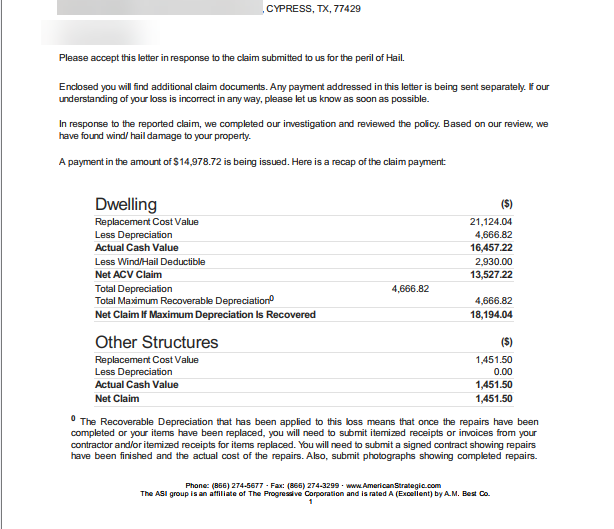
If your policy has already moved to ACV or you know it will at the next renewal, you need to run the actual math on a hypothetical claim before it happens, not after. A typical example we walk homeowners through:
- Home: 2,400 sq ft in a Katy master-planned community, replacement cost estimated at $18,000 for the roof (30-year architectural shingles, standard removal, standard decking)
- Roof age: 17 years
- Depreciation schedule under a typical Texas ACV policy: roughly 3.3% per year for a 30-year shingle → 17 × 3.3% = ~56% depreciation
- ACV payout: $18,000 × (1 – 0.56) = ~$7,900
- Less deductible: 2% of $500K dwelling = $10,000 deductible
- Net insurance payout: $0 — the depreciated ACV is below the deductible
If your carrier moves you to ACV and you keep a $10,000 wind/hail deductible, you may be paying premiums on coverage that will not actually pay out for a roof claim. This is worth understanding before you renew — not after. Some homeowners in this position drop their windstorm rider entirely (illegal in some cases, allowed in others depending on the mortgage) or move to a specialty carrier that will still write RCV. Both are decisions you should make with real numbers in front of you.
4. Shop the Katy roof insurance market before your renewal window closes
If your current carrier is restricting coverage or non-renewing, Texas has a functioning replacement market — but the answers depend on the age of your roof and the age of your house.
- Standard carriers (State Farm, Allstate, Farmers, USAA and similar): may accept an older roof with recent replacement documentation, but rarely take a 20+ year roof without one.
- Non-admitted / surplus lines carriers (Lloyd’s syndicates, some Texas-domiciled companies): will write policies standard carriers won’t, but usually at higher premiums and with ACV-only roof coverage.
- TWIA (Texas Windstorm Insurance Association): primarily coastal, but relevant if your coverage change is windstorm-specific rather than full-policy. TWIA has its own rules about roof age and inspection requirements.
- Texas FAIR Plan Association: the state’s insurer of last resort for homeowners who can’t get standard coverage. Coverage is basic, but it’s real and it can bridge you to a better carrier later.
An independent insurance agent — not a captive agent for a single carrier — is worth the phone call here. They can compare offers from 8-10 carriers at once, and they’ll usually know which carriers are actively writing older roofs in your ZIP code this quarter (that changes).
The move that saves the most on older roof insurance in Katy
If your roof is in the 15-20 year age range and in decent shape, and your carrier has just moved you to ACV or a higher deductible, the highest-leverage move is often to replace the roof preemptively — not because you have to, but because it resets you to full RCV coverage with lower deductibles for the next 15-20 years, and because insurance-related upgrades (impact-resistant shingles, ridge vent replacement, code-compliant underlayment) can qualify you for premium discounts that pay back part of the replacement cost.
That’s not a fit for everyone. If you’re planning to sell in the next two years, the calculus is different (and this is where the cross-domain angle gets useful — an older roof usually affects the sale price by more than the delta on your insurance premiums, but not always). If you’re planning to stay for a decade or more, the math tends to favor replacement. If you’re in the middle, run the numbers both ways with a roofer and an insurance agent before you decide.
We’ve done this analysis for homeowners in Cinco Ranch, Cross Creek Ranch, Firethorne, and Cane Island neighborhoods where 20-year builder shingles are hitting the wall at the same time carriers are tightening. Sometimes the answer is replace, sometimes it’s insurance-shop, sometimes it’s ride it out and self-insure the roof line. Depends on the specific numbers.
What we tell homeowners who are already in a claim
If you already have a roof claim in motion and the carrier is denying or lowballing based on roof age, a few things worth knowing:
The Texas Department of Insurance has a consumer complaint process at tdi.texas.gov. It’s not a magic bullet, but a properly filed complaint often gets a claim re-reviewed.
Under Texas law, if the roof was fully replaced within the past 10 years, most carriers cannot fall back to a pure age argument for denial — the policy language usually requires actual physical damage from a covered peril, and the burden of proof is on the carrier to show the damage isn’t from that peril.
Public adjusters (licensed by TDI) can represent you in a claim negotiation for a percentage of the recovery. This is worth considering on any claim over $15,000-$20,000 where the carrier’s estimate feels significantly low.
We work with adjusters on claims every week. If you’re stuck on a claim and want a second set of eyes on the carrier’s scope of work, call us. We’ll tell you honestly whether the estimate is fair, whether a supplement is warranted, and whether the claim is worth pushing.
The one thing you should not do
Do not file a “trial” claim on an older roof to see what the carrier will pay. This is the single most common mistake we see. Every filed claim — even one that ends up paying $0 — sits on your CLUE report (a national insurance claim history database) for seven years. Two or three CLUE hits will hurt your ability to shop insurance for years after, regardless of the outcome of any specific claim. That history follows you into every future conversation about older roof insurance in Katy. Only file a claim when you know there’s real, documentable damage and the claim is worth pursuing.
About the author
Brent Burgin is the owner and operator of All Out Roofing, a licensed local roofing contractor serving Katy, Houston, Cypress, Fulshear, and surrounding communities. Brent has lived in the Katy/Fulshear area since age 7 and is also a licensed Texas real estate agent (TREC #630213, with Terra Point Realty since 2013) — a cross-domain background that helps homeowners think through roof decisions in the context of their home’s overall value and any pending real estate transactions. All Out Roofing is a CertainTeed Select ShingleMaster and installs GAF and Owens Corning shingle systems. Brent has walked more than 200 Katy-area roofs over the past year on insurance-related visits and works claims with adjusters weekly.
If you got a non-renewal letter, a coverage endorsement, or a request for roof documentation and you want an honest read on what to do next — no sales pitch, no pressure — call us at (281) 769-4282 or send photos through the contact form. We deal with older roof insurance in Katy every week. We’ll come look, tell you what the roof actually is, and help you think through the options before your renewal window closes.
All Out Roofing, LLC — 25220 Kingsland Blvd, Ste 100, Katy, TX 77494. Available 24/7 for storm response.